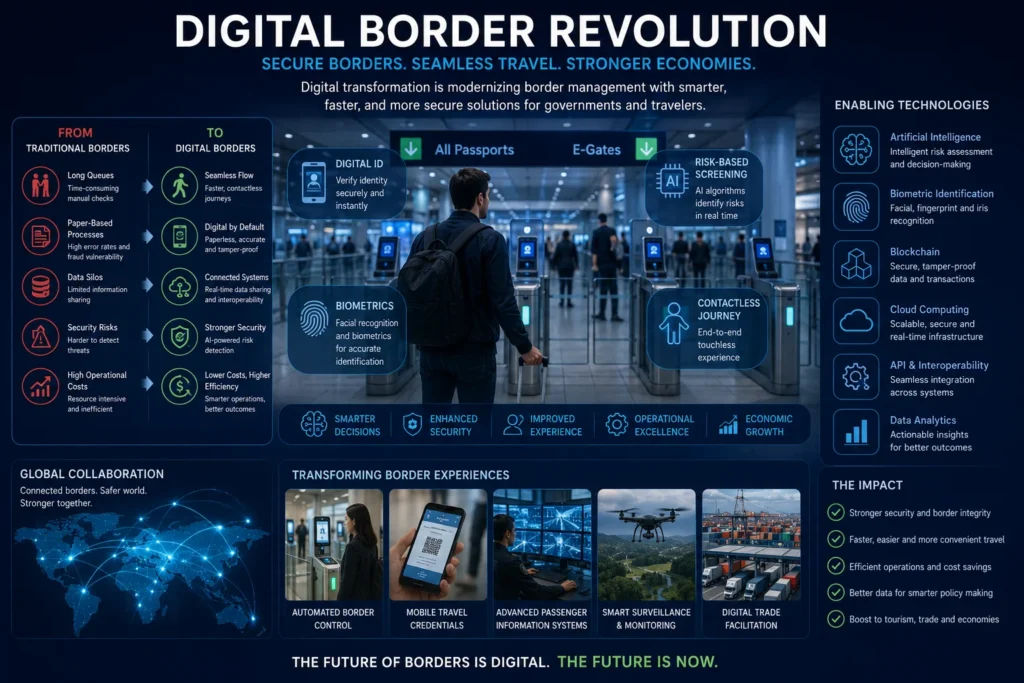
The international border management landscape is undergoing a permanent technological shift as state agencies move to counter terminal congestion and flight disruptions. Long considered one of the most stressful aspects of cross-border itineraries, the manual review of physical credentials at immigration desks is being replaced by scalable, contactless data systems. For destinations where the visitor economy serves as a core pillar of national development, the implementation of automated check-in procedures is increasingly viewed as a prerequisite for maintaining steady passenger volumes.
According to verified statistical releases from global immigration ministries, administrative bottlenecks at entry corridors regularly trigger cascading logistical delays that disrupt airline scheduling networks. To stabilize these transit tracks, sovereign governments are actively transitioning from subjective, legacy verification workflows to objective, technology-led frameworks. By executing comprehensive digital strategies, international transport hubs are lowering average processing times, reducing human friction, and ensuring that passenger clearance remains highly predictable.
Singapore Realizes Comprehensive Passportless Border Operations
The Immigration & Checkpoints Authority (ICA) of Singapore has established an advanced global benchmark for automated border control. In its formal operational briefing, the ICA confirmed that its New Clearance Concept has shifted the core of national border security away from manual inspection counters to a fully automated multi-modal network.
+-------------------------------------------------------------------+
|               Singapore ICA Next-Generation Border Statistics     |
+-------------------------------------------------------------------+
| Passportless Passenger    | Approximately 127 million travelers    |
| Clearances Recorded       | processed without physical documents. |
+---------------------------+---------------------------------------+
| Processing Time Reduction | Average transaction time decreased by |
| Metric                    | 60%, dropping from 25 to 10 seconds.  |
+---------------------------+---------------------------------------+
| Multi-Modal Footprint     | 1.2 million biometric motorcyclist    |
| Scale                     | clearances logged at land crossings.  |
+-------------------------------------------------------------------+
Official ICA statistics reveal that nearly 127 million travelers cleared Singapore’s air, land, and sea checkpoints without presenting a physical passport. This represents a substantial 270 percent volume escalation compared to earlier deployment phases. The architecture relies on tokenless clearance, which utilizes facial and iris biometric tracking arrays across all terminals at Changi Airport, Seletar Airport, and primary cruise hubs.
By pulling verified traveler data from pre-submitted electronic arrival declarations, the system has successfully reduced individual clearance times from 25 seconds down to a 10-second window. For land borders, the ministry has executed QR-code-based vehicle clearance lanes and facial recognition modules for motorcyclists, effectively cutting terminal ground congestion along high-density commercial roads.
The European Union Activates the Electronic Entry/Exit System
Concurrently, the Directorate-General for Migration and Home Affairs of the European Commission finalized the transition protocol for its comprehensive Entry/Exit System (EES). Operating across 29 European nations—including the vast majority of Schengen Area member states alongside associated partners like Switzerland, Norway, and Iceland—the digital framework represents a major step forward for continent-wide border security.
The official directive removes the practice of manually stamping physical passports for non-European Union nationals arriving for short-term stays of up to 90 days. Instead, the centralized system electronically registers the traveler’s exact name, travel document serial, entry and exit timestamps, and location coordinates directly within a secure database.
A primary pillar of the EES is the mandatory collection of biometric markers, capturing high-resolution facial images and fingerprints at the point of entry. Official implementation summaries highlight that since its progressive integration, the biometric infrastructure has registered over 45 million successful border crossings. This automated cross-checking capability allows border guards to rapidly identify cross-border identity fraud, verify visa validity limits, and automatically log short-stay compliance parameters without introducing lengthy administrative wait times.
United States Expands Mobile Passport Control Infrastructure
In North America, U.S. Customs and Border Protection (CBP) has targeted secondary bottlenecks by scaling up its Mobile Passport Control (MPC) app. Designed as a voluntary digital alternative to traditional processing queues, the application allows eligible travelers to submit their entry parameters securely prior to physical inspection.
+-------------------------------------------------------------------+
|             United States Mobile Passport Control Network         |
+-------------------------------------------------------------------+
| Total Operational Sites   | 60 active international air, sea,     |
|                           | and land boundary locations.          |
+---------------------------+---------------------------------------+
| Core Eligible User        | U.S. citizens, Canadian visitors,     |
| Demographics              | LPRs, and returning ESTA applicants.  |
+---------------------------+---------------------------------------+
| Integrated Features       | Provisional digital I-94 tracking and |
|                           | automated photo group submissions.    |
+-------------------------------------------------------------------+
CBP statements confirm that the operational footprint of the MPC framework has expanded to cover 60 distinct locations, including 35 international airports inside the United States, 14 international preclearance nodes, four maritime ports of entry, and four pedestrian land border crossings in Washington State. Eligible users, including U.S. citizens, lawful permanent residents, and returning Visa Waiver Program travelers with approved electronic authorizations, can submit their inspection data, capture required selfies, and manage up to 12 individual group profiles within a single digital transaction.
At the terminal, travelers access dedicated MPC lanes, bypassing generalized queues to finalize their entry checks with a CBP officer. This digital workflow significantly limits terminal crowding, helping to insulate airline schedules from the cascading flight disruptions often caused by customs processing delays.
Analytical Impact on Airline Economics and Passenger Security
From a global transport economics perspective, the shift toward automated, data-driven border infrastructure yields measurable benefits for the commercial aviation market. When international gateways operate with high clearance velocities, airport operators minimize the risk of terminal overcrowding, late-stage gate changes, and delayed departures. This improved efficiency allows passenger carriers to optimize their aircraft turnaround cycles and maintain tight connection windows across long-haul networks.
Furthermore, integrating advanced biometric systems allows border forces to target security checks with higher accuracy. By automating standard entry parameters via secure e-gates, law enforcement personnel can focus specialized resources on higher-risk profiles, moving away from subjective assessments toward objective, data-driven security.
Best Practices for Navigating Next-Generation Checkpoints
As international transport nodes continue to enforce digital check-in protocols, travelers are encouraged to align their routines with updated border specifications. Submitting required digital arrival cards or secure customs questionnaires up to 72 hours prior to flight departures remains a practical approach for ensuring low-friction transit. While biometric automation accelerates terminal movement, maintaining physical travel documents remains an international requirement, protecting cross-border itineraries against system updates or destination-specific manual checks.
For more travel news like this, keep reading Global Travel Wire