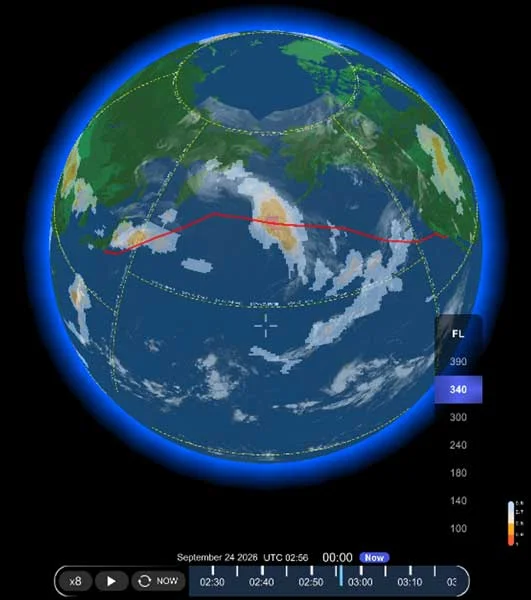
Japan’s ZIPAIR Tokyo began using artificial intelligence to forecast turbulence on 8 October 2026, adding weather intelligence to its operations. The technology supports flight planning by showing predicted turbulence risks across different altitudes and forecast times.
BlueWX’s AI Turbulence Forecast now operates within MTI’s 3DARVI aviation weather platform. The integration allows flight personnel to examine turbulence predictions alongside other weather information and flight plans.
The companies announced the development on 8 October. For travelers, its significance lies in supporting better preparation for potentially uncomfortable conditions, although no measured passenger benefits have yet been disclosed.
Forecasts Support Route and Altitude Decisions
Turbulence conditions can change across locations, flight levels and time periods. A forecast covering these dimensions gives operational personnel additional information when assessing a journey.
ZIPAIR’s integrated system allows users to compare predicted turbulence with the conditions affecting a planned route. That information can support decisions about flight paths and cruising altitudes.
However, changing a route or altitude involves several considerations. Flight personnel must account for air traffic instructions, aircraft performance, fuel requirements and other weather conditions.
The forecasting tool supports those assessments rather than making operational decisions independently. It does not control aircraft or automatically redirect flights.
Its practical value will depend on how personnel interpret the predictions within established procedures.
Deep Learning Combines Weather and Aircraft Data
BlueWX uses deep learning to analyse several types of information relevant to turbulence prediction.
Inputs include numerical weather forecasts, weather observations and turbulence data collected from aircraft. Together, these sources combine predicted atmospheric conditions with measurements and flight encounters.
Deep learning identifies patterns within the data to produce forecasts of turbulence risk. Personnel can then examine where potentially turbulent conditions may develop.
Aircraft-generated information adds evidence from actual operations, while weather models provide an estimate of future conditions.
Nevertheless, forecasting remains subject to uncertainty. Changing atmospheric conditions and the quality of available data can affect predictions.
The introduction therefore adds another resource for weather assessment without guaranteeing that every turbulence encounter can be anticipated.
Shared Weather Platform Brings Information Together
MTI’s 3DARVI service presents aviation weather information and flight plans within a common interface. Its three-dimensional visualisation helps users examine weather in relation to routes and altitudes.
Adding BlueWX’s forecasts brings another information layer into that environment. Flight personnel can review predicted turbulence alongside other conditions affecting operations.
This matters because route assessment involves more than identifying a single weather hazard. Personnel may need to compare several factors before choosing an appropriate operational response.
A shared platform can support that process by presenting relevant information together.
However, the announcement does not quantify faster decision-making, reduced workload or other improvements resulting from ZIPAIR’s implementation.
Four Years of Trials Preceded Introduction
The forecasting technology underwent approximately four years of trial operations during development. Thousands of pilots and flight managers participated.
The trials aimed to improve prediction accuracy and reliability before operational introduction. Input from aviation professionals also connects development with the conditions in which forecasts will be used.
That extended process provides context for the technology’s deployment. However, the supplied information does not include detailed validation results or numerical accuracy comparisons.
It therefore does not establish that the system outperforms every existing turbulence forecasting method.
Further operational evidence will be needed to assess its performance after implementation and distinguish expected benefits from measured results.
Passenger Comfort Remains the Relevant Travel Benefit
For tourism and international travel, turbulence forecasting matters because onboard conditions influence passenger comfort and the overall journey.
More detailed predictions could help crews prepare for changing conditions. Where operationally possible, the information may also support assessments of alternative routes or flight levels.
These remain potential benefits. ZIPAIR has not disclosed evidence showing fewer turbulence encounters, reduced injuries or improved passenger satisfaction following introduction.
The technology also does not change what travelers purchase. No associated changes to fares, baggage allowances, booking procedures or cabin services were announced.
Passengers should continue following crew instructions and keeping seatbelts fastened while seated. Forecasting supplements operational preparation rather than removing the need for onboard precautions.
Operational Results Will Determine Longer-Term Value
ZIPAIR’s adoption demonstrates how an AI forecasting product can enter an existing aviation weather workflow. It brings additional turbulence predictions into the information available to flight personnel.
For travelers, the immediate development is an operational investment rather than a new passenger-facing feature. Its longer-term contribution will depend on forecast performance and practical use.
The announcement provides no basis for promising turbulence-free journeys or industry-wide adoption. Future evidence will determine how effectively the system supports flight planning and weather-related decisions.
Verification: ZIPAIR’s official announcement is dated 8 October 2026.
For more travel news like this, keep reading Global Travel Wire