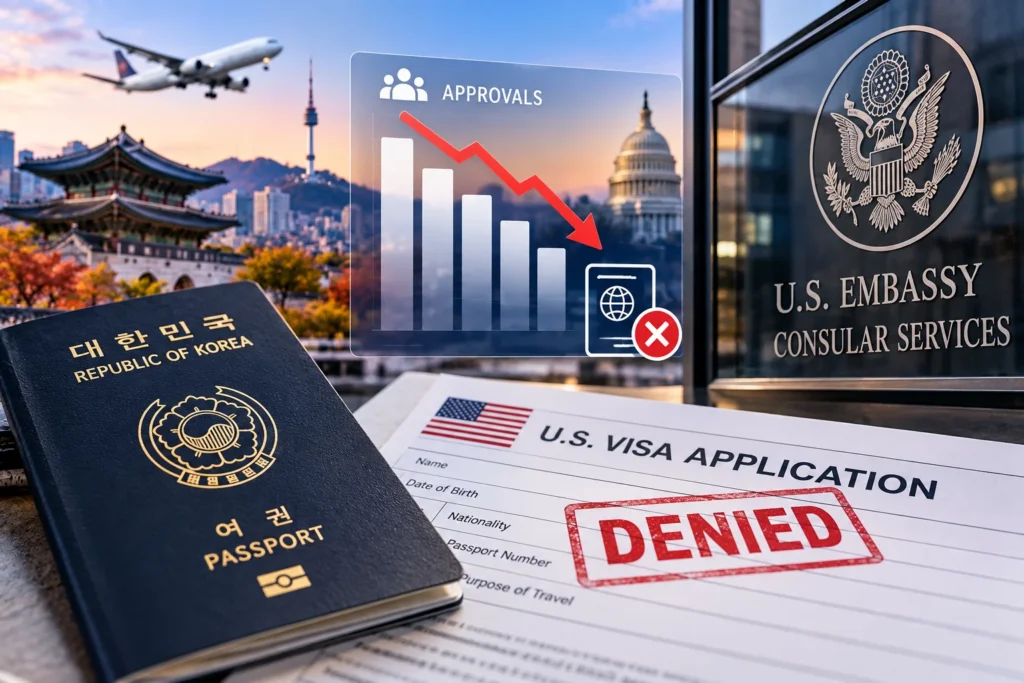
Analysis of official United States Department of State consular data indicates a notable reduction in nonimmigrant US visa issuances for South Korean citizens. During the 2025 calendar year, total nonimmigrant approvals reached 68,130, marking a 7.95 percent decline compared to the 74,015 visas granted during the previous twelve-month period.
The reduction across travel, business, and educational visa categories highlights evolving administrative priorities and heightened scrutiny under updated international entry frameworks. While initial declines impacted general visitor and student visa channels, targeted diplomatic coordination has begun reshaping business mobility protocols to safeguard cross-border economic ties and foreign direct investment initiatives.
Business and Tourism Mobility Experience Sector-Wide Shifts
The decline in overall nonimmigrant approvals affected multiple entry categories, including temporary business visitor visas and standard leisure travel authorizations. Monthly average approvals for temporary business travel and tourist travel experienced an initial downward trend, decreasing from a monthly average of 1,273 approvals in 2024 to 1,212 throughout 2025.
However, consular processing metrics began demonstrating a partial recovery during early 2026. Driven by institutional arrangements to facilitate corporate entry, monthly average approvals for business and leisure travel rebounded significantly to 2,027 during the first two months of the year.
The recovery in business entry channels follows joint bilateral efforts to prevent operational disruptions at major industrial projects. Following administrative detentions of corporate personnel in late 2025, diplomatic authorities established specialized consular protocols to streamline review procedures for workers, engineers, and subcontractors supporting multi-billion-dollar manufacturing investments across the United States.
Dedicated Support Desk Streamlines Corporate Travel Approval
To address entry uncertainties for international investors, public authorities introduced dedicated consular mechanisms at diplomatic missions in Seoul. The launch of the Korean Investment and Travel Desk established an integrated processing framework intended to facilitate group visa applications for corporate personnel and primary contractors.
Key procedural enhancements introduced under the dedicated business travel program include:
Group Application Processing: Major corporate investors and affiliated subcontracted partners can submit unified visa applications, reducing individual processing friction.
Annotated Visa Classifications: Enhanced documentation standards provide clear annotations on temporary business visas, specifying legitimate employment affiliations and project timelines to prevent border delays.
Expanded Consular Capacity: Increased interview scheduling allocations at primary consular facilities enable expanded processing volumes for business travel applicants.
While business travel pathways have stabilized through formal government coordination, educational exchange programs face continued headwinds under current administrative frameworks.
Sharp Decline in International Student Visa Approvals
In contrast to the recent stabilization in corporate travel channels, nonimmigrant academic exchange approvals have experienced a prolonged downturn. Approvals for academic student visas dropped substantially from a monthly average of 1,195 in 2024 down to 965 in 2025.
The downward trajectory accelerated significantly into early 2026, with monthly academic approvals averaging just 273 during the first two months of the year. Public representatives analyzing the consular statistics expressed concern that sustained reductions in academic mobility could impact educational exchanges, research partnerships, and long-term talent pipelines between both nations.
Bilateral diplomatic channels continue to engage on normalizing academic visa processing to ensure that qualified students and academic researchers can fulfill enrollment requirements without administrative delays.
Future Outlook for International Travel and Consular Cooperation
The fluctuations in nonimmigrant visa statistics demonstrate the sensitive balance between national security oversight and international travel facilitation. While global administrative shifts have tightened entry scrutiny across various traveler demographics, targeted public-sector cooperation has proven effective at resolving trade and industrial transit bottlenecks.
As consular facilities adapt to updated policy directives, sustained diplomatic dialogue remains essential to maintaining open channels for business travelers, academic exchange participants, and international tourists, ensuring that cross-border mobility continues to support mutual economic growth.
For more travel news like this, keep reading Global Travel Wire