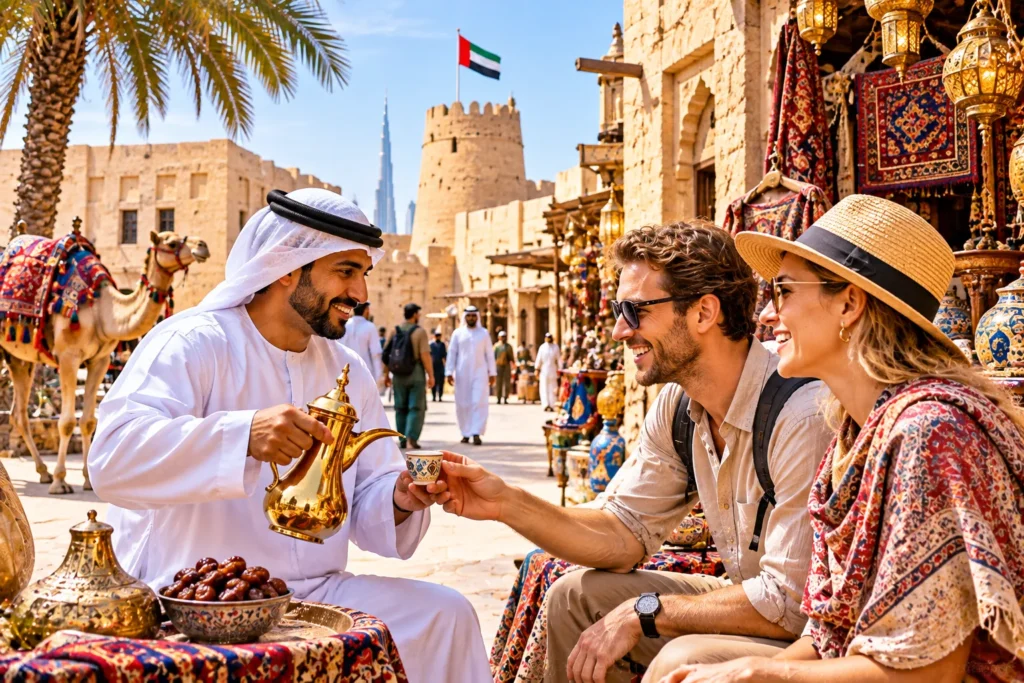
The intersection of premium hospitality and deep cultural discovery has emerged as the defining force shaping the travel landscape across the Middle East. Official market analytics presented in the Arabian Travel Market Travel Trends Report, compiled in collaboration with Tourism Economics, highlight that global holidaymakers are no longer satisfied with passive relaxation. Instead, modern visitors seek sophisticated journeys anchored in genuine human connections, historic heritage, and exceptional hospitality services.
The findings illustrate a clear evolution in consumer behavior across both inbound exploration and outbound trips from the Gulf region. As international travel maintains steady momentum, destinations capable of seamlessly combining upscale lodging with authentic community engagements are capturing substantial market interest and expenditure.
Luxury Hospitality and Cultural Exchange Lead Inbound Itineraries
Travel preferences toward Middle Eastern destinations display a unique convergence of elegance and cultural curiosity. According to the international market study, 77 percent of travelers considering a journey to the Middle East identify luxury accommodation and high-end services as their top booking priority. This contrasts sharply with general leisure bookings worldwide, where luxury features as a core consideration for only 51 percent of travelers heading to other global regions.
Yet, this emphasis on luxury is far from superficial. Direct interaction with local residents serves as a prominent attraction, demonstrating strong demand for locally hosted experiences, vernacular storytelling, and indigenous culinary traditions.
Heritage festivals and religious celebrations also anchor destination appeal. Among international visitors interested in attending events throughout the region, 55 percent highlight cultural and historic festivals as a primary trip driver, compared to 42 percent across competing global destinations. Furthermore, faith-based and religious gatherings motivate 22 percent of prospective travelers, substantially outpacing the 13 percent benchmark recorded in alternative markets.
This appetite aligns with broad international shifts toward purposeful exploration. Comprehensive travel statistics show that 42 percent of holidaymakers across the Middle East and North Africa identify as cultural immersion travelers, ranking above pure adventure or recreational pursuits. Similar patterns resonate worldwide, with cultural immersion leading traveller motivations across Asia at 50 percent, North America at 39 percent, and Europe at 36 percent.
Gulf Travelers Pioneer Spontaneous Cultural Outbound Journeys
While inbound visitors explore Middle Eastern heritage, outbound holidaymakers from the United Arab Emirates and the Kingdom of Saudi Arabia are redefining cross-border exploration. Official surveys reveal exceptional cultural curiosity, adaptability, and respect among travelers originating from these two nations.
Approximately 66 percent of travelers from the United Arab Emirates and Saudi Arabia actively strive to learn key phrases of the local language before arriving at a foreign destination, establishing the highest rate of linguistic preparation among fourteen major outbound markets studied. Furthermore, roughly 70 percent of voyagers actively search for local traditions and community customs that they had not researched prior to departure, indicating an appetite for genuine serendipity and spontaneous cultural discovery.
Accommodation habits further reflect this adventurous spirit. Rather than remaining isolated within a single property, 81 percent of United Arab Emirates travelers choose to book multiple hotels across different districts within a single vacation stay. Among this cohort, 52 percent diversify their lodging specifically to experience contrasting neighborhoods, while 46 percent blend boutique or budget properties with high-end luxury resorts to achieve a multifaceted perspective of their host city.
Industry leadership notes that these behavioral patterns present major commercial avenues for national tourism boards, independent hoteliers, and inbound tour operators. Connecting conventional room stays with neighborhood artisan workshops, regional gastronomy trails, and community-guided heritage walks creates memorable travel products that directly fulfill consumer desires.
Strategic Potential Across Regional Hubs and Multigenerational Circuits
The regional research outlines distinctive visitor dynamics for journeys extending across South Asia. In this corridor, gastronomy, culinary heritage trails, and family-centric activities serve as paramount decision drivers. This traveler segment skews notably younger, seeking flexible multi-destination itineraries that combine leisure with educational experiences for different generations.
Tourism boards and hospitality brands addressing this demographic benefit from designing multi-generational packages that feature transparent pricing structures, inclusive experiential itineraries, and structured storytelling. Highlighting regional food traditions, hands-on cooking classes, and localized craft demonstrations enables operators to create accessible entry points for visitors seeking comprehensive cultural engagement.
These evolving trends will anchor collaborative policy discussions and product development forums at the upcoming Arabian Travel Market gathering at the Dubai World Trade Centre. Centered around the theme of shaping global travel through borderless experiential journeys, the summit will convene international tourism delegations, ministry officials, and destination developers to refine the next generation of culturally integrated luxury tourism offerings.
For more travel news like this, keep reading Global Travel Wire