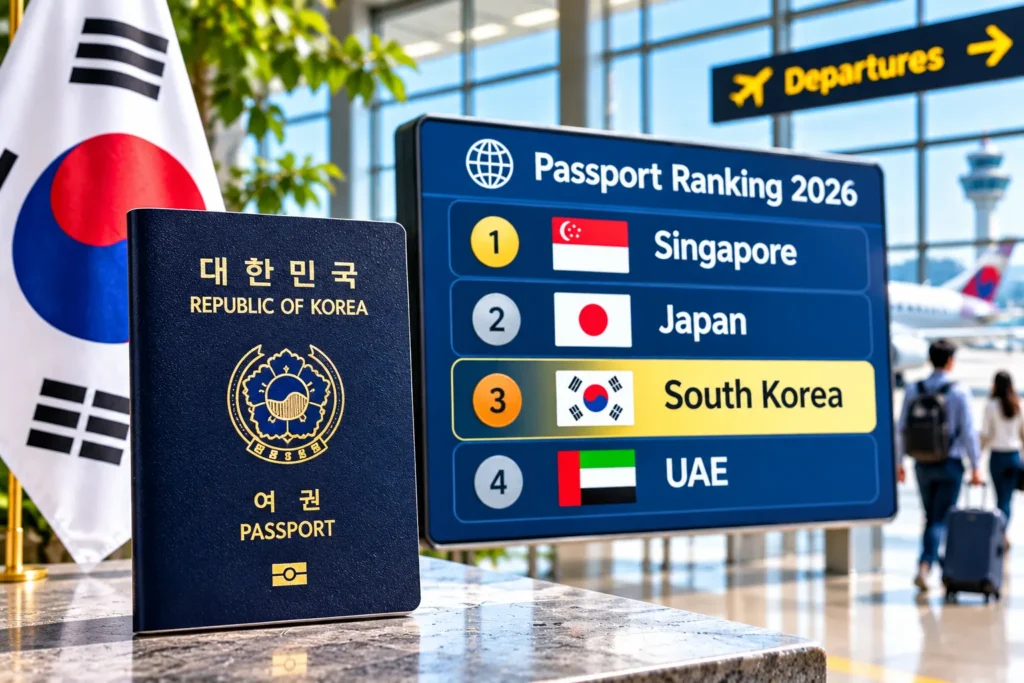
London, United Kingdom, November 26, 2026 — South Korea’s passport has moved one position to third place globally in the latest November 2026 update of the Henley Passport Index, granting South Korean citizens visa-free or visa-on-arrival access to 187 destinations worldwide. Previously tied for second place with Japan and the United Arab Emirates at 188 destinations, South Korea now stands alone in third position while Japan and the UAE retain joint second place with visa-free entry to 188 destinations.
At the top of the global mobility table, Singapore continues to hold the world’s most powerful passport, enabling its citizens to enter 193 destinations out of 227 countries and territories without obtaining a traditional visa prior to departure. Together, Singapore, Japan, the United Arab Emirates, and South Korea demonstrate how sustained bilateral diplomacy and reciprocal visa-waiver agreements have placed Asian and Gulf travel documents ahead of traditional European leaders.
Methodology Behind Global Travel Mobility Tracking
Compiled by London-based citizenship and residence advisory firm Henley & Partners, the Henley Passport Index evaluates 199 national passports across 227 international travel destinations using exclusive, continuously updated entry-regulation data from the International Air Transport Association (IATA).
Under the index’s methodology, a passport receives one point for every destination where its holders require no advance visa—encompassing full visa-free entry, visa-on-arrival (VOA) facilities, and streamlined Electronic Travel Authorisations (ETAs) issued automatically upon arrival or via pre-departure clearance without consular interviews. Destinations requiring a conventional embassy visa or pre-departure government-approved e-visa do not count toward the visa-free score. Updated regularly throughout the year, the index serves as a benchmark for international aviation demand, diplomatic reciprocity, and outbound leisure and business travel capacity.
Notable Movers and Regional Shifts in the November 2026 Update
Beyond the top three tiers, the November 2026 ranking highlights shifting visa policies across major outbound travel markets and emerging economies:
European Clustering Near the Summit: Twelve European Union and European Economic Area nations—Belgium, Denmark, Finland, France, Germany, Ireland, Italy, Luxembourg, the Netherlands, Norway, Spain, and Sweden—share fourth place with visa-free access to 185 destinations, followed closely by Austria, Greece, Malta, Portugal, Switzerland, and the United Kingdom in fifth place at 184 destinations.
United States Advances to Ninth Place: The United States passport climbed one rank to ninth place—sharing the tier with Liechtenstein—after its visa-free destination count increased from 179 to 180.
Vietnam Gains Momentum in Southeast Asia: Vietnam’s passport rose four places to 85th globally, with Vietnamese travellers able to enter 50 destinations worldwide without securing a visa in advance.
Persistent Mobility Divide at the Lower Tier: At the bottom of the index, conflict-affected and fragile states continue to face severe international travel restrictions, with Pakistan, Yemen, Iraq, Syria, and Afghanistan occupying the five lowest positions globally.
What Passport Power Means for Global Tourism Flows
For national tourism boards, airlines, and destination management authorities, passport mobility scores translate directly into outbound travel elasticity. High-ranking passports—such as those held by citizens of Singapore, Japan, the United Arab Emirates, and South Korea—eliminate consular processing fees and administrative waiting times, encouraging spontaneous short-haul city breaks, multi-country itineraries, and high-frequency corporate aviation across the Asia-Pacific, Europe, and the Middle East.
Even with a one-destination adjustment in November 2026, the South Korea passport ranking 2026 keeps South Korean travellers among the world’s most globally mobile populations—reinforcing strong outbound demand for international airlines and destination hospitality markets heading into 2027.
For more travel news like this, keep reading Global Travel Wire