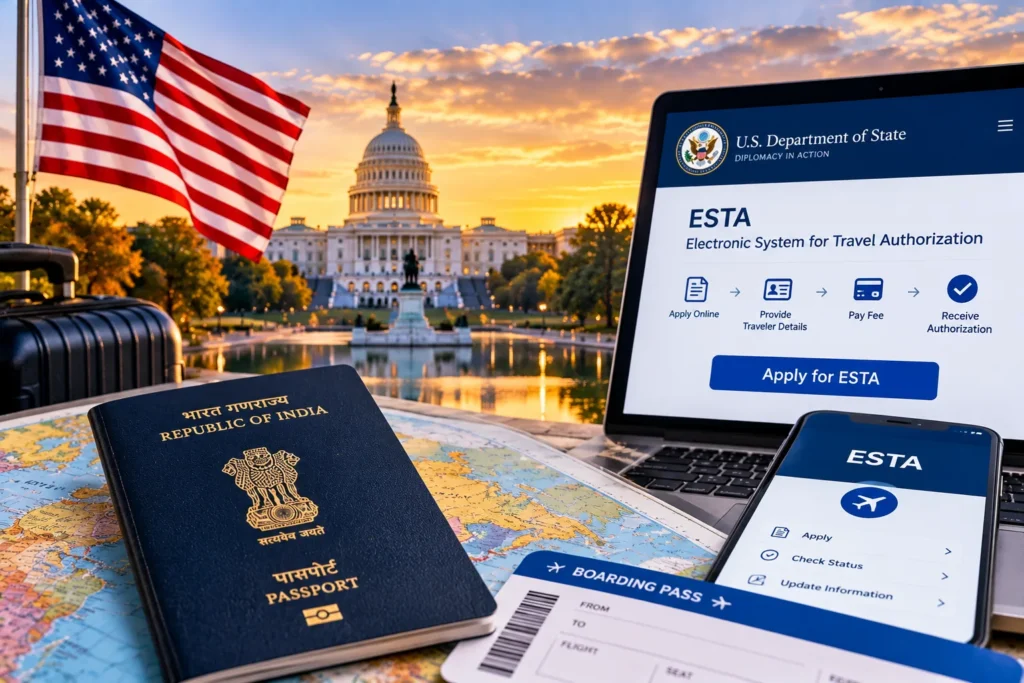
Official consular guidelines released by the United States Department of State and the Department of Homeland Security have reaffirmed the operational parameters of the Visa Waiver Program. Designed to facilitate international tourism and commercial transit, the long-standing intergovernmental initiative enables qualified citizens and nationals from participating global partner territories to travel to the United States for business or tourism for stays of up to 90 days without obtaining a traditional non-immigrant visitor visa.
Federal authorities emphasize that participation in the program is anchored in strict security standards, comprehensive bilateral counterterrorism intelligence sharing, and rigorous immigration compliance checks. While the framework provides a convenient gateway for millions of holidaymakers and corporate travelers each year, it operates under defined regulatory limits, mandatory digital clearance protocols, and specific disqualification criteria established by United States immigration law.
Mandatory Electronic Travel Authorization and Digital Clearance
Travelers utilizing the program cannot simply present a foreign passport upon arrival at an American port of entry. All prospective passengers, regardless of age, must obtain advance travel clearance through the Electronic System for Travel Authorization, administered by United States Customs and Border Protection.
The digital travel screening system functions as an automated pre-departure risk evaluation mechanism, allowing border security authorities to review traveler profiles before they board commercial aircraft or passenger vessels bound for the United States. Operational regulations mandate that applicants possess an electronic passport containing an embedded biometric chip with personal identifier data.
Once approved, digital travel authorizations generally remain valid for a period of two years or until the associated passport expires, whichever occurs first. Approved authorizations permit multiple entries into the United States, provided each individual stay does not exceed the statutory 90-day threshold. Consular authorities advise travelers to apply online at least 72 hours prior to international departure to account for verification workflows.
Official border regulations also clarify that an approved travel authorization does not confer an absolute right of admission; upon arrival at an international port of entry, federal border protection officers retain statutory legal authority to conduct final identity assessments and confirm traveler admissibility.
Participating Sovereign Nations and Global Geographic Scope
To earn and maintain designated status within the program, sovereign partner governments must demonstrate sustained compliance with high standards of civil aviation security, law enforcement cooperation, and low non-immigrant visa refusal rates.
The official roster of designated nations spans key geographic corridors across Europe, East Asia, the Middle East, Oceania, and South America. Among the participating partner jurisdictions are:
European economies, including Andorra, Austria, Belgium, Croatia, Czechia, Denmark, Estonia, Finland, France, Germany, Greece, Hungary, Iceland, Ireland, Italy, Latvia, Liechtenstein, Lithuania, Luxembourg, Malta, Monaco, the Netherlands, Norway, Poland, Portugal, San Marino, Slovakia, Slovenia, Spain, Sweden, Switzerland, and the United Kingdom.
Asia-Pacific and Middle Eastern partners, including Australia, Brunei, Israel, Japan, New Zealand, Qatar, the Republic of Korea, Singapore, and Taiwan.
South American representation, including Chile.
Each designated territory is subject to ongoing statutory compliance reviews by United States homeland security officials to ensure continued adherence to international document security standards and border verification metrics.
Ineligibility Guidelines and Statutory Exclusions
United States immigration statutes establish explicit restrictions that disqualify certain travelers from using the streamlined digital waiver system, even if they hold valid citizenship from a designated participating country.
Under federal law, individuals who have traveled to, or been present in, countries designated under United States statutes as state sponsors of terrorism or areas of security concern are generally ineligible to travel under the program. These statutory travel exclusions apply to individuals with prior travel history to Iran, Iraq, Syria, Sudan, Libya, Somalia, Yemen, or Cuba on or after statutory reference dates specified in immigration enactments. Furthermore, individuals who hold dual nationality with any of these designated nations are restricted from using the digital waiver framework.
Exclusions also apply to travelers who have previous records of domestic immigration violations in the United States, such as exceeding authorized admission windows during prior visits, as well as individuals with specific criminal convictions or previous visa refusals.
For travelers affected by these statutory disqualifications, the standard consular visitor visa process remains the required travel mechanism. Ineligible travelers must schedule a formal visa interview at an overseas United States embassy or consulate to submit documentation, provide biometric markers, and apply for a standard B-1 business or B-2 tourism non-immigrant visa.
Operational Parameters for International Visitors
Travelers entering the United States under the program must adhere to strict administrative restrictions:
Permitted activities are confined exclusively to leisure tourism, family visits, short-term medical evaluations, and standard business consultations, including contract negotiations, corporate meetings, and attendance at academic or commercial conventions.
Productive employment, salaried work for local enterprises, formal study in accredited academic courses, and permanent residence are strictly prohibited under the waiver scheme.
The 90-day admission window cannot be extended under standard conditions, and participants are legally barred from applying for an adjustment of immigration status while physically present in the United States.
For more travel news like this, keep reading Global Travel Wire