Norwegian Cruise Line Holdings has entered a critical phase of operational reform. The company aims to correct internal inefficiencies and restore profitability. Leadership recently outlined a structured recovery plan focused on execution and accountability.
The cruise operator confirmed that its long-term strategy remains strong. However, leadership acknowledged that internal coordination weakened performance. The company now seeks tighter alignment across departments and improved operational discipline.
Strategy Remains Strong but Execution Faltered
The chief executive emphasized that the corporate blueprint still supports future growth. However, fragmented processes slowed implementation. Departments often advanced initiatives without synchronized planning.
A major example involved a planned 40 percent Caribbean capacity increase in early 2026. The expansion targeted strong regional demand. Yet supporting infrastructure at Great Stirrup Cay lagged behind.
This mismatch created booking friction and weaker revenue performance. Commercial ambition moved faster than operational readiness. Leadership now insists that infrastructure and marketing must align before future expansions.
The Caribbean remains a vital cruise market. According to regional tourism authorities, cruise arrivals continue to grow steadily. Therefore, synchronized planning becomes essential to capture demand effectively.
Breaking Down Internal Silos
The company identified siloed operations as a core challenge. Revenue management, marketing, and operations often worked independently. This separation limited agility and reduced pricing optimization.
Without coordinated forecasting, booking curves softened. Promotional pressure increased and yields declined. Leadership now prioritizes cross-functional integration to prevent similar gaps.
Technology gaps also contributed to inefficiencies. Fleet modernization advanced over the past decade. However, digital booking tools and data systems progressed more slowly.
These limitations restricted demand forecasting accuracy and guest personalization. The recovery plan includes accelerated investment in back-end technology. Management expects improved analytics to enhance pricing precision and inventory management.
Three-Pillar Framework to Restore Momentum
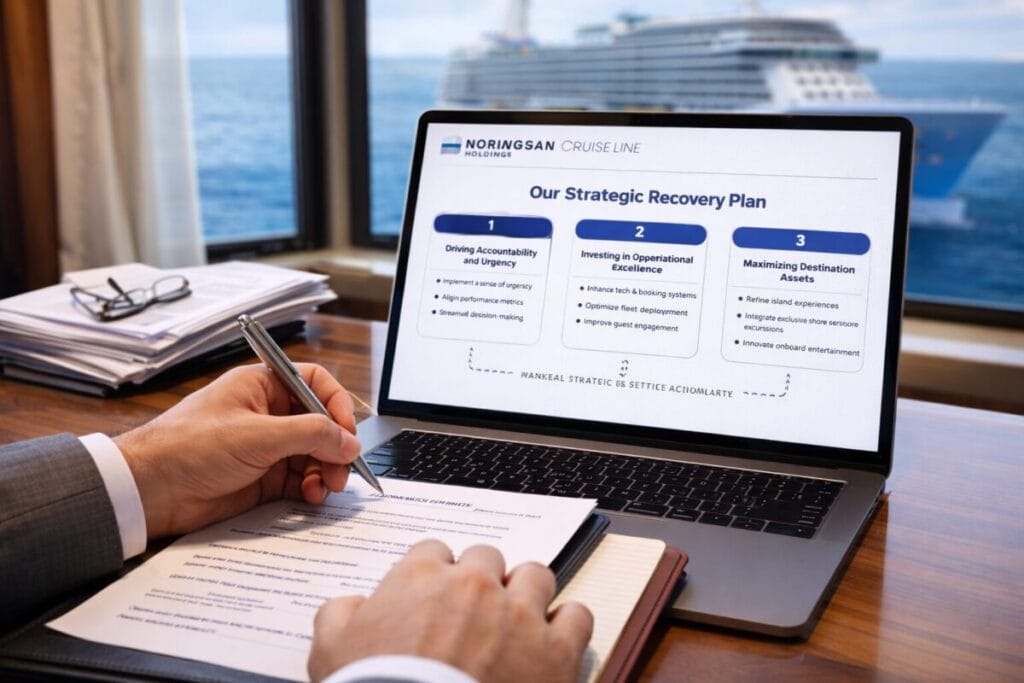
Leadership introduced a structured three-pillar framework to drive recovery. Each pillar targets operational improvement and sustainable growth.
1. Strengthening Accountability and Speed
The first pillar centers on cultural transformation. Executives aim to instill urgency across all departments. Decision-making processes will become leaner and faster.
Performance metrics now align directly with strategic objectives. Leaders expect greater ownership at every level. This shift should accelerate execution and improve coordination.
Streamlined communication between commercial and operational teams will support stronger alignment. Management believes that faster responses will reduce revenue volatility.
2. Investing in Operational Technology
The second pillar emphasizes reinvestment in operational efficiency. The company will prioritize digital booking systems and itinerary optimization tools.
Enhanced scheduling analytics will guide ship deployment decisions. These systems will identify markets with stronger yield potential.
Improved guest engagement platforms will support personalized marketing. Direct-to-consumer communication will also expand through upgraded digital channels.
Industry analysts highlight technology adoption as critical for cruise competitiveness. Cruise lines must respond quickly to shifting demand patterns. Norwegian Cruise Line Holdings aims to strengthen that responsiveness through digital modernization.
3. Maximizing Destination Assets
The third pillar focuses on unlocking value from private destinations and onboard experiences. Proprietary islands represent strategic assets with strong revenue potential.
Management plans to refine pricing strategies and marketing for these destinations. Enhanced amenities and exclusive excursions will drive incremental revenue.
Onboard innovations in dining and entertainment will also expand ancillary income streams. These improvements aim to increase per-passenger spending while improving satisfaction.
Private island investments continue to shape cruise competitiveness. Regional tourism boards confirm that exclusive shore experiences drive booking decisions. Norwegian Cruise Line Holdings seeks to capitalize on that trend.
Leadership Restructuring Supports Reform
The turnaround effort includes leadership restructuring. The company recently appointed new executives in operational and commercial roles.
This refreshed management team brings diverse industry experience. Leaders now oversee integrated reporting structures to encourage collaboration.
Unified oversight aims to eliminate departmental isolation. Shared performance targets will align marketing, revenue, and operations.
The chief executive stressed that mindset change will determine long-term success. Cultural cohesion must support structural reforms.
Gradual Recovery Amid Competitive Pressures
The cruise sector remains highly competitive. Pricing sensitivity and global economic shifts continue to influence booking patterns.
Despite these challenges, cruise demand shows resilience. Industry data indicates steady occupancy improvements across major operators.
Norwegian Cruise Line Holdings expects gradual margin stabilization as reforms take effect. Leadership emphasizes disciplined growth rather than rapid expansion.
Future capacity increases will follow operational readiness benchmarks. This approach should prevent misalignment between infrastructure and sales.
Aligning Growth with Preparedness
The company’s recalibrated strategy focuses on synchronization. Infrastructure upgrades, marketing campaigns, and pricing strategies must advance together.
By reinforcing this alignment, management seeks to strengthen booking momentum. Coordinated planning will also reduce promotional dependency.
Improved forecasting tools will allow better inventory management. Real-time data integration will guide pricing adjustments and itinerary decisions.
This holistic approach reflects broader cruise industry evolution. Operators increasingly rely on analytics to optimize profitability.
Charting a Disciplined Course Forward
Norwegian Cruise Line Holdings does not plan to reinvent its business model. Instead, it intends to refine execution and restore operational discipline.
The structured recovery framework provides a clear roadmap. Cultural urgency, technology upgrades, and asset optimization anchor the plan.
While recovery will require patience, leadership expresses confidence in the strategy. The company believes stronger coordination will translate into improved financial performance.
As global cruise demand continues to rebound, disciplined execution will define competitiveness. Norwegian Cruise Line Holdings now aims to translate strategic vision into measurable results.
Through tighter alignment and digital modernization, the company seeks to strengthen profitability and position itself for long-term expansion in the global cruise industry.
For more travel news like this, keep reading Global Travel Wire