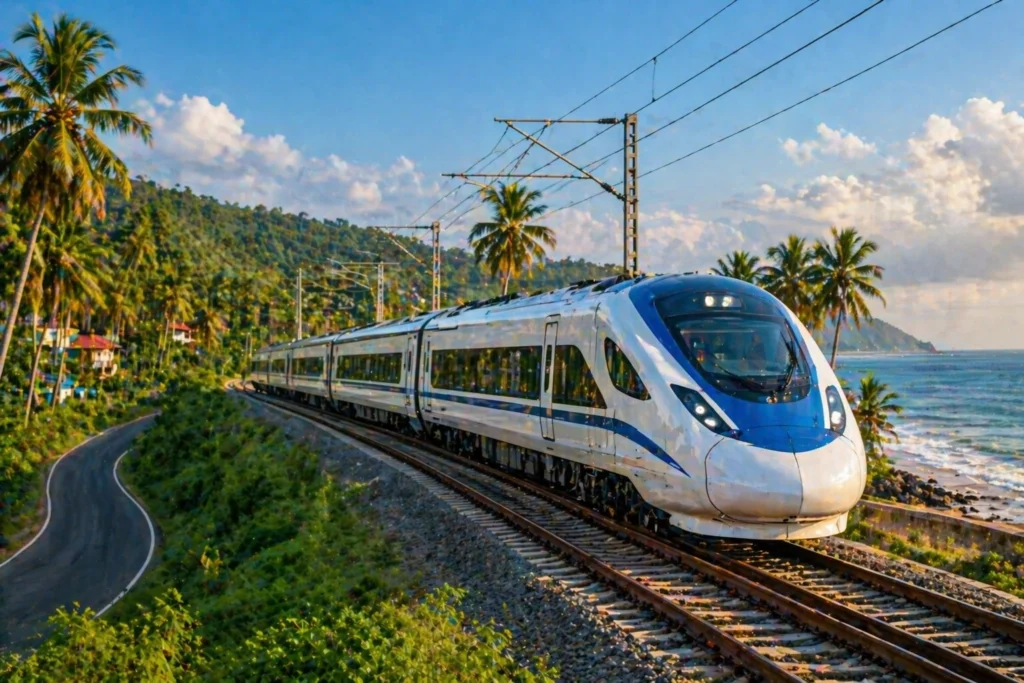
India’s central government has directed Kerala to revise the Detailed Project Report for its proposed semi-high-speed rail corridor so the line aligns with broad gauge standards and national railway specifications. The move marks a major policy shift toward integrated rail development, ensuring future projects connect seamlessly with the wider Indian Railways network rather than operating as isolated systems.
The decision could significantly influence long-term travel across Kerala and beyond by supporting interoperability, stronger passenger connectivity, shared infrastructure and easier expansion of faster rail services. For travelers, it signals a future where high-quality regional rail upgrades work in tandem with the national network rather than apart from it.
Why the Centre Wants Broad Gauge
Broad gauge is the dominant rail standard across India and underpins almost the entire national rail system. By requiring Kerala’s project to adopt the same gauge, the government is aiming to maximize compatibility with existing rolling stock, signaling systems, electrification standards and operational practices.
That matters because unified standards can lower long-term costs, simplify maintenance and create more flexibility for future services. Trains and technologies developed for the national network can be used more efficiently when infrastructure follows common specifications.
In transport planning, standardization is often as important as speed because it determines how well systems can grow over time.
What the Revision Includes
According to the direction issued to Kerala Rail Development Corporation Limited, the revised plan should incorporate several key national standards. These include broad gauge track adoption, safety systems such as Kavach automatic train protection, upgraded electrification using 2×25 kV systems, engineering changes suited to broad gauge operations and environmental safeguards.
Together, these elements point to a corridor designed not only for faster journeys, but also for resilience, safety and future expansion.
For passengers, the practical benefits could include more dependable operations, stronger safety oversight and smoother integration with long-distance travel options.
A Turning Point for Kerala’s Rail Vision
The corridor was originally associated with the SilverLine concept, a proposed 530+ kilometer route connecting Thiruvananthapuram in the south with Kasaragod in the north. The project aimed to transform travel times across Kerala, one of India’s most densely populated and linear states.
Fast north-south connectivity is particularly valuable in Kerala because road congestion and long travel times often affect business mobility, tourism flows and daily commuting between cities.
The revised broad gauge approach suggests the project may evolve from a stand-alone concept into a corridor more closely tied to national rail modernization goals.
What It Means for Travelers
If implemented successfully, a broad gauge semi-high-speed line could bring multiple benefits for passengers:
Faster journeys between major Kerala cities
Improved links to trains beyond the state
More reliable operations using national systems
Potential for wider route choices in the future
Stronger station connectivity and integrated transport planning
For domestic tourists, easier rail movement can support multi-city itineraries linking beaches, backwaters, hill stations, heritage towns and medical tourism centers across Kerala.
For residents, shorter travel times can improve access to jobs, education and services.
Boost for Tourism and Economy
Kerala is one of India’s best-known tourism states, attracting visitors for wellness travel, nature experiences, houseboats, cuisine and cultural tourism. Better rail infrastructure can strengthen the visitor economy by making movement between destinations quicker and more comfortable.
Improved rail also supports conferences, domestic weekend travel and year-round regional tourism. Businesses near stations, hotels, restaurants and local transport providers often benefit when major connectivity upgrades are delivered.
Large infrastructure projects can also create construction jobs and stimulate related investment over time.
Part of India’s Bigger Rail Strategy
The directive fits within India’s wider push to modernize rail through faster corridors, upgraded conventional lines, improved electrification and digital safety systems. Across the country, routes are being enhanced for higher speeds and better passenger experiences.
Rather than building disconnected systems, the government appears focused on creating a layered network where conventional, semi-high-speed and future high-speed services complement one another.
That integrated model can be more scalable and cost-effective in the long run.
Challenges Ahead
Revising a major DPR is only one step. Land acquisition, environmental approvals, financing, engineering design and execution timelines will all shape the project’s future.
However, clearer alignment between state ambitions and national standards may help improve planning confidence and operational clarity.
Looking Ahead
The Centre’s decision to seek a broad gauge revision for Kerala’s semi-high-speed rail plan is more than a technical adjustment. It is a strategic move toward connected, future-ready transport infrastructure.
For Kerala, it could unlock a smarter path to faster rail travel. For India, it reinforces a national vision where modern mobility is built on compatibility, safety and seamless connectivity across the entire railway network.
For more travel news like this, keep reading Global Travel Wire