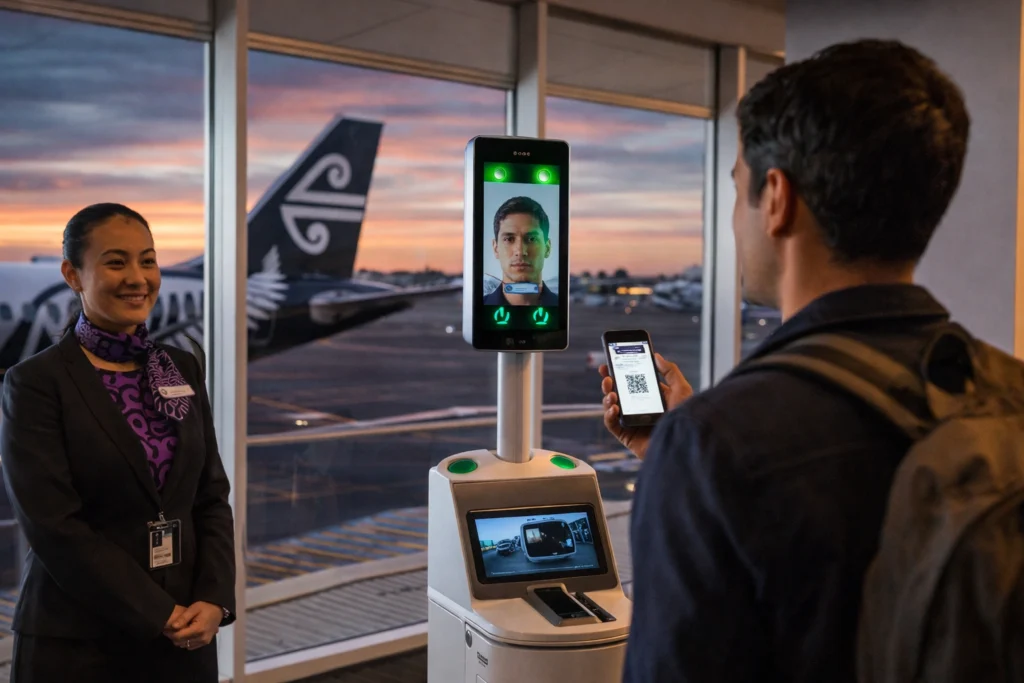
New Zealand is moving closer to a faster and more seamless travel future after Air New Zealand successfully completed a digital identity trial designed to simplify the airport journey. The pilot, carried out in March on selected flights between Auckland and Hong Kong, allowed passengers to share verified digital identity details during online check-in and use biometric verification at parts of the airport process.
The result could reshape how travelers move through airports in the years ahead. Instead of repeatedly presenting passports and boarding passes, passengers may eventually pass through key checkpoints using secure facial recognition linked to pre-verified travel credentials.
For travelers, that means less time in queues and more time enjoying the journey.
How the Digital ID Trial Worked
During the trial, selected passengers uploaded passport details securely through the airline’s mobile app before arriving at the airport. Once the information was verified, the system connected that digital identity to biometric checkpoints.
At participating points in the airport journey, travelers could confirm identity through facial scans rather than repeated manual document checks.
This process aimed to remove friction from international travel while maintaining security standards already required for cross-border journeys.
For passengers navigating busy airports, especially on long-haul routes, even small reductions in wait times can significantly improve the experience.
Why This Matters for Travelers
Airports often create stress through long lines, repeated checks, and time pressure. Digital identity systems directly address those pain points.
Instead of searching for passports at multiple stages, travelers can move more efficiently through check-in, security, and boarding where supported infrastructure exists.
That smoother flow becomes especially valuable for:
Business travelers managing tight schedules
Families traveling with children and bags
Transit passengers making short connections
Leisure travelers who want a relaxed start to their holiday
By reducing unnecessary delays, the overall travel experience becomes more comfortable and predictable.
Faster Airports, Better Journeys
One of the strongest advantages of digital identity is speed.
Manual document inspection takes time, particularly during peak travel periods. When thousands of passengers move through terminals at once, even minor delays can build quickly.
Biometric verification can help airports process travelers faster while reducing congestion in high-pressure areas.
For destinations dependent on tourism, easier airport experiences can also improve first impressions and encourage repeat visits.
Travel does not begin at the destination. It begins the moment a passenger enters the airport.
Security and Privacy Remain Central
While speed matters, trust matters even more.
Digital identity systems rely on secure data handling, encryption, and passenger consent. Airlines and airports involved in these programs emphasize that travelers should remain in control of how their data is shared and when biometric tools are used.
That balance between convenience and privacy will play a major role in public adoption.
Travelers are increasingly open to digital tools, but they also expect transparency, strong safeguards, and clear opt-in choices.
As these systems expand, privacy standards will remain essential to long-term success.
Expansion Could Reach More Routes
Following the successful Auckland-Hong Kong test, Air New Zealand plans to expand further trials on additional international services. Australia is expected to be an early focus for the next phase.
That next step matters because short-haul and regional international routes often carry high passenger volumes and frequent business traffic.
If digital identity tools perform well across multiple markets, the model could later support wider adoption across Asia-Pacific and beyond.
The airline’s collaboration with airports and global aviation partners also helps create standards that other carriers may eventually follow.
A Boost for Tourism and Connectivity
Seamless travel technology can support tourism growth as well as operational efficiency.
Many travelers choose destinations partly based on convenience. Lengthy airport procedures and stressful transit experiences can influence booking decisions, especially for short breaks and multi-stop trips.
By making travel easier, digital identity systems can strengthen destination appeal for countries that rely on international visitors.
For New Zealand, smoother journeys could support inbound tourism while reinforcing its image as an innovative and traveler-friendly destination.
That benefit extends to outbound travel too, giving residents a more efficient way to connect with the world.
Air New Zealand’s Wider Digital Strategy
The digital ID trial fits into a broader strategy to modernize customer experience through technology.
Air New Zealand already offers mobile booking tools, digital boarding passes, travel alerts, and self-service functions through its app ecosystem.
Adding secure identity verification builds on those foundations and moves the airline toward a more integrated mobile-first travel model.
For passengers, that means fewer disconnected steps and a more intuitive journey from booking to boarding.
What Travelers Should Expect Next
Digital IDs are unlikely to replace passports everywhere overnight. Infrastructure varies between airports, and regulatory alignment between countries still takes time.
For now, traditional documents will continue alongside digital tools in many markets.
However, the direction is clear. Airports are becoming smarter, more automated, and more traveler-focused.
The Future of Flying Is Becoming Simpler
Air New Zealand’s successful trial signals more than a technology upgrade. It shows how aviation is rethinking the passenger journey from the ground up.
If future rollouts continue to succeed, seamless travel may soon become an everyday reality rather than a premium convenience.
For more travel news like this, keep reading Global Travel Wire