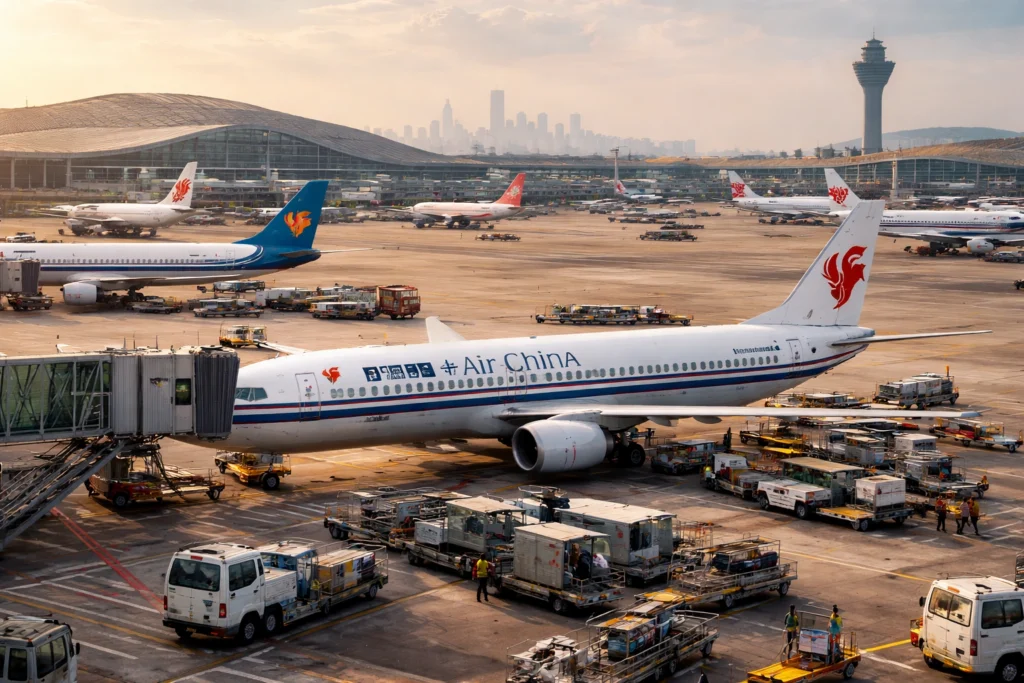
China’s air travel network has entered a new period of disruption after more than 120 flights were cancelled across several of the country’s busiest airports, affecting both domestic and international passengers during a key travel period. The latest wave of China flight cancellations April 2026 has hit major hubs including Beijing, Shanghai, Guangzhou, Shenzhen and Chengdu, while long-haul routes to Frankfurt, Munich and Tel Aviv also faced suspensions.
The scale of the disruption has raised concerns for travelers, airlines and tourism businesses as China continues to manage strong passenger demand across its vast aviation network. Repeated cancellations on major corridors now threaten onward connections, hotel bookings and business travel plans.
Beijing Faces the Largest Impact
Beijing recorded the heaviest operational pressure, with widespread cancellations reported at both of the capital’s main airports.
At Beijing Capital International Airport, airlines suspended more than two dozen departures serving cities such as Shanghai, Shenzhen, Chengdu, Xiamen and Urumqi. Some international services also dropped from schedules, creating further uncertainty for global travelers.
Meanwhile, Beijing Daxing International Airport also saw extensive disruption. Flights to Guangzhou, Macau, Xi’an, Nanchang and Chongqing were among those affected.
The repeated loss of services on the busy Beijing–Shanghai corridor stands out as one of the most significant developments. That route supports both business and leisure demand and ranks among the country’s most important air links.
Shanghai Airports Struggle With Domestic and Overseas Routes
Shanghai’s two-airport system also came under pressure.
At Shanghai Pudong International Airport, airlines cancelled a mix of domestic and international departures. Long-haul routes to Frankfurt and Munich were among the most notable suspensions, while domestic services to Chengdu, Tianjin and Dalian also dropped from schedules.
Shanghai Hongqiao International Airport, which handles a large share of domestic traffic, reported repeated cancellations on flights to Beijing, Chengdu, Xiamen, Changsha and Zhuhai.
Because Shanghai acts as a key gateway for both inbound tourism and corporate travel, disruption there can ripple quickly through hotel demand, meetings, events and regional connections.
Guangzhou Sees Persistent Route Suspensions
Guangzhou Baiyun International Airport also reported ongoing cancellations over multiple days, pointing to sustained scheduling pressure rather than a one-off issue.
Routes to Hefei, Beijing Daxing, Wuhan, Shanghai Hongqiao, Yiwu, Nantong, Qingdao and Nyingchi all experienced interruptions.
Several early morning and late-night departures disappeared from timetables, reducing flexibility for passengers who depend on off-peak travel options. Repeated disruption on the Guangzhou–Beijing Daxing route further highlights strain on one of China’s busiest domestic markets.
For southern China’s tourism and trade economy, reliable Guangzhou connectivity remains essential. Any prolonged slowdown can affect visitor flows and cargo-linked business travel alike.
Shenzhen and Chengdu Continue to Feel Pressure
Shenzhen Bao’an International Airport also faced fresh disruption, with cancellations affecting services to Beijing, Zhengzhou, Chengdu and select international destinations.
Repeated cuts on Shenzhen–Beijing flights show that demand-heavy routes remain vulnerable when network pressure rises.
Further west, Chengdu Tianfu International Airport reported around 20 cancelled departures. Flights to Shanghai, Lhasa, Hangzhou, Changsha and Guangzhou were among those impacted.
Chengdu plays a growing role in western China’s tourism economy, acting as a gateway to mountain regions, cultural attractions and domestic leisure markets. Therefore, reduced air access can quickly affect travel plans across a wide area.
What the Pattern Suggests
The latest China flight cancellations April 2026 reveal several consistent trends.
First, the same routes have faced repeated cancellations across multiple days. That often signals broader operational constraints rather than isolated technical issues.
Second, the largest hubs have seen the most pressure. Beijing, Shanghai and Guangzhou anchor national connectivity, so any slowdown there spreads rapidly through the wider network.
Third, both domestic and international services have been affected. This creates added complexity because missed long-haul flights often involve hotel stays, visa timing, onward rail travel or connecting itineraries.
Finally, both narrow-body and wide-body aircraft appear in the disruption pattern. That suggests challenges across short-haul and long-haul operations alike.
What Travelers Should Expect Now
Passengers traveling through China in the coming days may need extra flexibility.
Travelers could face longer journey times, limited rebooking choices and tighter seat availability on alternative departures. Popular city pairs may sell out quickly when cancelled passengers move to later flights.
International travelers should also allow more connection time, especially when transferring through major hubs such as Beijing or Shanghai.
Those with hotel reservations, tours or cruise departures may want to review cancellation terms and stay in contact with airlines for schedule updates.
Impact on Tourism and Airlines
For airlines, continued cancellations increase costs and complicate aircraft planning, crew schedules and customer service operations. Carriers must also protect passenger confidence while managing network reliability.
For tourism businesses, flight disruption can slow visitor arrivals, reduce last-minute bookings and affect occupancy in gateway cities. Destinations that rely on short domestic breaks may feel the impact fastest if travelers postpone trips.
Outlook
China remains one of the world’s largest aviation markets, and demand for travel continues to recover strongly. However, the latest wave of cancellations shows how quickly pressure at major hubs can affect the entire system.
If operations stabilize soon, disruption may remain temporary. But if cancellations continue across key routes, travelers and tourism businesses should prepare for further volatility in the weeks ahead.
For more travel news like this, keep reading Global Travel Wire