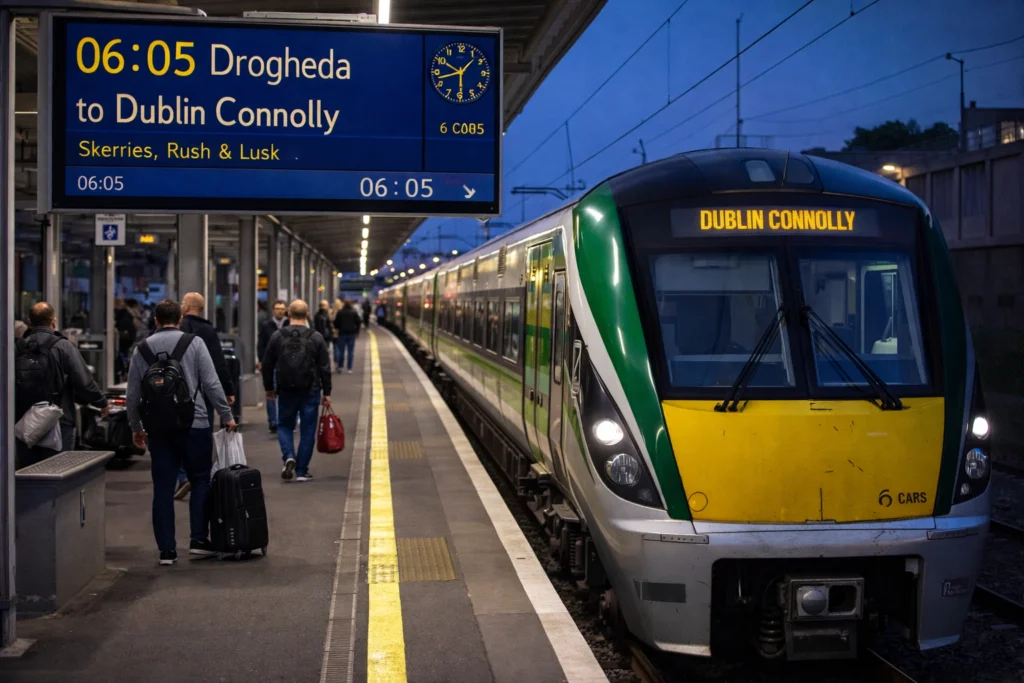
Ireland is expanding its public transport network with the launch of a new early morning rail service linking Drogheda and Dublin Connolly, a move set to improve capacity on one of the country’s busiest commuter corridors. Starting on April 20, 2026, the additional departure will give passengers another fast and reliable option to reach the capital during peak demand hours.
The new Drogheda to Dublin Connolly train service arrives as rail demand continues to rise and highlights Ireland’s wider push to deliver greener, higher-capacity mobility for commuters and visitors alike.
For travelers across County Louth and North Dublin, the service promises more flexibility, better comfort and stronger access to the city.
New Early Morning Option for Commuters
The added departure will leave Drogheda at 06:05 and arrive at Dublin Connolly at 07:09, creating a valuable earlier option for passengers who need to reach the capital before the busiest rush-hour period.
Along the route, the train will call at key commuter stations including Balbriggan, Skerries, Rush & Lusk, Donabate and Malahide.
These stops serve fast-growing communities where demand for rail travel has increased steadily in recent years. An earlier service can help spread passenger numbers across the morning peak and reduce crowding on later trains.
For many daily commuters, that can mean a less stressful start to the day.
Why This Route Matters
The Drogheda-Dublin corridor plays a vital role in Ireland’s transport network.
It connects one of the country’s largest regional towns with the national capital, supporting workers, students, business travelers and leisure visitors. Strong rail links on this route help reduce car dependence while supporting regional growth beyond Dublin itself.
As housing and employment patterns continue to evolve, more people now live outside the capital while commuting into the city. Reliable rail services therefore become increasingly important.
The latest expansion directly responds to that shift.
More Capacity at a Busy Time
The new train will operate as a six-carriage service, giving passengers additional seating during a high-demand travel window.
That extra capacity matters on a corridor where peak trains can become crowded quickly. More seats and more departures together create a stronger passenger experience than relying on frequency alone.
The service will also continue into another important role after arriving in Dublin, supporting onward operations on the Belfast route.
That efficient use of rolling stock shows how rail operators can maximize network value through smart scheduling.
Stronger Choice for Travelers
With the addition of this departure, passengers from Drogheda will now have ten morning peak services reaching Dublin before 09:00.
Greater frequency gives travelers more control over their day. Instead of adjusting work schedules around limited train times, passengers gain the freedom to choose journeys that better suit personal and professional commitments.
That flexibility can increase public transport use because convenience often drives travel behavior as much as price.
For occasional visitors heading into Dublin for meetings, events or tourism, the expanded timetable also improves trip planning.
Greener Travel Future on the Horizon
The route is also set to benefit from future battery-electric DART trains planned for introduction from 2027.
These next-generation services are expected to bring longer trains, increased capacity and lower-emission operations. Supporting infrastructure, including charging capability, is also planned for Drogheda.
That investment aligns with Ireland’s wider sustainability goals and reflects a broader European trend toward cleaner rail transport.
For travelers, greener trains can deliver environmental benefits without sacrificing speed or comfort.
Positive Impact for Dublin and Louth
Improved rail connectivity often creates economic benefits at both ends of the line.
For Dublin, better access supports labor mobility, retail activity and city-center footfall. For Drogheda and surrounding communities, strong commuter links can boost residential appeal and local business confidence.
Reliable transport helps regions grow while staying connected to national opportunities.
That makes transport investment a tourism and economic story, not just a commuter one.
What It Means for Visitors
Although the service mainly targets commuters, tourists can benefit too.
Visitors staying in Drogheda or nearby coastal towns gain another practical option for early access to Dublin’s museums, shopping districts, events and onward rail links. Likewise, travelers based in the capital may find day trips to the Boyne Valley region easier to plan with stronger timetable flexibility.
As rail networks improve, tourism choices often expand naturally.
A Broader Public Transport Strategy
The launch also reflects Ireland’s larger commitment to modernize transport infrastructure.
Across the country, rail upgrades, fleet renewal and service expansions are reshaping how people move between cities and regions. The Drogheda to Dublin Connolly train service is one visible example of that strategy in action.
Small timetable changes can have a large real-world effect when they target the right corridor at the right time.
Outlook
Ireland’s new early morning rail link between Drogheda and Dublin Connolly offers more than another departure on the board. It delivers extra capacity, stronger commuter choice and a glimpse of a cleaner rail future.
As battery-electric trains and wider network improvements approach, passengers across the corridor can expect travel to become faster, easier and more sustainable in the years ahead.
For more travel news like this, keep reading Global Travel Wire