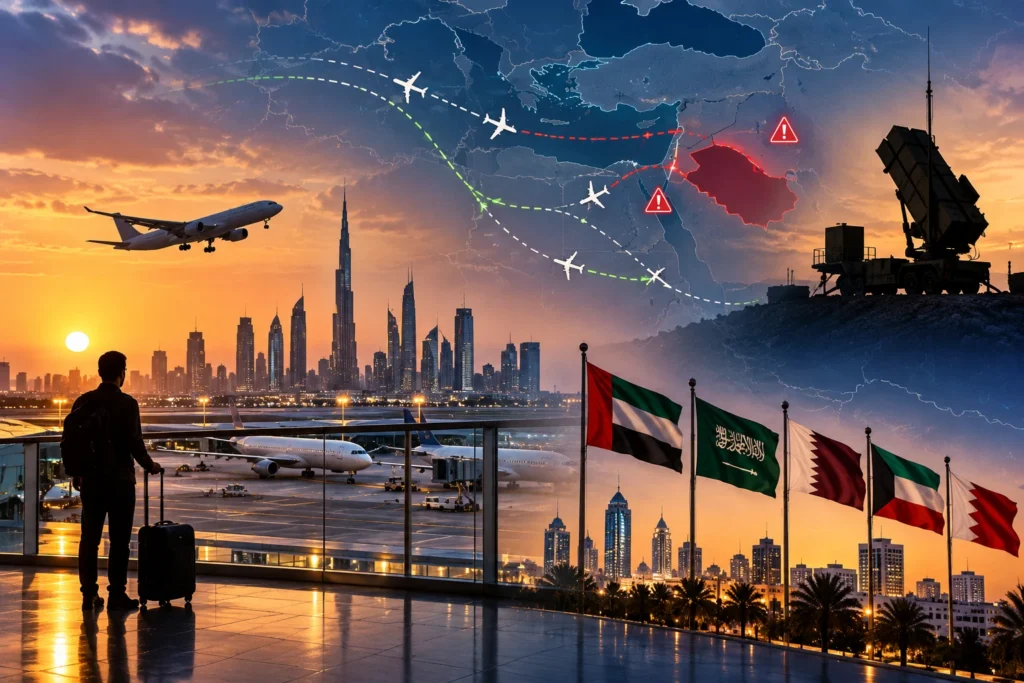
A growing evacuation crisis is affecting the United States, Canada, the United Kingdom, Germany, Mexico, Spain, Brazil, France, Ireland, Switzerland, Italy and other nations as renewed disruption in the Strait of Hormuz combines with regional airspace restrictions to delay repatriation flights from the Middle East. Governments are facing rising pressure to move citizens home while airlines navigate shrinking flight corridors, higher fuel costs and rapidly changing security conditions.
The situation underscores how deeply connected maritime security and aviation networks have become. As one of the world’s most important energy chokepoints faces disruption, the effects are extending far beyond shipping lanes into airports, airline schedules, tourism recovery plans and emergency evacuation operations across multiple continents.
Repatriation Flights Hit by Route Restrictions
Evacuation efforts rely on predictable airspace access, airport capacity and efficient airline operations. Those fundamentals are now under strain across several Middle Eastern corridors. Restrictions or controlled operations affecting Israel, Saudi Arabia, Qatar, the UAE, Kuwait and neighboring airspace have reduced routing options and increased congestion on remaining open paths.
For governments organizing repatriation missions, that means longer flight times, fewer available slots, higher operating costs and slower passenger processing. Charter flights, military airlift and commercial rescue operations all become more complex when regional routes tighten suddenly.
United States and Allies Face Growing Pressure
The United States is among the countries managing large-scale assistance efforts while thousands still seek support. Canada, the UK, Germany, France and Italy are also confronting major logistical challenges as demand for seats exceeds available capacity in some hubs.
European coordination mechanisms and bilateral support arrangements are helping, but the scale of disruption means recovery is uneven. Nations with large resident populations, tourism flows or business communities in the region face especially difficult planning decisions as conditions continue to evolve.
Oman and Jordan Become Key Transit Gateways
With some routes restricted, countries such as Oman and Jordan are emerging as critical evacuation gateways. Open airspace and functioning airport infrastructure make them valuable transit points for passengers leaving affected zones.
However, success creates its own pressure. Higher traffic volumes can strain terminals, hotel capacity, ground transport and available flight slots. For travelers, that may mean extended waits, rerouted journeys and overnight stays before reaching final destinations.
Airlines Face Rising Costs and Operational Complexity
Carriers operating in or around the region are dealing with longer routings that increase fuel burn and crew time. When flights must avoid closed or high-risk corridors, schedules can unravel quickly. Delays on one sector often affect aircraft rotations and connections elsewhere in the network.
Fuel market volatility adds another challenge. If maritime disruption pushes oil prices higher, airlines may face immediate cost pressure on top of already expensive rerouting operations. That combination can affect fares, capacity decisions and future route planning.
Tourism Recovery at Risk
The Middle East has become one of the world’s fastest-growing travel regions, with expanding airlines, new resorts, major events and strong transit traffic. Prolonged instability could slow that momentum by weakening traveler confidence and increasing transport costs.
Destinations reliant on international visitors may see booking hesitation if headlines remain dominated by conflict risk and travel uncertainty. Tour operators, hotels and attractions can also face cancellations or softer demand when access becomes more difficult.
Impact Reaches Global Networks
The disruption is not limited to the region itself. International airlines connecting Europe, Asia, Africa and North America often use Gulf hubs and surrounding air corridors. When those networks are disrupted, passengers worldwide may experience missed connections, schedule changes and higher fares.
Supply chain effects may also feed back into travel demand. Rising fuel and freight costs can influence consumer spending, corporate travel budgets and discretionary holiday decisions in distant markets.
What Travelers Should Do Now
Passengers with journeys involving the Middle East should check airline notifications frequently, confirm transit requirements and allow extra time for rebooking or schedule changes. Flexible tickets, travel insurance and updated contact details can be valuable during fast-moving disruptions.
Those awaiting assisted departures should follow official government instructions and registration channels, as evacuation processes may change according to airport access and available aircraft.
Outlook Depends on Stability
The next phase depends on whether maritime and airspace conditions stabilize. Governments are continuing emergency planning, while airlines adapt schedules day by day to protect passengers and crews.
For now, the evacuation challenge shows how quickly geopolitical shocks can disrupt global mobility. Until safe corridors expand and transport networks normalize, repatriation operations and international travel are likely to remain under pressure.
For more travel news like this, keep reading Global Travel Wire