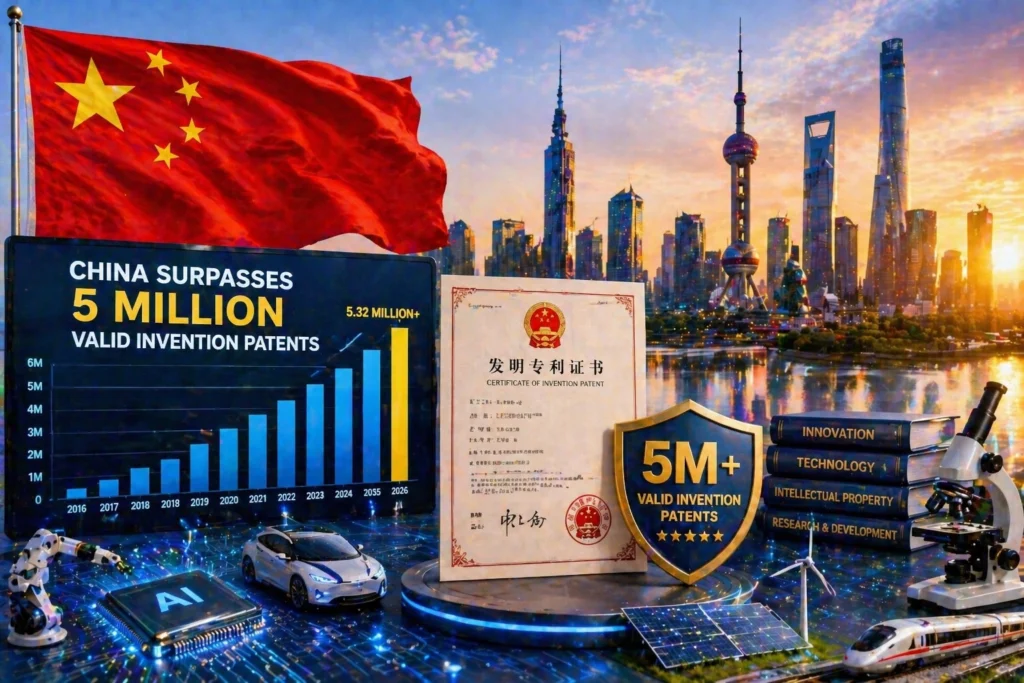
China has crossed a historic milestone by surpassing 5 million valid invention patents, reinforcing its position as a global leader in innovation and intellectual property. The achievement signals a major shift in the international technology landscape, where patent strength increasingly reflects economic power, research capability, and future industrial influence.
According to the user-provided information, official figures show China holding more than 5.32 million valid invention patents in force, placing it ahead of other major economies. The milestone highlights how rapidly the country has evolved from a manufacturing center into a technology powerhouse with growing influence across multiple strategic sectors.
Why Patent Strength Matters
Patents are more than legal documents. They can indicate where new ideas are being developed, which industries are expanding, and which countries are investing heavily in research and development.
A strong patent base can support licensing revenue, attract investment, encourage startup growth, and strengthen competitiveness in high-value industries. It can also provide leverage in global supply chains where technology ownership is increasingly important.
For governments and businesses alike, patent activity is often seen as a forward-looking signal of economic direction.
China’s Rise Built on Long-Term Strategy
China’s rapid growth in patents has not happened by chance. Over the past decade, the country has combined major research spending, industrial policy, university expansion, and stronger intellectual property systems to build a large-scale innovation ecosystem.
That approach has encouraged both domestic firms and multinational companies operating in China to file and protect new technologies. It has also supported national ambitions to lead in advanced manufacturing, digital infrastructure, and next-generation science.
The result is a dramatic increase in both patent filings and patents in force.
Key Sectors Driving Growth
Much of China’s patent momentum is linked to frontier industries. According to the user-provided material, filings have expanded strongly in artificial intelligence, telecommunications, robotics, and other advanced technology fields.
These sectors are central to the future global economy. AI is reshaping productivity and automation, telecommunications underpins digital connectivity, and robotics is transforming manufacturing and logistics.
China’s strength in these areas suggests its patent leadership is closely tied to industries likely to define the next phase of global growth.
Tech Giants and Universities Play Major Roles
Large corporations have been among the biggest contributors to China’s patent expansion. Companies such as Huawei, Alibaba, Baidu, and ZTE are widely associated with large research programs and continued technology development.
Universities and research institutions also play a crucial role. Academic research can generate foundational discoveries that later become commercial products, helping countries build deeper innovation pipelines.
This combination of government policy, corporate investment, and academic research has created a broad-based model for innovation growth.
Global Implications for Business
China’s growing patent portfolio is reshaping competition worldwide. Companies in Europe, North America, and other Asian markets may face stronger rivals in sectors where Chinese firms hold increasingly valuable intellectual property.
That can influence everything from licensing negotiations and market entry strategies to research priorities and joint ventures.
For multinational businesses, understanding the evolving Chinese patent landscape is becoming more important as technology markets globalize further.
Green Technology and Future Industries
Another notable area of growth is sustainability. The user-provided information highlights increasing patent activity linked to clean energy, electric vehicles, and carbon-related technologies.
That matters because future economic leadership may depend not only on digital innovation, but also on who leads the transition to lower-carbon industries. Patents in green technologies can shape supply chains, manufacturing standards, and export opportunities for years to come.
China’s scale in these fields could strengthen its long-term industrial position.
Stronger Intellectual Property Systems
China’s progress has also been supported by reforms aimed at improving patent protection and enforcement. Clearer systems for registration, rights protection, and dispute handling can encourage inventors to invest more confidently in new ideas.
For foreign companies, stronger IP frameworks may also influence decisions on partnerships, R&D presence, and market participation.
Confidence in enforcement often plays a major role in innovation ecosystems.
What to Watch Next
The next phase of China’s patent story will depend on quality as much as quantity. Investors and policymakers will watch how many patents translate into profitable products, global standards leadership, and commercially successful technologies.
They will also track how other countries respond through research investment, industrial strategy, and talent development.
A New Innovation Era
China surpassing 5 million valid invention patents is more than a statistical milestone. It reflects a deeper rebalancing of global innovation power toward economies that combine scale, policy focus, and technology ambition.
As competition intensifies in AI, green energy, advanced manufacturing, and digital systems, patent leadership may become one of the defining measures of economic strength in the decades ahead.
For more travel news like this, keep reading Global Travel Wire