Global air travel is reaching historic highs, with official reports from the International Air Transport Association (IATA) confirming sustained year-over-year growth in passenger traffic across both domestic and international routes. As international hubs process millions of travelers daily, civil aviation authorities and airport operators face a critical operational challenge: maintaining maximum security standards without causing massive checkpoint bottlenecks or flight delays.
Traditional surveillance and manual screening methods struggle to monitor expansive multi-terminal facilities, crowded departure lounges, and restricted airside perimeters around the clock. To address these demands, major international gateways are deploying advanced AI airport security systems. By integrating deep learning algorithms, computer vision, and real-time threat detection, these intelligent technologies are streamlining passenger processing while elevating global aviation safety.
Real-Time Threat Detection Accelerates Terminal Safety
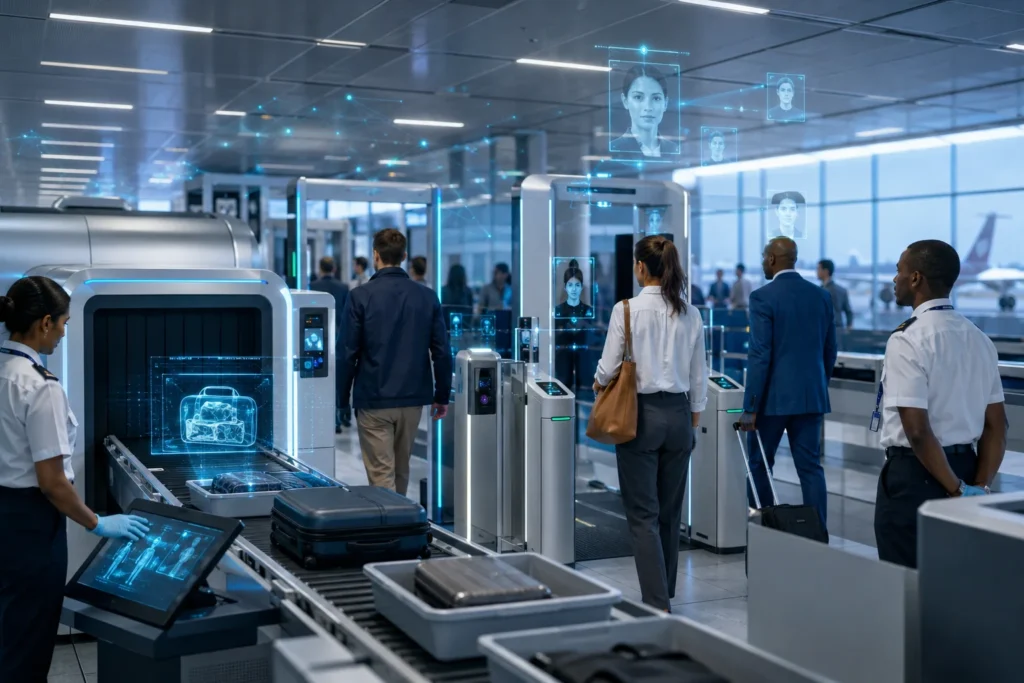
Airports generate thousands of hours of video footage every minute, making comprehensive manual oversight by human security personnel virtually impossible. Next-generation surveillance systems utilize deep-learning computer vision to continuously analyze live feeds across terminals, departure gates, and public concourses.
Instead of relying solely on reactive monitoring after an incident occurs, artificial intelligence proactively identifies operational anomalies and safety hazards in real time, including:
Unattended Luggage Identification: Automatically flagging bags or parcels left unattended beyond predefined safety timeframes.
Perimeter Security Breaches: Monitoring airport fences, tarmac perimeters, and runway access points for unauthorized human or vehicle movement.
Unauthorized Restricted Access: Spotting individuals entering staff-only corridors, baggage sorting facilities, or secure airside zones without proper clearance.
Loitering and Anomaly Detection: Recognizing unusual movement patterns or prolonged loitering in high-risk terminal areas.
By delivering instantaneous automated alerts to security control centers, these systems allow law enforcement and airport officers to respond within seconds, preventing potential threats from escalating.
Streamlining Checkpoints and Passenger Flow Management
Lengthy lines at security checkpoints remain a primary source of travel frustration for international tourists and business travelers. AI-driven video analytics and predictive software are fundamentally altering checkpoint logistics by providing real-time visibility into crowd density and queue behavior.
By continuously evaluating passenger movement rates, automated systems can predict bottlenecks before severe congestion forms. Terminal operators can dynamically allocate screening staff, open auxiliary security lanes, and redirect incoming passenger streams toward less congested checkpoints.
Furthermore, modern Computed Tomography (CT) baggage scanners powered by threat-detection algorithms allow passengers to leave approved liquids and electronic devices inside their carry-on bags. According to aviation security guidelines from the Transportation Security Administration (TSA) and Airports Council International, algorithm-assisted screening enhances explosive detection accuracy while significantly accelerating hourly passenger throughput.
Protecting Sensitive Infrastructure and Airside Zones
Airport security extends far beyond passenger departure halls. Critical airside facilities—such as aircraft parking stands, maintenance hangars, air traffic control towers, fuel storage depots, and baggage distribution hubs—require uncompromising protection against unauthorized access and insider threats.
While traditional electronic badge readers only record card swipes, AI-enhanced access systems analyze access patterns and behavioral indicators. The technology identifies repeated failed access attempts, detects piggybacking through secure doors, and verifies whether personnel entering restricted zones match authorized duty schedules.
This multi-layered surveillance capability shields vital airport infrastructure against physical intrusion and operational tampering, ensuring continuous aircraft safety.
Accelerating Incident Response Through Advanced Video Analytics
Investigating security incidents in complex airport environments historically required security teams to manually review hundreds of hours of recorded footage—a labor-intensive process that consumed critical time.
AI-powered video search capabilities transform forensic investigations by allowing security officers to search recorded footage using specific object, color, or behavioral parameters. Rather than manually scanning timeline scrubbers across multiple camera feeds, operators can locate specific individuals or items across an entire airport facility in seconds.
Rapid search capabilities enable security personnel to reconstruct incident timelines quickly, preserve vital digital evidence, support law enforcement agencies, and restore normal terminal operations with minimal disruption to scheduled flights.
Integrated Cloud Dashboards and Multi-Terminal Coordination
Large international hubs operating across multiple passenger terminals, cargo complexes, and parking structures benefit from unified operational oversight. Modern cloud-enabled security platforms consolidate data from thousands of sensors, cameras, and access control points into a centralized management dashboard.
A centralized architecture provides security leadership with complete operational visibility, enabling:
Unified Incident Management: Coordinated cross-terminal responses managed through a single command platform.
Automated Alert Distribution: Direct transmission of real-time video clips and situational alerts to mobile security patrols.
Data-Driven Resource Allocation: Continuous analysis of terminal passenger density to optimize security staffing across shifts.
This interconnected approach streamlines communication between airport security, local law enforcement, and border protection agencies, ensuring swift, synchronized responses across the entire aviation complex.
Future Outlook for Smart Aviation Security and Global Mobility
As global passenger volumes expand, civil aviation authorities and airport authorities view artificial intelligence as an essential force multiplier rather than a replacement for human expertise. By automating routine surveillance and screening analysis, intelligent systems empower trained security personnel to focus on high-priority decision-making and direct passenger interaction.
The ongoing deployment of smart airport screening tools demonstrates how digital innovation can harmonize robust security protocols with an efficient, stress-free passenger journey. As airports worldwide continue implementing smart infrastructure upgrades, global air travel is becoming increasingly secure, seamless, and resilient.
For more travel news like this, keep reading Global Travel Wire