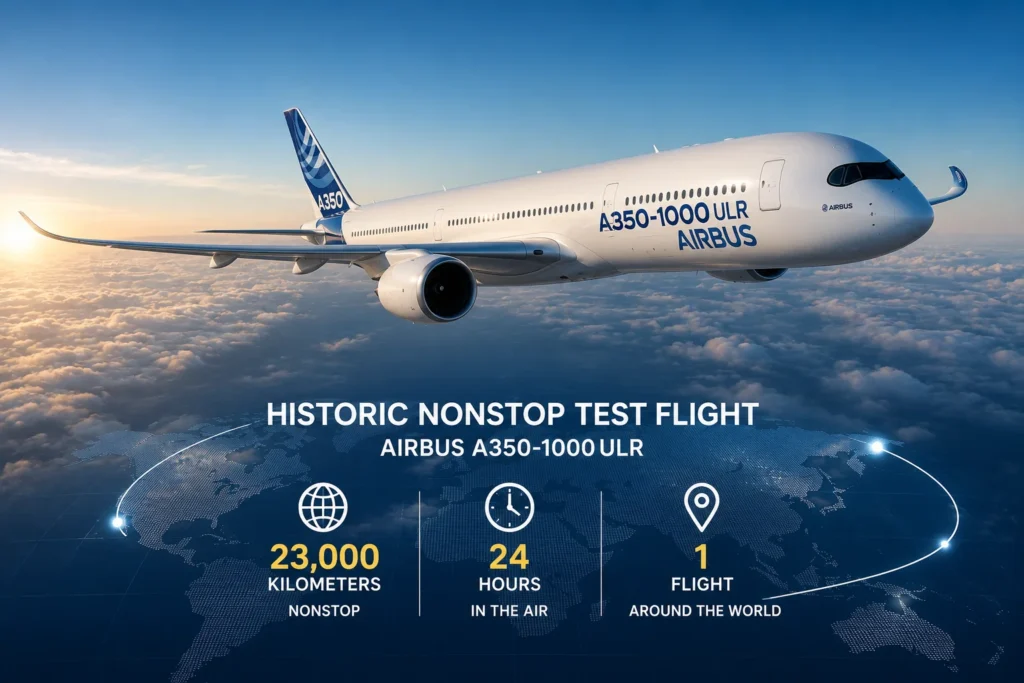
In a historic milestone for global aviation and international travel, a twin-engine passenger aircraft has successfully flown more than 23,000 kilometers without stopping for refueling. The development test aircraft, an Airbus A350-1000ULR (Ultra Long Range), completed a nonstop journey from Melbourne, Australia, to Toulouse, France, remaining continuously in the air for 24 hours and 24 minutes.
The transoceanic flight marks the longest flight duration ever recorded by a commercial passenger jet during development testing. Traversing the Pacific Ocean, crossing airspace over the United States and Canada, and spanning the Atlantic, the flight demonstrated the operational maturity of next-generation aircraft technology designed to connect the farthest corners of the globe.
A Technical Milestone for Next-Generation Commercial Aviation
The test aircraft, registered as F-WULR, departed Melbourne Airport on July 27 and safely touched down at Toulouse-Blagnac Airport in southern France on the morning of July 28. To ensure complete operational safety across more than a full day in the air, three flight crews rotated duties throughout the journey.
As the airliner made its final approach to Toulouse, the flight crew executed a standard go-around maneuver in accordance with flight test protocols before executing a smooth landing. The flight forms part of an intensive flight-test campaign evaluating aircraft systems, fuel management, and cabin environmental controls under extreme operational conditions.
Specialized Engineering Behind Ultra Long Range Capability
The Airbus A350-1000ULR modification features a specialized engineering enhancement: a lightweight, high-capacity Rear Center Tank capable of holding an additional 20,900 liters of jet fuel. Combined with aerodynamic wing refinements and fuel-efficient Rolls-Royce Trent XWB-97 engines, the aircraft achieves an operational range of nearly 10,000 nautical miles under commercial payload conditions.
The extended fuel reserves permit airlines to plan commercial routes of up to 22 hours of scheduled block time while retaining full diversion, holding, and weather safety margins required by international civil aviation authorities.
Project Sunrise and the Future of Point-to-Point Global Travel
The successful endurance flight marks a pivotal advancement for Project Sunrise, the initiative established by Australia’s national carrier, Qantas, to establish direct, nonstop commercial air links connecting Sydney and Melbourne with major economic and cultural centers including London and New York.
Historically, travel between Australia’s east coast and Western Europe or the US East Coast has required mandatory intermediate stopovers in the Middle East or Southeast Asia. Direct routes enabled by the A350-1000ULR will trim total door-to-door travel times by up to four hours, eliminating layover delays and customs processing at transit hubs.
Scheduled commercial operations under Project Sunrise are slated to begin following aircraft deliveries starting in 2027, with ticket sales anticipated to open early that year. The initial delivery of 12 dedicated A350-1000ULR aircraft will establish Australia-UK and Australia-US corridors as the world’s longest direct passenger routes.
Redefining Passenger Comfort and Destination Accessibility
Operating flights lasting longer than 20 hours requires an entirely new approach to cabin architecture and passenger wellbeing. To address traveler fatigue during ultra-long journeys, aircraft operating these non-stop routes will feature customized cabin configurations focused on health and comfort.
Dedicated Onboard Wellbeing Zone: A open space situated between cabin sections featuring guided stretching programs, hydration stations, and movement handles.
Low-Density Seat Layout: Configured with just 238 total seats—the lowest seat density of any A350 aircraft globally—providing increased personal space in all cabin classes.
Enhanced Cabin Environment: Advanced LED lighting systems designed to align with circadian rhythms, alongside customized multi-layer memory foam seating and climate control systems.
By eliminating intermediate layovers, nonstop long haul flights represent a transformative shift in global travel infrastructure. Long-range air links reduce journey friction, improve regional tourism accessibility, and allow travelers to reach distant continents faster and more comfortably than ever before.
For more travel news like this, keep reading Global Travel Wire