The competitive landscape of international aviation is undergoing a major transformation as America’s three dominant legacy carriers launch an expansive network expansion across the Atlantic. For the summer travel season, American Airlines, Delta Air Lines, and United Airlines have collectively rolled out a historic volume of nonstop services linking major domestic hubs with premium European destinations. The strategic deployment comes in response to robust international passenger traffic projections compiled by the U.S. Department of Transportation, highlighting an insatiable consumer appetite for long-haul cultural tourism.
Rather than merely increasing frequencies on well-established trunk routes, the corporate strategies of the “Big Three” show a calculated shift toward capturing high-yield secondary markets. By bypassing traditional congested mega-hubs, these carriers are providing direct access to emerging coastal, cultural, and historical areas. This structural redirection is supported by a period of stabilized jet fuel prices, which allows airlines to deploy widebody aircraft onto long-haul routes without experiencing the severe margin erosion seen in previous volatile energy cycles.
American Airlines Targets Central Europe and Mediterranean Gateways
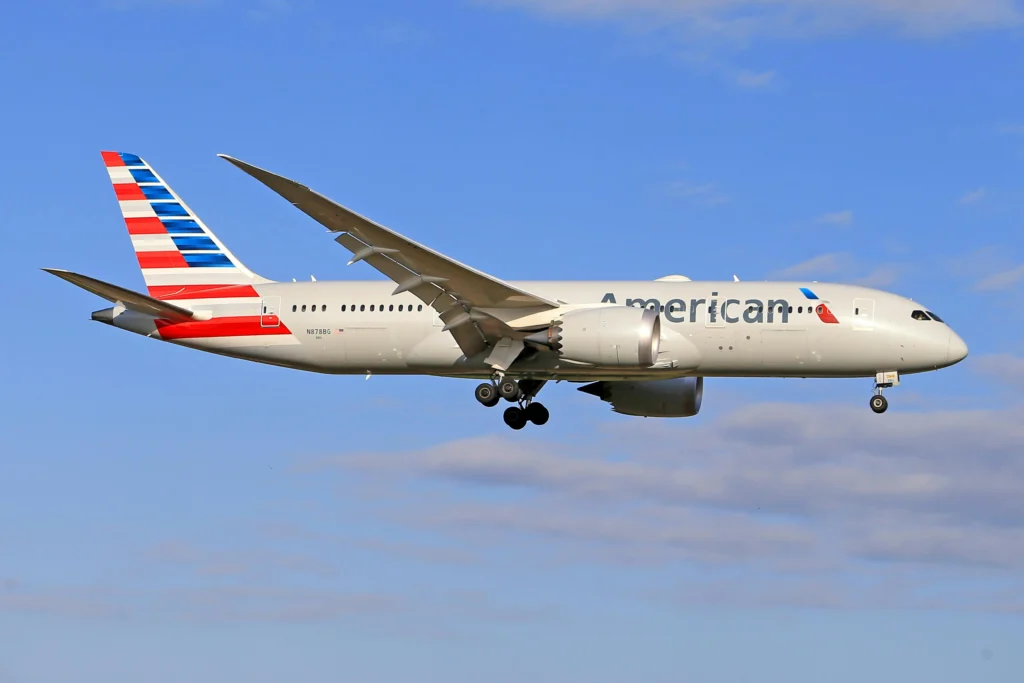
According to operational network updates from American Airlines, the carrier has commenced an aggressive seasonal expansion utilizing its primary international exit points. A cornerstone of its summer network strategy involves establishing direct connections from Philadelphia International Airport to historically rich Central European capitals. The airline has initiated daily seasonal operations to both Budapest Airport in Hungary and Prague Airport in the Czech Republic utilizing its optimized Boeing 787-8 fleet.
Simultaneously, the Oneworld alliance founding member is maximizing its long-haul capacity from its expansive Dallas-Fort Worth hub, deploying heavy Boeing 777 variants to manage high-volume routes to Athens, Greece, and Zurich, Switzerland. In a bid to secure year-round premium revenue streams, the carrier has also initiated direct flights from Miami International Airport to Milan Malpensa, alongside highly anticipated seasonal service from New York’s JFK International Airport to Edinburgh, Scotland.
Delta Air Lines Pioneers New Mediterranean Pathways
Delta Air Lines has officially inaugurated its largest transatlantic schedule to date, heavily emphasizing the expansion of its Mediterranean and Southern European footprint. Network schedules from the SkyTeam carrier show a concerted effort to capture premium leisure travelers by establishing highly specialized island and coastal connections that previously required complex multi-stop routings.
A key highlight of Delta’s updated network includes the launch of a historic, first-ever nonstop connection between New York-JFK and Olbia on the island of Sardinia, opening an immediate gateway for North American travelers to the Italian holiday destination. Furthermore, the carrier is broadening its network from secondary domestic hubs, launching new routes from Boston Logan International Airport to Madrid, Spain, alongside fresh departures from Seattle-Tacoma International Airport to Barcelona and Rome. To complete its summer deployment, Delta is finalized plans to debut nonstop flights between New York-JFK and Malta, supplementing its resumed seasonal services to key markets like Copenhagen, Munich, and Reykjavik.
United Airlines Captures Distinct and Cultural European Destinations
Operating the largest overall transatlantic network among domestic carriers, United Airlines has focused its summer expansion on highly distinct, off-the-beaten-path locations. Official schedule filings from the Star Alliance member reveal an operational capacity of up to 210 daily transatlantic departures during peak windows, connecting the United States with 36 unique European points, including 14 destinations completely unserved by any other domestic network competitor.
From its primary East Coast hub at Newark Liberty International Airport, United has successfully initiated the industry’s only nonstop flights to Bari, Italy, serving as the primary gateway to the southern region of Puglia. The carrier has also established first-ever direct services to Split, Croatia, along the Dalmatian Coast, and Santiago de Compostela in northern Spain, a prominent cultural and pilgrimage destination. From its capital hub at Washington-Dulles, United has introduced a capital-to-capital link to Reykjavik, Iceland, utilizing premium configured aircraft featuring fully lie-flat business class suites to capture high-end corporate and leisure spend.
Collaborative Alliance Networks and Ancillary Economics
The massive scope of this route deployment relies heavily on the structural frameworks of global airline alliances. By coordinating arrival schedules and codeshare agreements with European partners like British Airways, Air France-KLM, and the Lufthansa Group, the domestic legacy lines can offer seamless onward connections to hundreds of regional airports. This interconnected approach allows travelers to access boutique holiday destinations through a single luggage check-in process.
While the immense addition of seat capacity provides travelers with unparalleled routing options, airlines are continuing to refine their ancillary revenue frameworks to mitigate rising fixed operational expenses. Industry transport data reveals a coordinated industry trend toward dynamic pricing for premium seat allocations, advanced cabin positioning, and checked baggage allowances on long-haul routes. By decoupling baseline fares from premium services, carriers aim to maintain competitive entry-level pricing for price-sensitive vacationers while maximizing yield via premium economy and business class cabin configurations.
Frequently Asked Questions
Why are domestic legacy carriers focusing heavily on secondary European cities?
Passenger demographics show a noticeable shift toward experiential travel and less congested, culturally rich regions. Launching direct flights to these destinations captures high-yield vacationers who prefer avoiding secondary regional connections at stressed European mega-hubs.
How do global airline alliances benefit passengers on these new routes?
Alliances allow domestic airlines to synchronize operations with overseas partners. This integration ensures that passengers enjoy streamlined baggage transfers, shared frequent flyer mileage recognition, and coordinated terminal transfers when connecting to regional destinations.
What specific aircraft types are being deployed for these long-haul summer services?
Carriers are primarily utilizing advanced twin-engine widebody aircraft, including the Boeing 787 Dreamliner series and the Boeing 777 family, which provide the optimal fuel efficiency and range profiles required to operate long-haul seasonal flights profitably.
Are these newly announced transatlantic routes intended to operate year-round?
While select routes to major commercial centers operate on a permanent year-round basis, a significant portion of the newly introduced coastal and island destinations are structured as seasonal services, operating heavily between late spring and the early autumn months.
For more travel news like this, keep reading Global Travel Wire