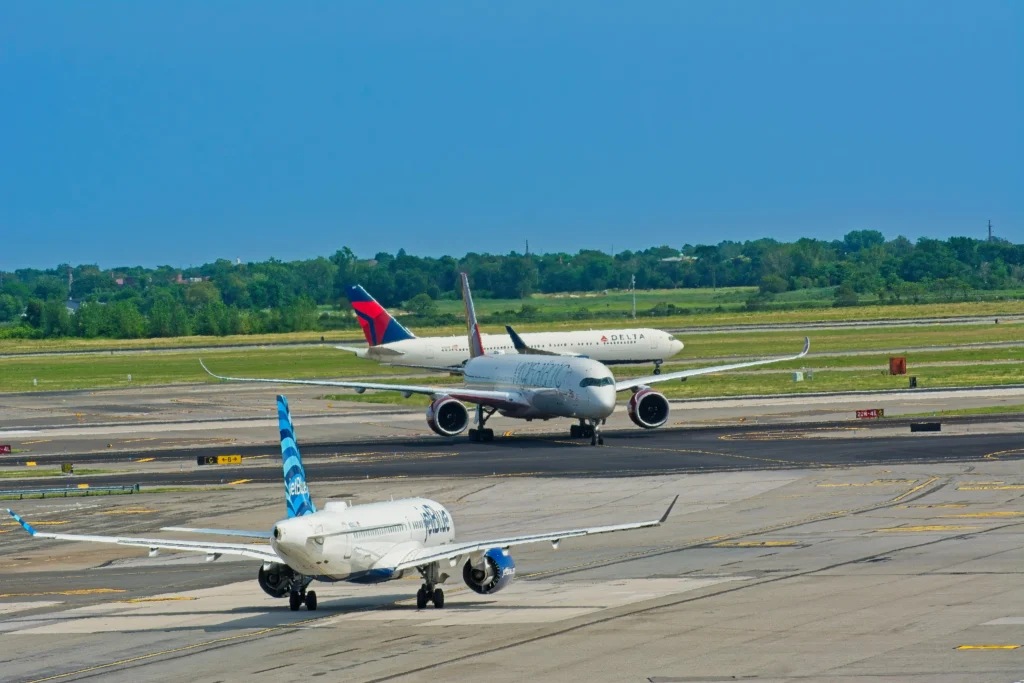
The Port Authority of New York and New Jersey alongside JFKIAT, the dedicated private management entity of Terminal 4 at John F. Kennedy International Airport, are officially celebrating twenty-five years of operations. As the first major airport terminal terminal in the United States to be developed, built, and managed under a non-airline public-private partnership, the facility stands as a blueprint for contemporary transport infrastructure. Since opening its doors at the dawn of the new millennium, this vital gateway has transitioned from a localized facility into a massive global transit hub, redefining passenger logistics and infrastructure funding.
To commemorate the quarter-century milestone, an anniversary reception was hosted at the historic TWA Hotel. The event brought together regional aviation leaders, transport administrators, and international airline representatives to look back on a multi-decade journey of infrastructural modernization. A curated historical film highlighted the structural progression of the building since May 2001, mapping out how the facility grew from an aging arrivals hall into an architectural anchor for the entire metropolitan area.
Strategic Growth and Unprecedented Passenger Capacity
The establishment of this groundbreaking collaborative framework in 2001 directly replaced the outdated International Arrivals Building at the airport. At its inception, the new management structure aimed to build an adaptable space capable of keeping pace with the rapid acceleration of international commercial travel. The success of this model is clearly illustrated by the terminal’s historic growth statistics over the past twenty-five years.
Under the guidance of the public-private partnership, the facility successfully expanded its operational capacity from handling 4 million travelers annually to serving more than 27 million passengers each year. Through targeted terminal expansions executed in 2013, 2015, and 2024, the physical footprint of the terminal was scaled up to encompass more than 2 million square feet. This extensive infrastructure optimization allows the gateway to support a highly diverse array of international airlines, cementing its reputation as the busiest individual terminal at the airport, managing a substantial percentage of the location’s total air traffic.
Sustainable Modernization and High-Tech Operations
Beyond sheer physical capacity, the management team has continuously integrated environmental benchmarks into their core operational strategy. The terminal secured a notable environmental milestone by earning LEED Gold and subsequently LEED Platinum certification for Existing Buildings: Operations and Maintenance from the U.S. Green Building Council. This designation establishes the facility as the only preexisting passenger air terminal in the nation to hold a LEED Platinum rating.
On the operational safety front, management introduced a state-of-the-art Security Operations Center in 2018. This facility utilizes predictive monitoring and advanced communications networks to streamline terminal operations and coordinate closely with federal security agencies. Transport administrators frequently reference the security setup as a model framework for modern terminal management throughout the domestic aviation ecosystem.
A Catalyst for the Broad Transformation of New York Infrastructure
The recent $1.5 billion modernization and terminal expansion project, executed in close coordination with Delta Air Lines, constitutes a vital building block of the Port Authority’s comprehensive $19 billion overhaul of the entire airport. This wider master plan includes the creation of two entirely new international terminals, the extensive modernization of existing facilities, and a streamlined airport roadway network.
The Port Authority’s strategic model relies heavily on using public funds to secure major private sector investments. Globally, the agency’s $3.9 billion public allocation for regional roadways and base airport infrastructure has successfully leveraged more than $15 billion in private terminal investments. This specialized funding method has already successfully delivered award-winning facilities across the metropolitan area, including the redevelopment of LaGuardia Airport, and the same structural approach is scheduled to guide upcoming redevelopment initiatives at Newark Liberty International Airport.
Looking Toward the Future of the Terminal Experience
Building on a twenty-five-year foundation of operational reliability, management has introduced its next strategic framework, known as the North Star program. This upcoming development phase is designed to thoroughly revamp the terminal’s commercial spaces, introduce hyper-localized dining concepts, and add high-end amenities for passengers. The program aims to harness the entrepreneurial spirit of the local community, utilizing creative partnerships to craft a unique sense of place that mirrors the diverse cultural fabric of Queens and the wider metropolitan region.
Furthermore, management maintains its long-standing focus on civic engagement via its local corporate social responsibility platform, known as 4GOOD. This ongoing community program invests directly in educational initiatives, economic developments, and community organizations located in the adjacent neighborhoods surrounding the airport, ensuring that global transportation growth yields measurable positive impacts for local residents and small businesses alike.
Frequently Asked Questions
What unique operational model was pioneered at this specific New York gateway terminal?
The facility pioneered the use of a non-airline public-private partnership for terminal operations in the United States. This structural approach allows an independent private operator to manage, construct, and upgrade terminal spaces in direct coordination with regional government port authorities.
How has the passenger capacity of the terminal evolved over the last quarter-century?
Through ongoing structural expansions, the terminal successfully boosted its passenger volume limits from an initial 4 million travelers per year up to its current operational capacity of more than 27 million international and domestic passengers annually.
What specific sustainability milestones has the terminal achieved?
The building achieved both LEED Gold and LEED Platinum certifications from the U.S. Green Building Council. These designations distinguish the facility as the single preexisting commercial air terminal in the United States to secure a LEED Platinum operational ranking.
How does this specific development project relate to the wider airport modernization initiatives?
The recent $1.5 billion terminal upgrade serves as a core component of the overarching $19 billion transformation plan designed to simplify airport road systems, build new flight concourses, and deliver a modern international travel experience.
For more travel news like this, keep reading Global Travel Wire