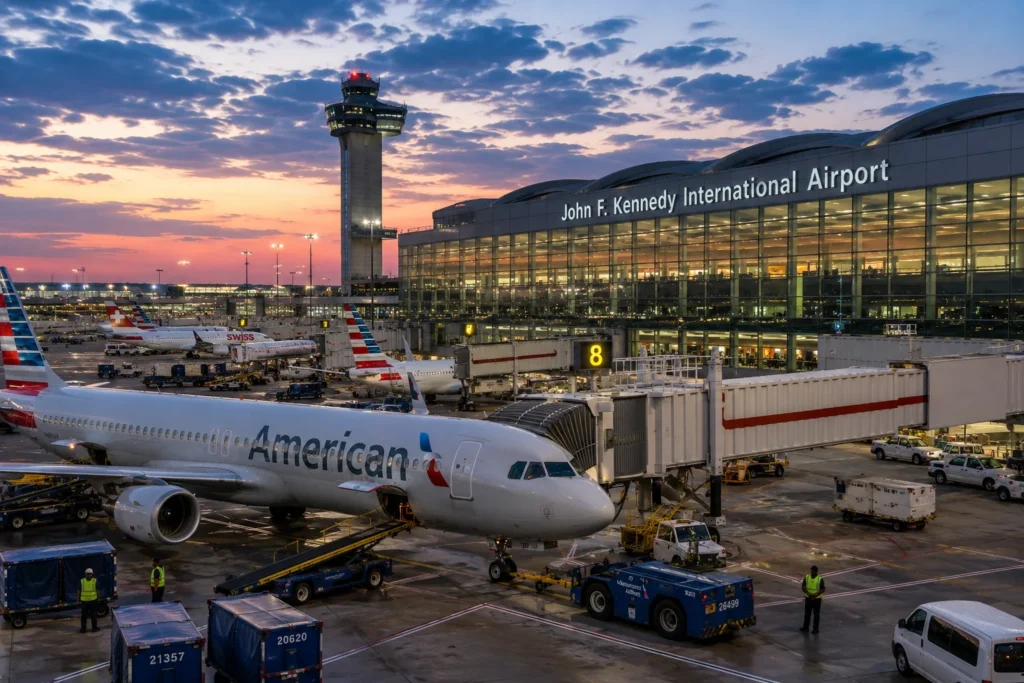
The operational integrity of transoceanic flight corridors is facing renewed engineering and regulatory analysis following a definitive fuel management notification involving an international widebody arrival at John F. Kennedy International Airport (JFK) in New York. Federal tracking logs and civil air traffic control records indicate that an EL AL Israel Airlines Boeing 777-200ER, arriving from Tel Aviv Ben Gurion Airport (TLV), initiated a late-stage “minimum fuel” declaration during its final approach sequence. The event has put a spotlight on the tight margins that dictate international flight networks when long-range operations collide with high-density airport terminal congestion.
A review of public aviation safety data reveals the hidden operational pressures that pilots and air traffic controllers navigate daily. As modern hub congestion forces heavy aircraft into prolonged tracking patterns, understanding the exact terminology, regulatory thresholds, and flight dynamics is paramount to preserving the unblemished record of global commercial flight operations.
The Chronology of Flight LY19 and the Atlantic Airspace Corridor
On May 20, 2026, Flight LY19 operated its scheduled international route connecting Tel Aviv to New York, an itinerary that typically requires an average block time of 11 to 11.5 hours depending on North Atlantic jet stream vectors. On this specific operational date, the aircraft, registered under tail number 4X-ECF, encountered extensive airspace flow controls upon nearing the United States Eastern Seaboard.
To systematically manage the high volume of transatlantic arrivals converging on the New York metropolitan area, the Federal Aviation Administration (FAA) utilized standard offshore holding points. Consequently, the Boeing 777 was instructed to enter a continuous holding pattern over Rhode Island, where it remained for more than 30 minutes. This extended routing extended the total flight time to approximately 12.5 hours, burning into the aircraft’s contingency fuel reserves before it received final clearance to descend toward the New York tracking gateway.
The Runway 31R Final Approach and Air Traffic Phraseology
The primary core of the post-flight safety analysis centers on the communication exchange between the flight crew and JFK Terminal Radar Approach Control (TRACON) during the final segments of the Instrument Landing System (ILS) approach to Runway 31R.
The structural events unfolded as follows:
Speed Management Directives: Due to tight landing sequences, controllers instructed the arriving widebody to maintain standard approach speeds of 170 knots, subsequently reducing to 160 knots, to ensure legal separation from preceding aircraft.
The Telemetry Status Statement: As the aircraft reached a point approximately eight miles from the runway threshold, the flight crew formally communicated a “minimum fuel” status, explicitly advising the control tower that the flight could not mathematically accept a standard “go-around” or missed approach instruction.
Immediate Sequence Priority: Recognizing the operational constraints communicated by the pilot-in-command, air traffic control prioritized the aircraft’s final path, ensuring an un-interrupted landing. The aircraft touched down safely at approximately 9:20 PM local time with zero injuries or structural damage reported.
Legal Definitions: Minimum Fuel vs. Fuel Emergency
The incident highlights a critical point regarding international aviation safety protocols: the distinct legal difference between a “minimum fuel” declaration and a “fuel emergency” under FAA and International Civil Aviation Organization (ICAO) regulations.
According to official air traffic control management directives, a declaration of “minimum fuel” serves strictly as an informational advisory. It alerts controllers that the aircraft’s fuel supply has reached a point where it cannot accept any further undue delays or routing extensions. Crucially, a minimum fuel advisory does not imply an immediate crisis, nor does it automatically grant the aircraft absolute tactical priority over other traffic in the sequencing line.
Conversely, if an aircraft’s calculated fuel reserves drop to a critical level where a successful landing depends on receiving immediate priority routing, the pilot-in-command is legally mandated to declare a formal “fuel emergency.” This action triggers mandatory priority handling, clears adjacent airspaces, and requires the filing of a formal post-flight investigative report to the national civil aviation authority. Because the flight crew indicated an inability to execute a missed approach—a constraint functionally equivalent to an emergency status—while utilizing the lower-tier minimum fuel advisory, regulatory bodies are reviewing communication timelines to prevent ambiguity in congested terminal areas.
Strategic Infrastructure Safeguards for Long-Haul International Travelers
For global tourists and corporate travelers navigating transoceanic networks, this incident underscores the importance of build-in operational buffers within personal travel schedules. Modern airspace management systems are highly resilient, yet the realities of weather, peak scheduling blocks, and oceanic routing deviations require strategic planning.
Aviation safety experts recommend that international passengers booking connecting flights through major global megahubs like JFK, Chicago O’Hare, or London Heathrow allocate a minimum of three hours between flights. This ensures adequate time to clear customs, recheck baggage, and absorb unexpected holding patterns without risking a missed connection. As civil aviation infrastructure undergoes continuous modernization, the meticulous enforcement of standardized phraseology remains the most effective tool for maintaining passenger safety across global networks.
For more travel news like this, keep reading Global Travel Wire