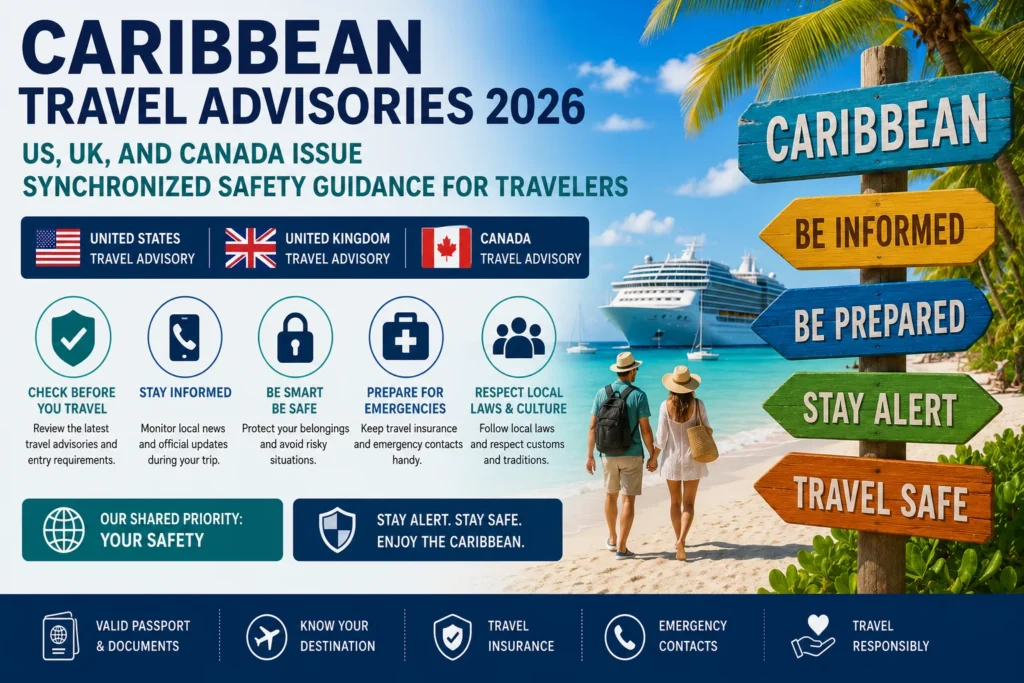
International travelers planning tropical holidays or cruise itineraries are being urged to review their safety plans following a coordinated update to regional travel guidance. The governments of the United States, the United Kingdom, and Canada have simultaneously revised their security profiles for several popular island destinations. The updated Caribbean travel advisories 2026 apply specifically to Turks and Caicos, Jamaica, the Bahamas, the Dominican Republic, and Grenada. The announcements place a significant emphasis on managing personal security risks during a period of high-volume seasonal leisure transit.
Public safety authorities state that these operational adjustments are not designed to discourage travel to the region. Instead, they serve as official safety guidance to increase awareness among international holidaymakers, independent explorers, and cruise passengers who may venture beyond the secured perimeters of private resorts or corporate tour networks.
Critical Safety Assessment by Major Destination
The revised government notifications detail varying risk parameters based on regional infrastructure and local security conditions. While property crimes and opportunistic thefts remain the primary drivers behind the synchronized updates, certain areas require more specific behavioral precautions.
Turks and Caicos Islands
Despite maintaining its reputation as an ultra-luxury vacation sanctuary renowned for Grace Bay Beach, the territory remains under a targeted Level 2 caution. Official consular reports emphasize a steady increase in localized thefts, burglaries, and targeted robberies. Authorities are strongly advising visitors to avoid unlit or isolated coastal areas after dark and to rely exclusively on reputable, pre-arranged transport providers. Furthermore, border enforcement agencies remind travelers to inspect all personal luggage thoroughly before departure due to the strict domestic prosecution of unauthorized possession of hunting ammunition or stray casings.
Jamaica
Security updates for this major leisure market remain focused on distinct urban sectors and community-specific hot spots. While primary resort zones in Montego Bay, Ocho Rios, and Negril continue to manage high guest volumes safely under heavy private security, foreign ministries advise against entering unfamiliar inner-city residential neighborhoods. Travelers are strictly urged to bypass public bus transit networks entirely and secure ground transportation solely through entities authorized by the national tourism board.
The Bahamas
As one of the world’s most heavily trafficipated cruise corridors, the archipelago faces heightened urban security monitoring. The updated advisories draw attention to persistent petty crime and localized armed robberies in dense municipal areas of Nassau and Freeport. Cruise line passengers are directed to stay alert in high-density shopping plazas, avoid carrying large quantities of physical cash, and adhere closely to the structured safety paths mapped out by shipboard excursion teams.
Dominican Republic
The advisory framework for this high-density, all-inclusive resort destination centers on opportunistic theft, credit card skimming, and financial scams. Consular alerts advise travelers to exercise vigilance when withdrawing funds from automated teller machines and to avoid hailing unregistered street taxis, recommending app-based tracking platforms or hotel-vetted vehicle services instead.
Grenada
As an emerging hub for specialized eco-tourism and independent nature excursions, the security guidance for Grenada remains pre-emptive. The public safety updates focus on standard situational awareness, reminding self-guided hikers and solo travelers to secure local, registered guides when exploring remote rainforest trails or isolated beach coves.
Comprehensive Regional Safety Risk Matrix
The operational details of the updated global travel safety parameters can be understood through the following structural overview:
| Destination | Primary Traveler Concern | Tourism Significance | Core Visitor Advice |
| Turks and Caicos | Property crime and strict weapons laws | Luxury resorts and premium villa rentals | Avoid unlit areas after dark; check luggage |
| Jamaica | Specific urban neighborhood crime | Major regional leisure market | Utilize authorized transport; stay in resort zones |
| Bahamas | Municipal pickpocketing and robbery | Leading international cruise destination | Follow cruise line directives; limit cash |
| Dominican Republic | Opportunistic theft and financial scams | Massive all-inclusive hotel market | Use hotel-vetted taxis; protect valuables |
| Grenada | Independent exploration awareness | Emerging nature and cruise terminal hub | Use local registered guides for remote trails |
Aviation Network Performance and Transit Logistics
Despite the implementation of these extensive safety notifications, commercial flight networks linking North America and Western Europe to the Caribbean basin continue to demonstrate absolute operational resilience. High-capacity commercial airlines maintain their standard timetables, providing stable transport capacity for thousands of vacationers weekly.
Major network operators sustaining these critical aviation corridors include:
American Airlines: Providing the highest volume of daily non-stop connections between primary mainland hubs and regional Caribbean airports.
Delta Air Lines: Maintaining vital seasonal leisure frequencies connecting the upper Midwest and East Coast markets directly to tropical hubs.
JetBlue Airways: Sustaining an extensive holiday network that serves budget-conscious and premium leisure travelers alike.
United Airlines: Offering major transit corridors for West Coast and central North American passengers connecting through secondary hubs.
Air Canada: Delivering essential seasonal flight capacity designed to accommodate high-volume winter and spring holiday flight demands.
Shift Toward Awareness-Based Travel Practices
The simultaneous alignment of these federal advisories highlights an evolving trend within the international hospitality market, specifically addressing the balance between private resort bubbles and surrounding municipal realities. For major aviation stakeholders and international cruise line syndicates, the preservation of destination reputation remains the absolute foundation of consumer demand. When multiple governments update security alerts concurrently, it creates a notable psychological impact on the independent traveler segment.
This structural shift demonstrates that the modern tourism industry is transitioning away from an avoidance-based model toward an awareness-based framework. In this environment, the responsibilities placed on travel operators increase significantly. Travel agencies and tour providers are required to provide transparent, real-time safety updates to their clients to preserve guest confidence and protect operational stability.
Moving forward, cruise lines are anticipated to implement stricter shore excursion parameters, potentially reducing independent wandering windows in high-traffic ports. For the traditional aviation and all-inclusive resort sectors, demand is projected to remain fundamentally stable due to the self-contained design of modern holiday packages. However, public safety departments remind all international passengers that verifying active travel notices through official government portals right before departure is an indispensable component of modern travel planning.
For more travel news like this, keep reading Global Travel Wire