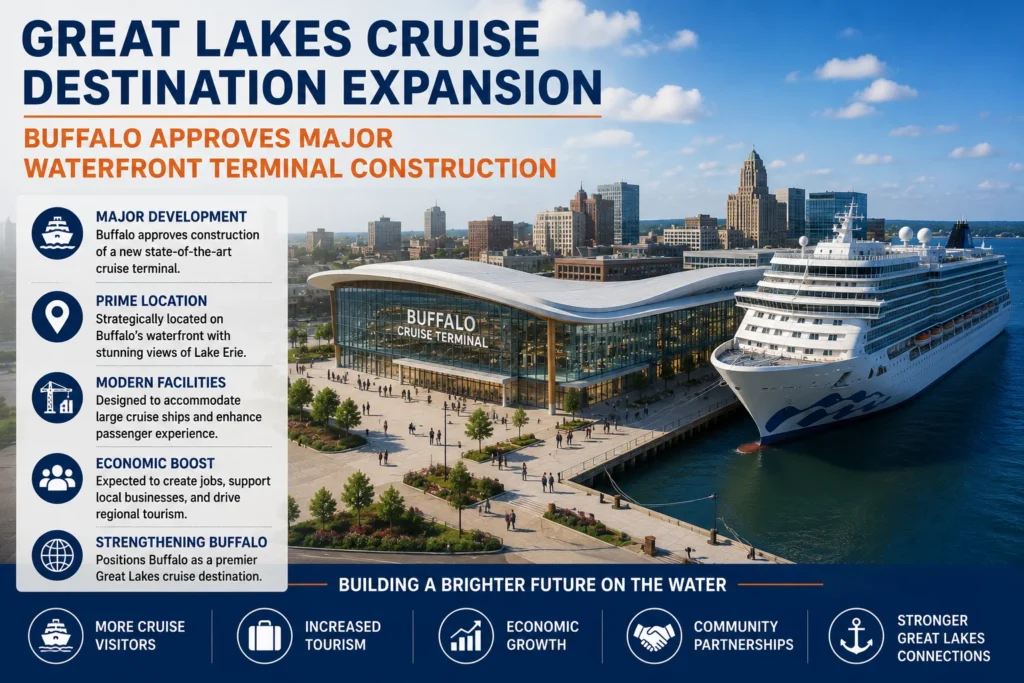
The maritime travel landscape of Western New York is set for a massive transformation following a definitive developmental decision by state and local planners. The Erie Canal Harbor Development Corporation (ECHDC) board of directors officially met and authorized a critical phase 1 contract with Union Concrete and Construction Corporation to begin structural development on the highly anticipated Buffalo Cruise Terminal. Strategically located at the Outer Harbor’s Slip 2 parcel on Fuhrmann Boulevard, this capital improvement initiative targets a long-vacant waterfront site that formerly housed the Pier Restaurant before its removal in 2007.
The approved construction agreement is capped at an amount not to exceed $13.4 million. Site clearing, mobilization, and major earthworks are officially scheduled to commence next month, establishing the initial framework for a grand opening slated in time for the 2028 passenger travel season. This major logistical step immediately follows public design presentations unveiled by state executive leadership, which showcased modern rendering visions of the terminal as a primary international and domestic maritime gateway.
Initial Engineering Phases and Seawall Restoration
The strategic development at Slip 2 is organized across two distinct phases to ensure strict adherence to marine engineering standards and local environmental regulations. The phase 1 allocation focuses extensively on foundational sub-surface and heavy edge improvements along the immediate harbor line. Specialized engineering blueprints call for the extensive rehabilitation of more than 950 feet of concrete seawall to anchor heavy commercial hulls safely.
Contractual tasks under this initial agreement involve the integration of heavy-duty mooring bollards, pneumatic marine fenders, and safety guardrails to accommodate changing water metrics. The first stage also includes comprehensive site remediation, utility infrastructure routing, and low-voltage lighting installations. As these structural waterfront updates hit specific benchmarks, passenger vessels will be permitted to systematically access the site for scheduled dockings while subsequent features advance.
Upland terminal facilities and immediate guest infrastructure will be managed via a separate, subsequent phase 2 bidding process. The second phase focuses on erecting a dedicated terminal building that will feature modernized public restrooms and a fully integrated customs screening center operated in alignment with U.S. Customs and Border Protection specifications.
Commercial Long-Term Operations and Cruise Carrier Integration
Demonstrating immediate economic viability for the developing infrastructure, the ECHDC board concurrently authorized a 20-year revocable license agreement with American Cruise Lines Incorporated. The strategic contract outlines non-exclusive operational rights, allowing the carrier to manage orderly passenger boarding, vessel off-boarding, and necessary dockside resupply logistics directly at the Slip 2 facility. The financial structure includes an initial upfront payment of $25,000 paired with monthly user fees calculated on passenger density and physical vessel dock-time.
Because the operating agreement remains non-exclusive, regional economic authorities retain the explicit legal right to secure future docking contracts with additional global cruise operators. This multi-ship utility approach ensures maximum flexibility for the port as consumer demand increases across the Great Lakes system.
The state first launched programmatic steps to capture this market sector, recognizing that passenger liners frequently traversed the waterways between Toronto and Cleveland while bypassing the Buffalo riverfront entirely. A subsequent market demand analysis completed by the ECHDC detailed the long-term feasibility of capturing these existing regional routes. The positive conclusions of the review led directly to successful negotiations with prominent Great Lakes cruise lines, yielding multiple firm itinerary commitment letters ahead of the terminal’s construction launch.
Regional Economic Projections and Public Waterfront Spaces
The creation of the terminal positions the city to tap into a rapidly growing domestic travel trend. The broader Great Lakes cruise sector has experienced significant post-pandemic acceleration, with aggregate regional passenger numbers rising from 9,000 travelers in 2010 to more than 25,000 recorded passengers annually. By participating in this growth alongside established regional port hubs like Milwaukee, Detroit, and Duluth, Buffalo effectively utilizes its geographic placement at the southern entry of the Welland Canal to welcome incoming intercontinental vessels.
Public planners emphasize that the terminal is designed to integrate cleanly with nearby recreational parks and pedestrian infrastructure. The outer perimeter of the site will feature an expansive multi-use recreational path, an illuminated waterfront promenade, and a designated sunset viewing point with custom public seating installations.
To preserve architectural cohesion along the Outer Harbor corridor, the visual design elements of the upcoming terminal will directly reflect the landscaping models used at nearby ECHDC spaces, including Wilkeson Pointe and the Bell Slip. This design approach ensures that when passenger vessels are not docked at the terminal, local residents and regional visitors can continue to enjoy uninterrupted access to the scenic walkways, recreational lanes, and open park spaces that characterize the revitalized industrial waterfront.
For more travel news like this, keep reading Global Travel Wire