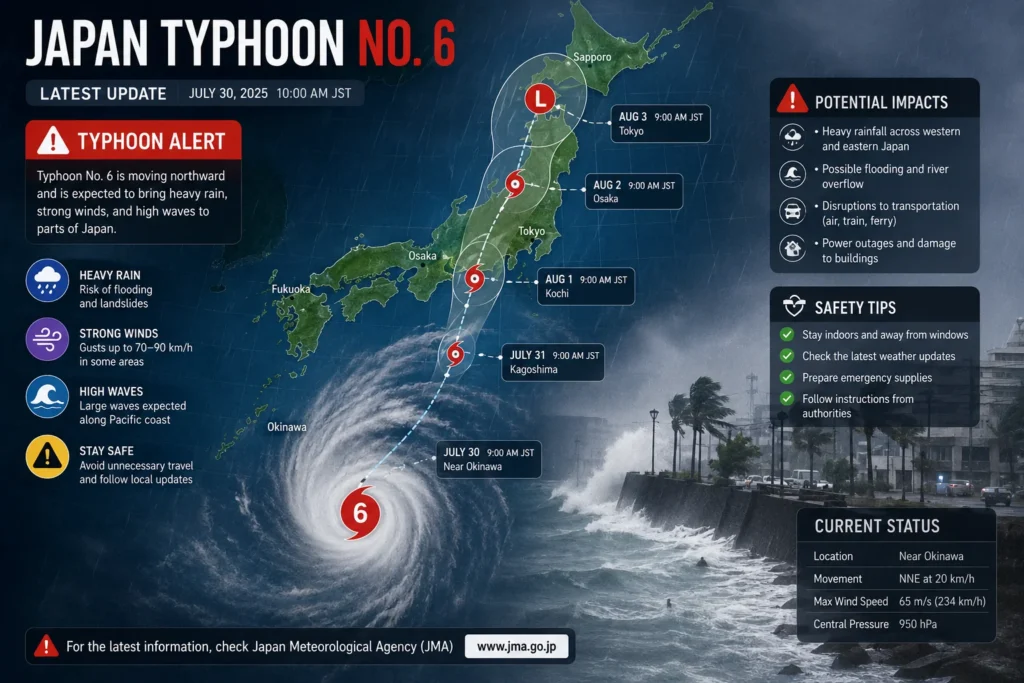
The Japan Meteorological Agency (JMA) and national transport ministries have issued comprehensive safety updates following the landfall of Typhoon No. 6. The significant tropical weather system, which made landfall in the southern region of Wakayama Prefecture early on June 3, 2026, has crossed the main island of Honshu and moved eastward over waters south of Chiba Prefecture. While meteorologists project the system will be downgraded to an extratropical cyclone by June 4, the localized storm has generated substantial transit bottlenecks, infrastructure constraints, and preventative emergency protocols across major international tourism corridors.
For global visitors navigating the Tokyo metropolitan area and surrounding cultural destinations, understanding the status of national rail operations and municipal hazard classifications remains critical for itinerary management.
Official Disaster Prevention and Regional Safety Warnings
The Fire and Disaster Management Agency (FDMA) reported that as of mid-afternoon on June 3, the storm system accounted for 23 documented minor injuries across six prefectures, including Okinawa, Kagoshima, Miyazaki, Tokushima, Nara, and Aichi. Structural impacts were maintained at a relatively low scale, with minor structural damage recorded at dozens of residential dwellings nationwide.
In response to concentrated precipitation bands, municipal authorities executed structured safety measures under the state’s five-tier emergency warning system. The JMA temporarily declared a Level 5 special warning for flooding—the highest achievable threat index—for the Kozagawa River in Wakayama Prefecture during the morning hours, which was swiftly adjusted to an advisory status as river levels receded.
Concurrently, local governments issued Level 4 evacuation orders for approximately 1.52 million individuals across Tokyo, Kanagawa, and Chiba prefectures to mitigate risks associated with linear precipitation bands. Within the Tokyo metropolitan area, flood warnings were specifically directed toward neighborhoods adjacent to the Zenpukuji, Nogawa, Senkawa, Meguro, and Kanda rivers, while landslide advisories temporarily affected sectors of Shinagawa and Ota wards. By late afternoon, the JMA confirmed that all primary Level 4 severe hazard warnings across the Kanto, Tokai, and Kinki tourist corridors had been successfully lifted as the storm core advanced out to sea.
Widespread Ground Transportation and Shinkansen Delays
The East Japan Railway Company (JR East) instituted systemic operational adjustments from the initial scheduled departures on June 3 to safeguard travelers and prevent track infrastructure failures. The preventative suspensions have heavily modified local transit times throughout the greater Kanto area.
Ground transport disruptions across key scenic and regional transit lines include:
Shonan-Shinjuku Line: Full service suspension on routes connecting Omiya and Odawara stations, as well as segments between Ikebukuro and Zushi stations.
Tokaido Line: Operations halted entirely on the heavy-volume line between Odawara and Atami stations.
Sobu Line: Complete suspension of rail activity between Sakura and Choshi stations for the calendar day.
Chuo and Ome Lines: Partial evening suspensions on the Ome Line between Ome and Okutama, with delayed resumes on the Chuo Line stretching between Takao and Fujimi.
To preserve passenger safety along major tourist paths, JR East also suspended specialized premium limited express fleets. This includes the cancellation of all routes bound for the popular hot-spring resorts of the Izu Peninsula in Shizuoka Prefecture, such as the Odoriko and Saphir Odoriko express trains. Similar cancellations impacted the Wakashio and Sazanami lines serving the coastal Boso area of Chiba Prefecture.
Crucially for overseas arrivals, the Narita Express network, which serves as a vital artery connecting Narita International Airport to central Tokyo, experienced widespread cancellations through the evening hours. While Central Japan Railway Company confirmed that high-speed bullet trains on the Tokaido Shinkansen line continued to maintain active operations, officials cautioned that localized rainfall totals could prompt short-notice emergency cancellations.
International and Domestic Aviation Adjustments
Air travel infrastructure within the greater Tokyo region faced major scheduling realignments as commercial airlines minimized ground risk at major hubs. The severe weather patterns necessitated the cancellation of hundreds of scheduled flights routing through Tokyo International Airport (Haneda) and Narita International Airport.
According to official fleet dispatch releases, All Nippon Airways cancelled 232 domestic routes alongside 55 international departures and arrivals. Japan Airlines executed parallel safety measures, cancelling 292 domestic flights and 37 international operations. The combined scheduling changes affected tens of thousands of passengers, creating processing queues across terminal customer service counters.
| Transport Sector | Official Operator Updates | Passenger Guidance & Status |
| Aviation Hubs | Haneda and Narita Airports | Hundreds of domestic/international flights cancelled; passengers must verify rebooking windows. |
| High-Speed Rail | Tokaido Shinkansen Line | Active operations maintained with explicit warnings of potential short-notice suspensions. |
| Airport Express Rail | Narita Express Network | Widespread service suspensions implemented through evening hours. |
| Limited Express Rail | Izu & Boso Leisure Lines | Total suspension of Odoriko and Wakashio fleets for the duration of the weather event. |
Practical Planning Protocols for Tourism Security
The Tokyo Metropolitan Government and national tourism bureaus advise international vacationers to remain observant of localized atmospheric shifts. Because current 24-hour rainfall projections indicate up to 120 millimeters of additional precipitation across the Kanto-Koshin and Tohoku regions through June 4, minor delays may persist across secondary transit lines as maintenance crews inspect tracks for debris.
Tourists currently positioned in Tokyo are encouraged to verify real-time transport updates via official smartphone applications provided by JR East and Tokyo Metro. In the event of localized municipal alerts, visitors should follow the guidance of hotel safety wardens or public transit officials. Ensuring flexible booking choices, confirming international airline status before departing for regional airports, and maintaining access to standard municipal emergency channels remain the most effective methods for ensuring personal safety during seasonal sub-tropical storms.
For more travel news like this, keep reading Global Travel Wire