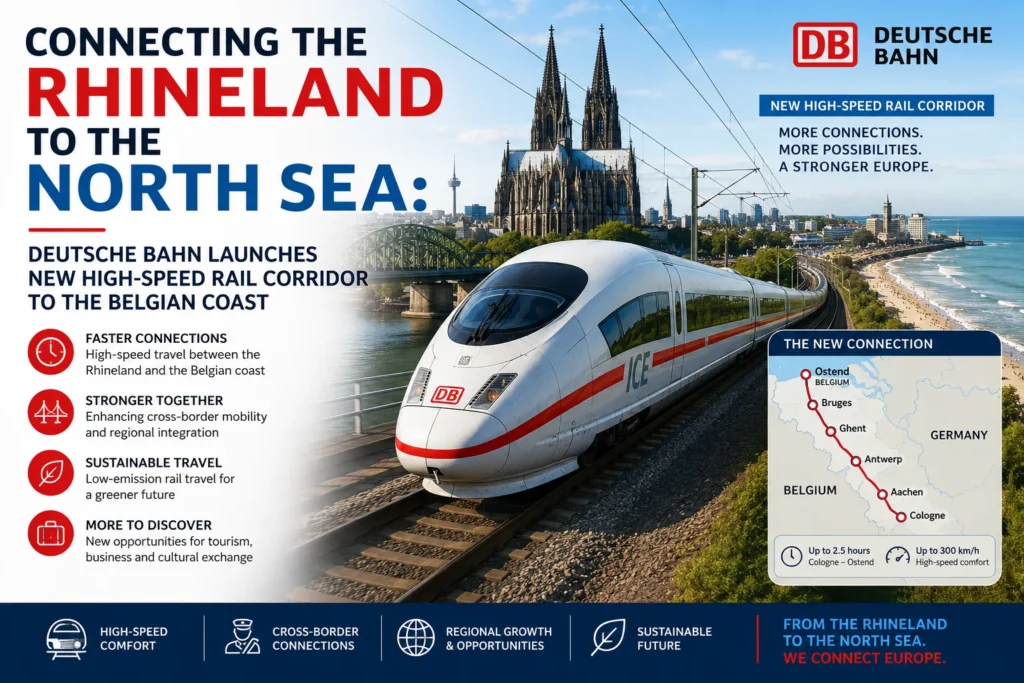
The international tourism sector is entering a definitive era of low-carbon regional mobility. As modern vacationers increasingly prioritize environmentally accountable transport networks, state rail providers across Western Europe are aggressively expanding their cross-border networks to deliver high-capacity alternatives to regional aviation and private vehicles. In a major structural development for European leisure corridors, the German state railway operator, Deutsche Bahn, has officially inaugurated a direct Intercity Express service linking the major transit hub of Cologne with the prominent North Sea resort town of Ostend, Belgium.
This strategic expansion represents the ninth daily train pair operating between the two neighboring nations, representing an ongoing commercial push to meet unprecedented traveler demand. Official data compiled by transport ministries reveals that cross-border passenger volumes on express lines running between Germany and Belgium surged by approximately 18 percent between 2019 and 2025. This sustained upward trajectory prompted the German state operator to widen its service footprint and solidify an institutional cooperation agreement with the National Railway Company of Belgium.
Christening the Fleet Flagship at Cologne Central Station
To mark the launch of this high-speed maritime corridor, a formal naming ceremony was executed at Cologne Central Station, a transit hub that coordinates more than 1,300 daily train arrivals and serves over 318,000 transit passengers every single day. One of the network’s newest long-distance trainsets was officially christened as the “Köln” using traditional water sourced directly from the River Rhine, establishing the state-of-the-art vehicle as a moving regional ambassador across German, Belgian, and Dutch rail lines.
The rollout relies entirely on the deployment of the advanced Intercity Express 3neo fleet architecture. Developed to sustain reliable, ultra-high-speed operations across diverse European electrical and signaling systems, these specialized trainsets represent the premium tier of modern long-distance travel. The rolling stock is highly regarded for its enhanced passenger comfort upgrades, including:
Advanced Digital Signal Optimization: The train cars are manufactured with specialized window panes completely permeable to mobile radio waves, ensuring continuous, high-speed digital connectivity for travelers.
Expanded Micro-Mobility Spaces: The interior configurations feature newly engineered, spacious luggage racks alongside dedicated onboard storage bays to seamlessly accommodate bicycles and bulky outdoor leisure equipment.
Ergonomic Accessibility Design: Low-floor passenger boarding structures and modern digital information monitors provide a highly inclusive, world-class travel environment for multi-generational vacationers.
Optimizing Summer Timetables for Weekend Coastal Tourism
The administrative layout of the newly introduced corridor is precision-engineered to appeal directly to weekend staycationers and regional beach tourists from the populous state of North Rhine-Westphalia. The seasonal direct route operates on a strict weekend schedule, minimizing weekday commuter conflicts while maximizing leisure time at the coastal destination.
The inbound morning train departs Cologne Central Station on Saturdays and Sundays at 10:08 a.m., moving efficiently through the scenic European countryside before pulling into the coastal terminal at Ostend at 1:47 p.m. To ensure that day-trippers and weekend travelers can experience a full, relaxed itinerary at the seaside, the return service is scheduled to leave Ostend at 2:24 p.m., arriving back at the Cologne hub at 5:50 p.m.
This express timeline bypasses the traditional bottleneck of forcing passengers to navigate complex train connections or platform transfers in Brussels. Instead, the route maintains standard intermediate operational stops at vital cultural and economic network hubs, including Aachen, Liège, Leuven, Brussels North, Brussels Midi, Ghent, and the historic medieval tourism center of Bruges.
Driving Tourism Growth Along the Belgian Coastline
The initiation of this direct rail connection is being heavily celebrated by national tourism bureaus, which track substantial visitor metrics from central Germany. Regional tourism statistics from Flanders illustrate that German travelers consistently represent the single largest international demographic visiting the Belgian North Sea coast, contributing to roughly 700,000 recorded overnight stays annually. Furthermore, data collected during recent spring holiday intervals showed that German tourists accounted for a massive 16 percent of the total regional visitor influx.
Municipal leadership in Ostend emphasized that the presence of a direct, high-speed rail link provides a critical economic tool to alleviate seasonal parking shortages and reduce highway infrastructure wear during peak holiday months. By lowering the entry barrier for inland travelers, the city expects to see a sustained increase in sustainable weekend visitation, directly supporting local maritime hospitality, maritime museum sectors, and regional culinary seafood markets.
Unlocking Future Corridors for the European Transit Network
The seasonal high-speed route to Ostend serves as the opening phase of a wider, multi-year international rail expansion strategy. State ticketing platforms have already opened advanced booking channels for an additional direct international link connecting Cologne directly to the major commercial port city of Antwerp.
Scheduled to commence operations on September 7, 2026, the upcoming Antwerp line will operate two comprehensive round-trip train pairs daily. Moving via the established regional network of Aachen, Liège, Leuven, and Brussels Airport, this secondary corridor ensures that the transcontinental rail network will continue to provide seamless, low-carbon connectivity across the primary travel gateways of Western Europe.
For more travel news like this, keep reading Global Travel Wire