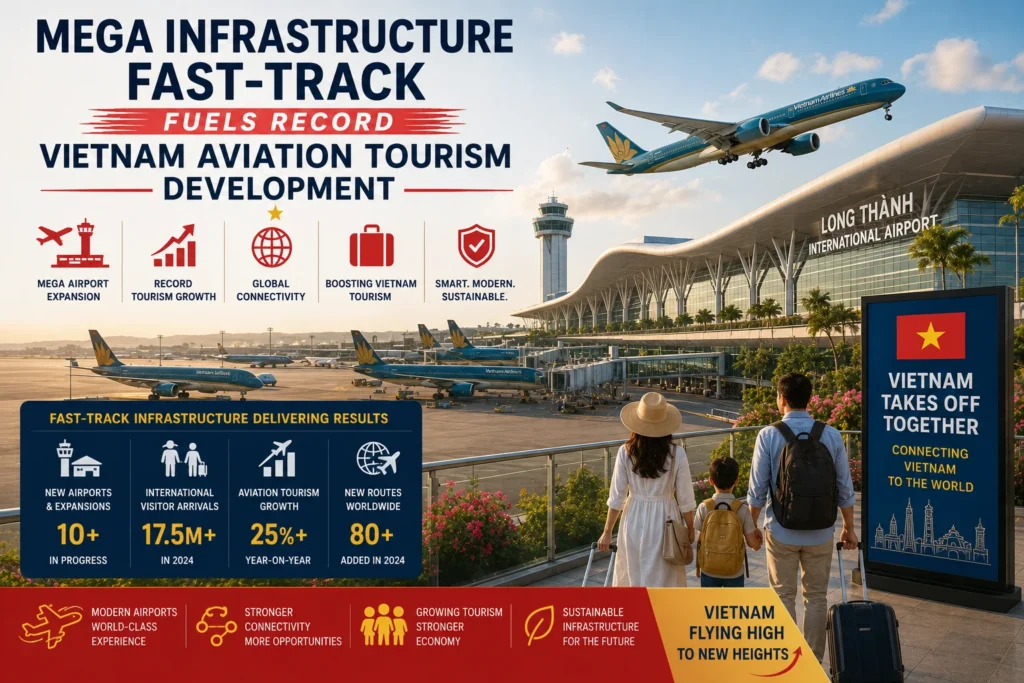
The southern economic locomotive of Vietnam is entering a transformative infrastructure phase, paving the way for an unprecedented expansion in regional travel capacity. In official public releases from the Office of the Party Central Committee, federal authorities have confirmed a comprehensive review of major national transport requests submitted by Dong Nai City. The municipal leadership is formally urging the immediate allocation of national resources to fast-track two key mega-projects: Phase 2 of the Long Thanh International Airport Project and the construction of the high-speed Bien Hoa–Vung Tau Railway.
This dual-pronged infrastructure strategy is designed to accelerate the birth of an aviation-centered economic ecosystem in southern Vietnam. According to master plan announcements from the Ministry of Construction, connecting high-speed rail lines directly with a high-capacity global air gateway will structurally maximize visitor distribution, establish fluid logistics corridors, and drastically strengthen regional connectivity between Dong Nai, Ho Chi Minh City, and surrounding coastal travel destinations.
Expanding Passenger Capacities Ahead of Global Traffic Surges
Under the Prime Minister’s approved master layout, Long Thanh International Airport is slated to become Vietnam’s largest aviation hub upon final completion. The mega-facility is designed to process an ultimate annual capacity of one hundred million passenger arrivals and five million tons of air cargo. The landmark project is moving forward in distinct development segments, with Phase 1 officially tracking to launch full commercial flight operations by the final quarter of 2026.
While original long-term targets envisioned the development of Phase 2 between 2028 and 2032, official proposals from the Airports Corporation of Vietnam (ACV) highlight an urgent need to transition directly into the subsequent phase without an operational gap. Phase 1 features a passenger terminal designed to handle twenty-five million passenger arrivals and departures annually.
However, corporate aviation forecasts indicate that international traveler traffic alone will reach twenty million arrivals and departures almost immediately upon opening. With Vietnam targeting sustained double-digit gross domestic product growth, airport demand across the southern economic region is climbing far more rapidly than historical models predicted, making immediate expansion critical to preventing severe bottlenecks.
Capitalizing on Active Industrial Workforces for Faster Delivery
In a formal submission to the 15th National Assembly during its 10th legislative session, the Government proposed critical strategic amendments to streamline the approval pipeline. The executive request seeks authorization to approve the feasibility study for Phase 2 directly, bypassing traditional multi-tier legislative delays.
Furthermore, the state’s submission notes that constructing the airport’s third major runway immediately after Phase 1 yields immense fiscal and operational advantages. By initiating construction consecutively, engineering contractors can seamlessly utilize the massive specialized labor forces, heavy machinery, and technical staging areas already mobilized on site. This direct continuity shortens construction timelines, significantly increases public investment efficiency, and effectively minimizes environmental disruptions—such as localized dust plumes and heavy equipment noise—for passengers utilizing the newly opened Phase 1 terminal.
Upon formal approval, Phase 2 will introduce an additional high-capacity passenger terminal capable of processing another twenty-five million travelers per year, accompanied by a state-of-the-art third runway and fully synchronized ground handling facilities.
The Bien Hoa–Vung Tau Railway: A High-Speed Tourism Arterial
To prevent localized road congestion and unlock regional coastal tourism hubs, the state is tightly integrating the national rail network with air terminal arrival infrastructure. The proposed Bien Hoa–Vung Tau Railway Line is a core priority within the national railway network development plan, establishing a direct transport corridor from inland hubs to southern maritime boundaries.
The planned railway line will stretch approximately one hundred and thirty-two kilometers through the southern landscape. The route originates at Trang Bom Station in Dong Nai City and extends down to its final terminus at Vung Tau Station, establishing a streamlined transit link with the Ho Chi Minh City metropolitan area. To maximize land-use efficiency and reduce land clearance timelines, the railway track will share a designated safety corridor with the concurrently developing Bien Hoa–Vung Tau Expressway.
According to technical specifications released by the Railway Project Management Board, the standard-gauge track will accommodate advanced rolling stock operating at distinct service speeds. Dedicated passenger trainsets will fly along the corridor at speeds of up to one hundred and sixty kilometers per hour, allowing arriving international vacationers to clear airport customs and reach southern coastal resorts in a fraction of traditional highway transit times. Simultaneously, specialized freight trains will move at one hundred and twenty kilometers per hour, linking the airport’s cargo terminals directly with the Cai Mep–Thi Vai deep-water port complex.
Institutional Backing and Next Operational Steps
The push for rapid mobilization received significant political support during a high-level working session led by Party General Secretary and State President To Lam. City leaders formally demonstrated that prioritizing federal funds for these interconnected networks is the most effective method to ensure the long-term economic returns of the initial airport investments.
Following the state session, official Conclusion No. 69 from the Office of the Party Central Committee instructed relevant ministries to immediately address the resource allocation requests. The Ministry of Construction has formally delegated final investment preparations for the airport terminal expansion to the ACV, while the Railway Project Management Board is aggressively finalizing the pre-feasibility study report for the rail link.
By systematically aligning mega-aviation terminals with high-speed passenger rail networks, Vietnam’s public planning bodies are successfully future-proofing the country’s transport network. This coordinated infrastructure push ensures that the ongoing story of Vietnam aviation tourism development continues to accelerate, offering international holidaymakers an ultra-modern, efficient, and deeply connected entry gateway into Southeast Asia.
For more travel news like this, keep reading Global Travel Wire