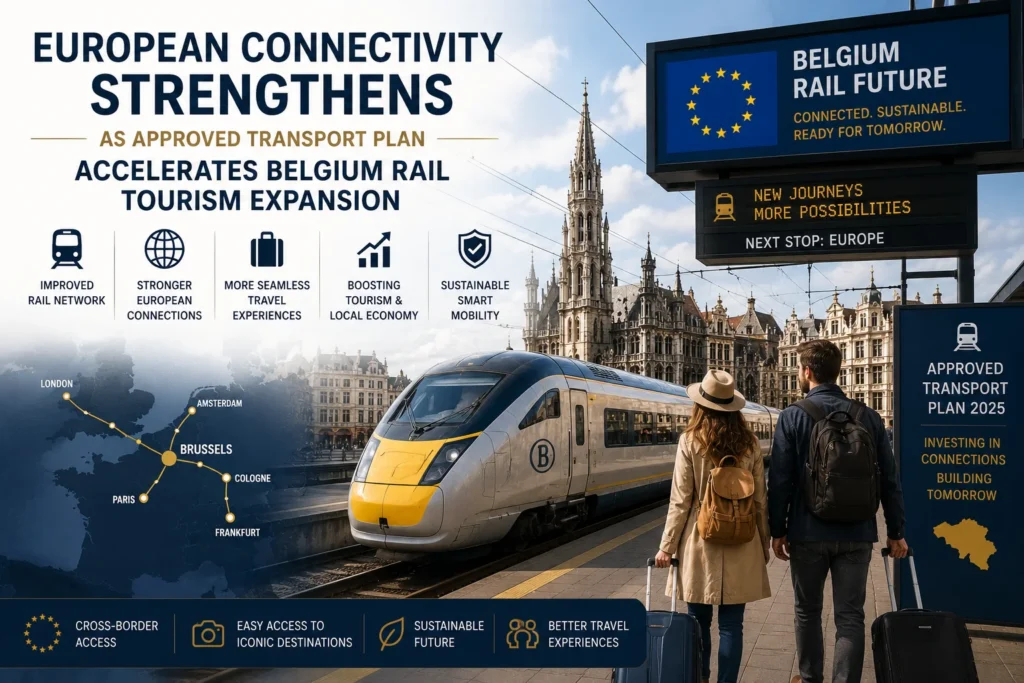
The landscape of sustainable European holiday travel is set for a substantial upgrade following an official policy directive from the Belgian federal government. The Council of Ministers has formally approved the 2026–2029 strategic transport plan submitted by the state-owned passenger operator, Belgian National Railways (SNCB). This comprehensive infrastructure roadmap authorises a three percent overall increase in national and regional train services over the next three years, consolidating Belgium’s position as a premier, eco-conscious transit hub for international visitors.
The newly ratified expansion operates as a core component of the broader 2023–2032 public service obligation contract established between the Belgian state and the national railway. This ten-year federal framework mandates a cumulative ten percent increase in total train service volume over the course of the decade. Following on the heels of the successful 2023–2026 transport plan, which effectively expanded countrywide operations by approximately five percent, this subsequent phase shifts focus toward optimizing structural entry points, enhancing intercity holiday travel, and reinforcing cross-border transit links.
Streamlining Gateways for International Vacationers
A central highlight of the newly approved transit layout is the aggressive optimization of connections to and from Brussels Airport Zaventem, the primary international aviation gateway into the kingdom. Federal mobility statements reveal a coordinated push to eliminate transit friction for global holidaymakers landing in Belgium. Under the updated operational guidelines, the railway operator will introduce specialized early-morning train frequencies running seven days a week.
These new schedules will drastically improve accessibility from some of Belgium’s most celebrated cultural destinations. Specifically, travelers departing from the medieval architectural jewel of Bruges, the vibrant culinary canals of Ghent, and the metropolitan hub of Brussels will be able to access the international airport terminal as early as 03:30. National tourism statistics regularly emphasize that providing reliable, ultra-early airport transfers is a vital component in capturing premium international markets, allowing travelers to comfortably catch early-morning outbound long-haul flights without requiring expensive overnight airport hotel stays.
Phased Infrastructure Integration Across Key Cultural Hubs
The execution of the 2026–2029 transport plan will unfold across three meticulously structured phases aligned with consecutive European winter timetable transitions. The inaugural phase is scheduled for deployment during the traditional winter timetable adjustments, taking effect on December 13, 2026. This opening phase will focus heavily on bolstering connectivity between major historic cities and ramping up the frequency of suburban train networks serving four critical urban and cultural zones: Brussels, Antwerp, Charleroi, and Liège.
Weekend travel options will also see immediate enrichment under the December 2026 guidelines. Recognizing the growing trend of city-break tourism, the plan introduces extensive late-evening train services running to and from Brussels on Saturday nights. This adjustment allows leisure tourists to fully experience the capital’s world-renowned culinary scene, evening museum openings, and cultural festivals before returning to outlying regional accommodations. Additionally, the first phase marks the official integration of the brand-new Braine Alliance railway station in Braine-l’Alleud into the greater Brussels suburban transit web, easing visitor dispersal toward the historic Waterloo battlefield region.
The secondary phase, taking effect with the December 2027 timetable transition, will launch the aforementioned expanded airport connections. It will also debut the physical merger of the Moensberg and Linkebeek stations into a singular, highly efficient interchange node within the Brussels suburban S-train network. The final phase of the master plan, scheduled for the late 2028 timetable shift, will bring a subsequent layer of frequency intensifications to wrap up the three-year development cycle.
Overcoming Network Challenges to Guarantee Reliable Leisure Travel
While federal approval marks a major legislative victory for the Belgium rail tourism expansion, official corporate statements from SNCB underline that seamless real-world execution depends closely on several external operational dependencies. The successful realization of the enhanced timetables requires the punctual finalization of major network capacity upgrades currently overseen by Infrabel, the national railway infrastructure manager.
Securing dedicated, unconflicted train paths remains an ongoing challenge on high-density arteries. SNCB authorities have pointed out that competing track requests from various commercial and international operators continue to trigger capacity bottlenecks along the critical Antwerp to Brussels corridor—a primary transit spine for international vacationers moving between the diamond capital and the European Union administrative heart.
Fleet Modernization Safeguarding Long-Term Network Capacity
To structurally support this network-wide growth, the national operator is heavily investing in a sweeping fleet renewal program. The long-term stability of the expanded service relies on the steady delivery of a massive 1.7-billion-euro framework order placed with the manufacturer Construcciones y Auxiliar de Ferrocarriles (CAF). The initial multi-billion-euro procurement encompasses one hundred and eighty next-generation trainsets of varying configurations, including eco-friendly battery-powered units designed to phase out legacy diesel models on non-electrified regional tracks.
The initial deliveries of these advanced passenger models are scheduled to commence rolling onto the network, with options built into the contract to expand the scope to three hundred and eighty units over the coming decade. These modern carriages will offer premium comfort upgrades, including dedicated quiet zones, independent level-boarding access for passengers with reduced mobility, advanced real-time information screens, and vastly expanded onboard storage capacity for bicycles. By systematically aligning cutting-edge rolling stock with optimized scheduling, Belgium’s public administrations are successfully future-proofing the nation’s passenger rail system, ensuring that eco-conscious tourism remains a highly attractive, efficient, and accessible option for travelers from across the globe.
For more travel news like this, keep reading Global Travel Wire