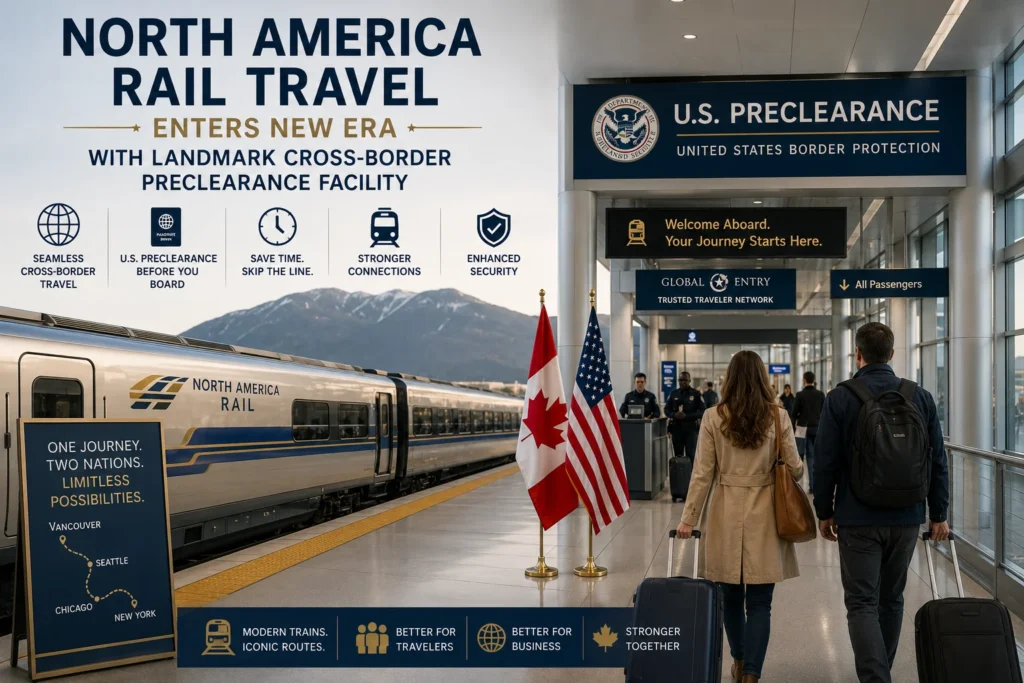
Passenger transportation across the Pacific Northwest has achieved a historic milestone that promises to fundamentally reshape cross-border tourism. In an unprecedented move for regional transit, Amtrak has officially debuted North America’s very first passenger rail preclearance facility. Located at the historic Pacific Central Station in Vancouver, British Columbia, this innovative facility allows travelers heading south into the United States on the popular Amtrak Cascades line to fully complete their U.S. customs, immigration, and agricultural inspections prior to stepping onto the train.
While preclearance operations have long been a staple of international aviation corridors, this operational launch marks the first time in continental history that identical border-handling capabilities have been integrated into a passenger rail hub. Public infrastructure reports and binational tourism assessments indicate that this development will act as a major catalyst for seamless regional travel, eliminating tedious transit bottlenecks and vastly improving overall travel reliability between Canada and the United States.
A Seamless Blueprint for Binational Transit
The implementation of the new border protocol represents the culmination of complex diplomatic coordination and physical infrastructure layout adjustments. According to official ministry statements from Public Safety Canada and Transport Canada, the new arrangement completely consolidates all inspection, security verification, and customs declarations into a singular, streamlined step executed entirely before departure.
The immediate result of this structural shift is a massive increase in operational efficiency. Southbound trains departing from Vancouver can now proceed directly across the international border at Blaine, Washington, without being subjected to mid-route screening delays or mandatory border stops. Federal transportation data highlights that eliminating these variable border queues allows rail operators to offer highly predictable, fixed schedules—a crucial factor in convincing travelers to choose sustainable rail travel over private automobiles or commercial flights.
The milestone initiative was delivered through an expansive partnership involving the Washington State Department of Transportation (WSDOT), VIA Rail, and multiple federal security agencies on both sides of the border. These participating bodies include U.S. Customs and Border Protection (CBP), the Canada Border Services Agency (CBSA), and Public Safety Canada. To accommodate the heightened security and strict processing requirements mandated by U.S. federal guidelines, Pacific Central Station underwent a series of targeted structural upgrades, establishing isolated, secure waiting zones and specialized inspection spaces within the historic 1919 terminal framework.
Capitalizing on Growing International Travel Demand
The unveiling of the preclearance hub arrives at a critical juncture for North America rail travel, as the Pacific Northwest prepares to capture unprecedented waves of global tourism. Public statements from regional tourism boards point out that the infrastructure upgrade is perfectly timed to accommodate massive passenger flows anticipated for the upcoming FIFA World Cup. With Vancouver scheduled to host seven major international matches and neighboring Seattle securing six, establishing a frictionless transit pipeline between the two host markets is a top economic priority for tourism authorities.
Binational representatives emphasize that easing cross-border mobility not only serves short-term athletic spectacles but also strengthens the long-term benefits of the United States-Mexico-Canada Agreement (USMCA) by fortifying integrated regional business travel and tourism supply chains. Legislative leaders backing the project note that high-performance public transit networks are vital mechanisms for boosting local small businesses, connecting disparate regional workforces, and fostering broader economic collaboration across the cross-border Cascadia corridor.
Next-Generation Fleet Fleet Deployment on the Horizon
The introduction of preclearance processing is part of a larger, multi-million-dollar modernization blueprint designed to elevate the standard of rail travel throughout the region. Officials from WSDOT have confirmed that the operational improvements at Pacific Central Station will soon be complemented by the arrival of brand-new, state-of-the-art Amtrak Airo trainsets.
Scheduled for revenue service deployment later this year, these advanced trainsets will introduce significantly more passenger seating, reduced carbon emissions, and enhanced onboard amenities, positioning the corridor for record-breaking ridership tallies.
National tourism statistics regularly demonstrate that when public transit options become more convenient and predictable, consumer behavior shifts rapidly toward rail integration. By transforming what was once a multi-step, stop-and-start border cross into a fluid, airport-style preclearance walk-through, the collaborative efforts of Canadian and American transportation agencies have successfully safeguarded regional accessibility. The new facility ensures that the Pacific Northwest remains one of the most attractive, tightly connected, and forward-thinking tourism corridors on the global stage, anchoring the future of North America rail travel for generations to come.
For more travel news like this, keep reading Global Travel Wire