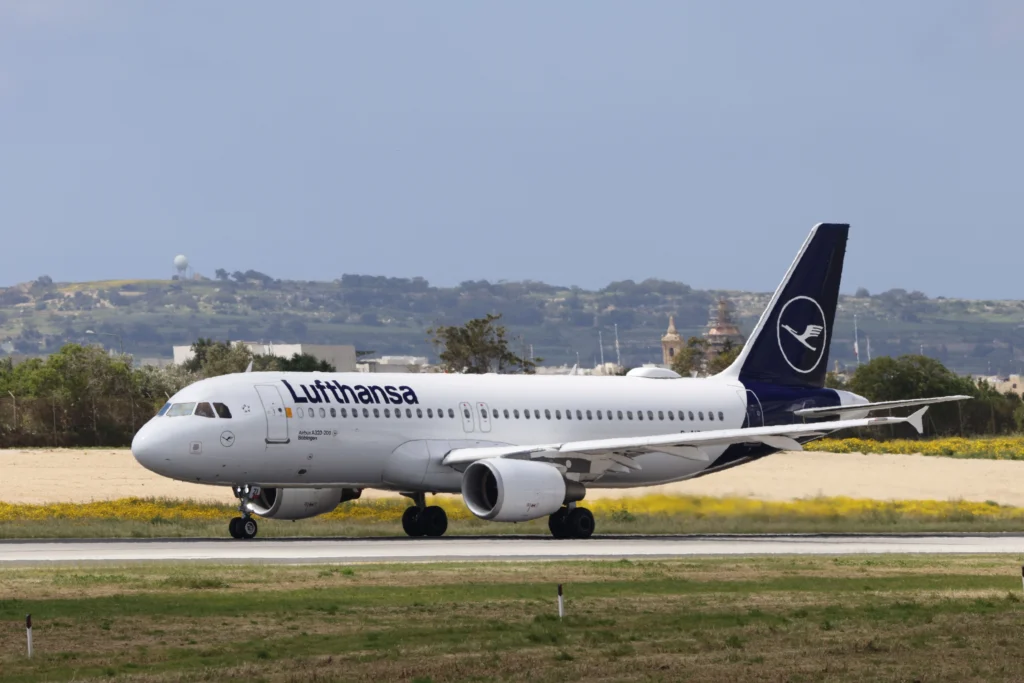
Official civil aviation logs from Massport and international flight safety registries confirm a significant logistical rerouting involving the world’s largest commercial passenger airliner. A Lufthansa Airbus A380-800 superjumbo executing a scheduled transatlantic crossing from California to Germany was forced to alter its flight plan over Canadian airspace, executing a strategic precautionary landing at Boston Logan International Airport.
The immediate decision to terminate the primary flight path and head for the Massachusetts transportation hub was made following an acute mid-flight passenger disturbance in the upper and lower cabin decks. According to official terminal operations reports from the Federal Aviation Administration (FAA) and state law enforcement agencies, all 508 travelers and crew members remained structurally secure, with the aircraft landing safely without secondary runway incidents.
Strategic Mid-Flight Rerouting Over Remote Airspace
Flight tracking telemetry records that the double-decker aircraft departed San Francisco International Airport on its standard route toward Munich Airport. The widebody jet had proceeded northeast and was tracking directly over the expansive geography of central Canada when cabin crew alerted the flight deck to an escalating physical altercation involving an unruly passenger who allegedly targeted another traveler.
Faced with a rapidly deteriorating cabin environment and recognizing the absolute necessity of passenger safety, the captain initiated standard emergency diversion protocols. Because the remote geographic sectors of central Canada lack civil aviation facilities and runways certified to handle the massive weight, wingspan, and passenger capacity of an Airbus A380, flight operations coordinated an immediate turn back toward major East Coast gateways.
Boston Logan International Airport was selected as the optimal diversion hub due to its certified Code F infrastructure. This designation means the facility features the specialized runway widths, taxiway clearances, and heavy-passenger ground-handling equipment needed to safely receive a superjumbo on short notice.
Law Enforcement Interdiction and Airport Ground Response
Upon the aircraft’s safe arrival at Boston Logan in the early morning hours, the Massachusetts State Police, in coordination with federal aviation security officials, boarded the static aircraft at the gate. Law enforcement personnel immediately took the disruptive individual into operational custody for processing and formal statements, allowing airport ground teams to secure the cabin environment.
While international airline operations routinely budget for minor delays, a diversion of this magnitude incurs massive localized operational costs. According to regional airport economic metrics and standard carrier cost formulations, spontaneous widebody diversions generate major financial outlays, which generally include:
Aviation Fuel Surcharges: The extreme fuel burn required to descend, dump or carry heavy transoceanic fuel loads, and climb back to cruising altitude.
Hub Landing Fees: Commercial weight-based charges levied by port authorities for non-scheduled infrastructure usage.
Crew Duty Regulations: Mandatory rest provisions that often necessitate fresh crew stand-ins or extended overnight accommodations for the current staff.
The disruptive traveler faces potential federal civil penalties under statutory frameworks maintained by aviation oversight bodies, which permit fines of up to $37,000 per individual safety violation for interfering with airline flight crew duties.
International Passenger Rights and Regulatory Protections
The sudden grounding of 508 international travelers in New England has renewed focus on consumer protection parameters, specifically European Union Regulation 261/2004 (EU-261). Under standard applications of this consumer charter, passengers are legally entitled to direct financial compensation of up to €600 for prolonged arrival delays on long-haul services entering or leaving European space.
However, formal circulars from civil aviation ministries clarify that unruly passenger disruptions are legally categorized under the “extraordinary circumstances” clause. Because spontaneous behavioral outbursts are deemed entirely outside the reasonable operational control of a commercial airline, carriers are statutorily exempt from issuing mandatory compensation payouts to delayed travelers.
Despite the lack of direct cash compensation obligations, Lufthansa ground teams at Boston Logan provided standard duty-of-care provisions, organizing terminal logistics, alternative routing connections, and necessary gate side assistance for the stranded manifest.
Technical Turnover and Service Resumption
Following the formal extraction of the passenger, comprehensive safety checks by certified aircraft mechanics, and full clearance from regional air traffic control, the Airbus A380 was permitted to resume its journey. The aircraft taxied out of Boston Logan and completed its delayed transatlantic transit to Munich, registering a total route delay of approximately 13 hours.
Global aviation safety statistics published by transport ministries indicate that while in-flight behavioral disruptions represent a fraction of total global operations, they require rigid adherence to established cockpit protocols to prevent wider systemic issues. The successful handling of the incident emphasizes the critical role of standardized crew training, real-time coordination with regional radar centers, and the strategic availability of certified alternative hub infrastructures across international flight corridors.
For more travel news like this, keep reading Global Travel Wire