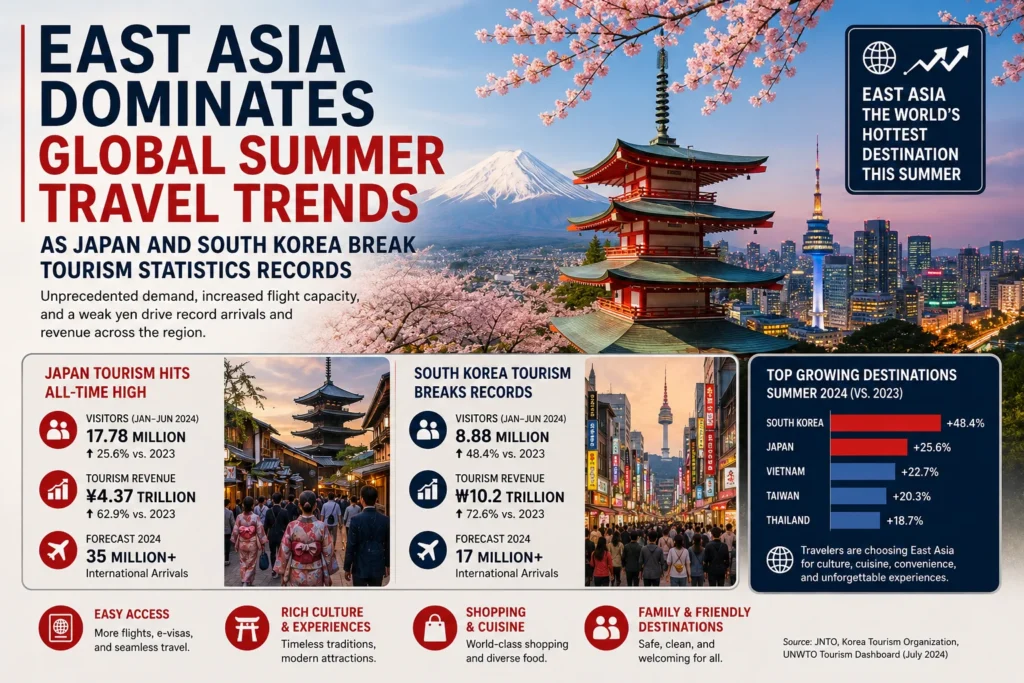
The landscape of international tourism is undergoing a major structural shift as long-haul transit networks adjust to changing consumer behavior. According to the newly released Summer Travel Report 2026, global summer travel trends are being heavily re-shaped by an unprecedented wave of interest in East Asian destinations. While traditional Mediterranean strongholds like Spain maintain their baseline spot at the top of absolute volume rankings, East Asia has emerged as the fastest-growing powerhouse in global tourism demand.
Official mid-year data shows that Japan has successfully climbed to the second position globally for summer travel itineraries, while South Korea has captured the highest rate of year-over-year growth among top international destinations. Additionally, the emergence of Thailand into the global top ten for the first time solidifies Asia’s position as a primary anchor of contemporary international travel planning.
Japan National Tourism Organization Confirms Record-Breaking Arrivals
The rise of Japan to the forefront of global summer travel trends is directly mirrored in the latest official public information released by the Japan National Tourism Organization. Following a historic performance that welcomed an all-time record of 42.7 million international visitors, the momentum has surged straight into the current calendar year.
According to official tourism statistics from the organization, estimated international arrivals for a single month reached 3,618,900, marking a 3.5 percent increase compared to the previous peak period. This brings the year-to-date international visitor volume to an unprecedented total of 10,683,481 for the initial months of the tracking cycle.
A detailed breakdown provided by the immigration authorities highlights that South Korea remains the largest source market for Japan, contributing 795,600 visitors, followed closely by Taiwan with 653,300, and the United States with 375,900 arrivals. The sustained weakness of the Japanese yen, which has stabilized around the 150-yen-to-the-dollar mark, continues to act as a powerful economic catalyst. This favorable exchange rate has effectively reduced the relative cost of luxury accommodation, domestic transport, and high-end gastronomy for long-haul travelers arriving from North America and Europe, positioning Tokyo as the world’s most desired city destination.
South Korea Reaches New Tourism Heights Driven by Cultural Output
Simultaneously, South Korea is experiencing its own historic inbound tourism boom, driven by aggressive public policy adjustments and a global fascination with its contemporary cultural exports. The Ministry of Culture, Sports and Tourism recently reported that international tourist arrivals surged to an all-time high of 18.94 million, resulting in record-breaking international tourism revenues of $27.2 billion.
The positive trajectory has accelerated dramatically. The Ministry’s initial data reveals that foreign tourist entries reached a record 4.76 million, representing a massive 23 percent growth compared to the same tracking timeframe. China led the inbound market with 1.45 million visitors, an expansion of 29 percent, while arrivals from Japan grew by 20 percent to reach 940,000.
This rapid expansion is the direct result of deliberate border deregulation strategies executed by the state. The ministry’s implementation of a temporary visa fee waiver for structured group tours, combined with the expansion of multi-entry visas for recurring visitors across 12 countries, has systematically cleared administrative barriers.
Furthermore, state transport policies have successfully decentralized tourism away from the capital city of Seoul. The launch of strategic domestic flight networks and expanded international capacities at regional airports drove a massive 50 percent increase in foreign passenger processing at local gateways. This policy shift successfully redirected 34.5 percent of all foreign tourists into diverse cultural experiences across provincial regions, including Jeju Island and Busan.
Rise of Multi-Destination Itineraries and Experience-Driven Journeys
The updated travel metrics indicate a broader evolution in consumer behavior, with international itineraries becoming significantly more ambitious and experience-driven. Public survey data shows that 46.4 percent of respondents are actively executing trips abroad this season, a sharp increase from the 37.6 percent recorded during the prior annual cycle.
Crucially, more than half of all international travelers now plan to incorporate multiple destinations or cross-border itineraries into a single summer vacation layout. This trend toward expansive, multi-city transit is being heavily amplified by major global sports and cultural events. Data shows that 75 percent of travelers intending to attend high-profile international competitions plan to visit two or more host cities, effectively turning a localized event into a comprehensive regional exploration.
The structural characteristics of these shifting global summer travel trends are outlined in the data matrix below, utilizing verified figures from regional transport ministries and national tourism boards:
| Destination Market | Verified Arrival Milestones | Primary Structural Policy Drivers | Active Passenger Origin Trends |
| Japan | 42.7M historical annual arrivals; 10.6M year-to-date | Sustained currency exchange incentives and seasonal cultural campaigns | Strong multi-continental volume from South Korea, Taiwan, and the US |
| South Korea | 18.94M annual arrivals; 4.76M initial quarter record | Visa-free group tour entry, regional airport expansion, and cultural fund allocations | Accelerated growth from China (up 29%) and Taiwan (up 37.7%) |
| Spain | Consistently retains the global number one volume spot | Traditional long-haul connectivity and established Mediterranean infrastructure | Stable baseline European and transatlantic leisure transit |
| Thailand | Enters the global top ten destination index for the first time | Eased entry protocols and optimized Southeast Asian transit networks | Rising presence in multi-country regional itineraries |
Essential Operational Advice For Modern Transcontinental Travelers
As international journeys expand to include complex, multi-city routes across East Asia, national aviation boards and tourism ministries recommend that passengers implement the following structured preparation steps:
Secure Telecommunications Pre-Departure: With multi-country itineraries rising sharply, passengers should explicitly coordinate their mobile data requirements before departure. Utilizing digital travel options like electronic SIM modules ensures seamless cross-border data switching across changing networks without requiring physical card changes.
Verify Regional Airport Alternatives: To bypass high-volume terminal congestion at primary hubs like Tokyo Haneda or Seoul Incheon, explore booking direct arrivals into newly expanded regional gateways such as Osaka Kansai or Busan Gimhae.
Account for Flight Rerouting Pacing: Given the increased volume across Asian air corridors, travelers should maintain a minimum of three hours between connecting flights to safely accommodate standard security checks and localized gate changes.
The clear data trends issued by official international monitoring bodies demonstrate that the global travel ecosystem has moved permanently beyond conventional boundaries. By pairing flexible visa policies and infrastructure investment with highly appealing cultural assets, destinations across Japan and South Korea are successfully capturing the global premium market, establishing a new blueprint for international tourism infrastructure.
For more travel news like this, keep reading Global Travel Wire