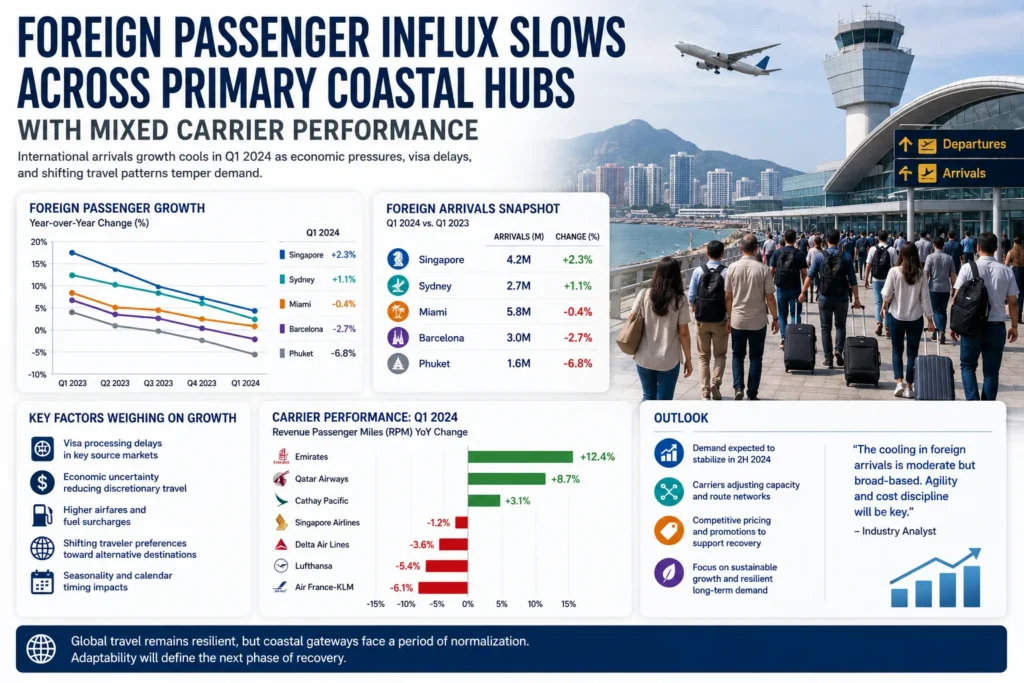
The international aviation matrix across Central America is navigating a prominent demographic transition. Official terminal operations registries and consolidated airline disclosures compiled for May 2026 reveal that foreign passenger volumes at major Mexican resort airports have experienced a targeted contraction. While baseline domestic commercial movements remain largely resilient, a multi-month cooling trend in inbound long-haul leisure travel is prompting regional hospitality systems and civil transport authorities to review network yields and passenger infrastructure models as the peak summer travel window approaches.
According to comprehensive monthly monitoring reports released by the country’s prominent publicly traded airport groups, the reduction in foreign passenger flow is primarily concentrated around high-profile shoreline vacation destinations. Regional aviation frameworks emphasize that while total passenger totals remain stable due to robust local business travel, the specific drop in international leisure arrivals introduces notable operational shifts, as cross-border travelers provide a significant portion of non-aeronautical retail revenue and international airport departure fees.
Dissecting Regional Port Operations and Group Disclosures
The strategic adjustment in global passenger distribution is reflected across the performance statements issued by the three primary private airport concessionaires managing the national network. The data shows distinct regional variances:
Grupo Aeroportuario del Sureste, which manages primary infrastructure nodes across the Yucatán Peninsula, reported a modest 1.6 percent contraction in total passenger movements for the month. However, the international segment at its primary gateway, Cancún International Airport, faced a distinct 11.1 percent reduction, moving 1.31 million foreign travelers compared to the same operational window from the previous year.
Grupo Aeroportuario del Pacífico, responsible for managing key western coastal gateways, noted a 4.1 percent drop across its entire terminal grid, with international passenger traffic falling by 8.2 percent. Among the major leisure-dominated terminals, Puerto Vallarta International Airport encountered the most significant adjustment, with its international visitor volumes down 26.5 percent for the reporting period.
Conversely, Grupo Aeroportuario del Centro Norte, which manages 13 terminal hubs primarily concentrated in central and northern industrial corridors, achieved a 3.6 percent increase in total terminal traffic. This positive trend was anchored by a 4.7 percent expansion in domestic business passenger volumes, which successfully offset a minor 2.8 percent softening in its localized international traveler segments.
Divergent Fleet Outcomes and Technical Supply Bottlenecks
The operational statistics provided by primary domestic carriers showcase a clear division in how individual fleets are managing the current market environment. Strategic network planning, fuel pricing volatility, and aircraft engine availability continue to act as major differentiators across corporate performance metrics.
Ultra-low-cost carrier VivaAerobus faced mixed results, transporting 2.5 million total passengers, representing a minor 1.4 percent year-on-year drop. The carrier’s international passenger segment recorded a 20.1 percent reduction, matching a calculated 26.3 percent intentional reduction in international capacity measured in available seat miles. Corporate directors attribute these adjustments to elevated jet fuel pricing lines and mandatory aircraft groundings required for ongoing Pratt & Whitney engine safety inspections.
In contrast, Volaris achieved solid passenger growth, moving 2.68 million travelers for a 7.2 percent net gain. The airline reported a notable 15.4 percent surge in cross-border and international passenger traffic, maintaining a healthy load factor of 86.2 percent. Management statements attribute this resilient showing to robust demand across core transborder routes. Concurrently, Aeroméxico registered a stable 2.1 percent expansion in total monthly traffic to 2.10 million passengers, supported by a 4.6 percent improvement in international movements and an optimized load factor of 85.8 percent.
Financial Realignments and Broader Tournament Projections
The shift in passenger composition has influenced investment sentiment across the regional transportation sector. Market analysts point out that domestic airline stock valuations on the Mexican Stock Exchange have encountered near-term headwinds, lagging behind various North American peers as institutional investors scrutinize localized engine caps, fuel cost structures, and changing traffic mixes.
This operational rebalancing arrives at a unique moment, as the country prepares its transportation infrastructure to co-host high-profile global sports events like the FIFA World Cup matches. Transport analysts note that while the upcoming tournament will undoubtedly generate concentrated traffic spikes in major urban areas, it may not immediately reverse the broader international leisure pacing shifts observed at coastal resort terminals. This is largely because a significant portion of incoming sports transit is routed through independent municipal hubs outside the main commercial coastal concessions.
Tactical Advice for Summer Vacation Planners
For international and domestic tourists arranging itineraries across the regional aviation network this summer, current market dynamics provide specific opportunities to optimize travel plans:
First, travelers heading to traditional beach destinations like Cancún and Puerto Vallarta can leverage dynamic airline capacity realignments to secure competitive seasonal accommodation rates. Second, due to selective fleet capacity reductions, booking direct cross-border flights well in advance is highly recommended to protect preferred flight windows. Third, passengers utilizing high-frequency carriers should leverage digital applications to complete check-in procedures early, ensuring smooth transit through terminal infrastructure. Finally, keeping track of real-time flight statuses through automated mobile notifications is recommended to stay updated on any equipment-related schedule adjustments.
For more travel news like this, keep reading Global Travel Wire