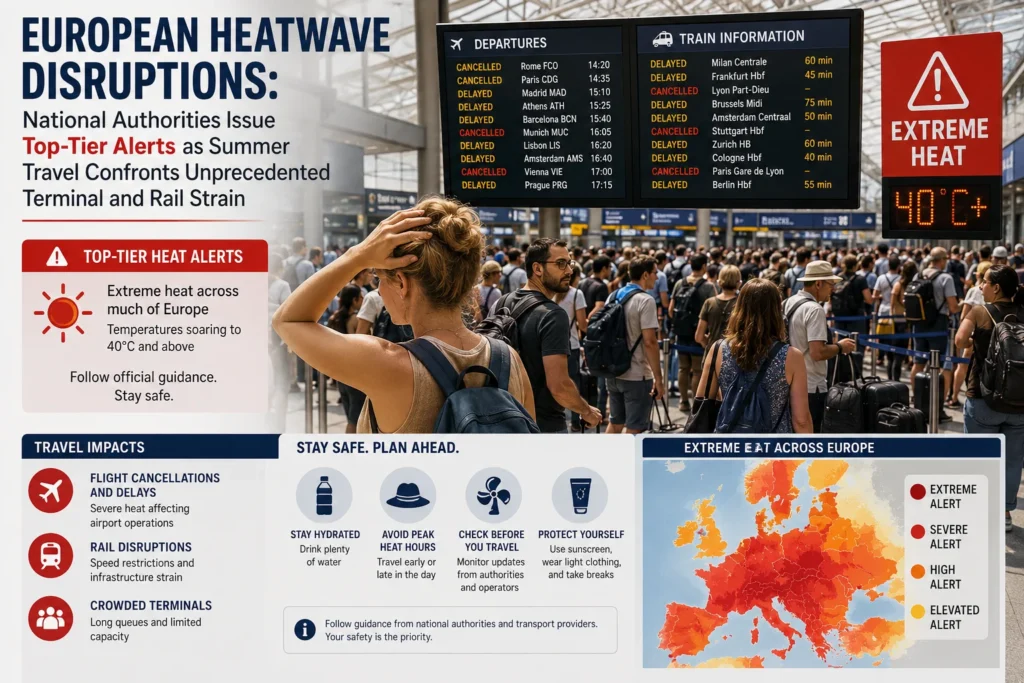
A massive atmospheric high-pressure system, frequently referred to as a heat dome, has drawn intense Saharan air northward across continental Europe. The severity of this weather pattern has prompted national meteorological agencies and civil protection ministries to simultaneously deploy highest-level red alerts across Spain, France, Italy, Germany, and the United Kingdom. With daytime temperatures regularly exceeding 40 degrees Celsius and local municipal infrastructure pushed to historical operational thresholds, the peak summer travel season is experiencing sweeping scheduling modifications and rigorous public safety enforcement.
Official public data confirms that these conditions represent an exceptional climate event rather than standard seasonal variations. In France, the national weather provider Météo-France expanded its red heatwave vigilance status to encompass 54 departments, tracking the warmest overnight minimum temperatures recorded since official records began in 1947. Simultaneously, Spain’s state meteorological agency, AEMET, activated emergency protocols for extraordinary danger across key transit and agricultural corridors, warning that localized valley regions could peak near 44 degrees Celsius.
Intercontinental Transport Networks Enforce Protective Speed Restrictions and Schedule Adjustments
The intersection of extreme ambient temperatures and high passenger volumes has introduced measurable friction across European transportation infrastructure. Steel rail lines exposed to direct, prolonged solar radiation can absorb thermal energy exceeding 50 degrees Celsius, introducing a structural risk of track deformation or buckling. To mitigate these infrastructure hazards, regional rail operators—including the French national railway network SNCF—have proactively modified operations, resulting in the cancellation of more than 70 intercity trains and the imposition of mandatory system-wide speed limits. Administrative leaders have formally advised vulnerable passengers to defer non-essential transit until thermal conditions stabilize.
The aviation sector faces corresponding operational constraints. Severe ground-level heat alters air density, directly impacting aircraft aerodynamic performance and maximum allowable takeoff weights. Consequently, international airports across Southern Europe have implemented strict aircraft handling restrictions. Ground operations, including fueling, technical baggage processing, and aircraft servicing, are moving at a calculated pace to safeguard ground crews working under reduced capacity guidelines. Travelers navigating major European hubs are encountering rolling flight delays and extended turnaround times as airlines re-evaluate schedule layouts to avoid the peak thermal hours of the day.
Public Health Ministries Mobilize Crisis Units and Strict Water Safety Protocols
National health security agencies are treating the ongoing heat dome as a significant public health priority. The World Health Organization’s regional office has urged member states to activate comprehensive heat-health action plans to counter a rise in heat exhaustion and severe heatstroke cases. In Italy, the Ministry of Health extended its red alert status across 15 major urban centers, including cultural tourism capitals like Rome and Milan, directing both municipal populations and international visitors to remain indoors during peak radiation intervals and maintain continuous hydration.
Civil protection authorities are simultaneously addressing a tragic surge in water safety incidents. The French Civil Protection agency reported that 40 individuals had drowned within a brief seasonal window as citizens and tourists sought relief in rivers, lakes, and unpatrolled coastal waters. Government spokespersons have issued urgent declarations regarding the physical shock of sudden cold-water immersion during periods of intense atmospheric heat. Furthermore, regional prosecutors have reiterated stringent warnings regarding vehicle safety, highlighting that internal cabin temperatures in parked vehicles can rapidly escalate to lethal levels, presenting severe risks if individuals or young children are left unattended for even brief periods.
Tourism Infrastructure Adapts with Modified Operational Hours and Cultural Site Restructuring
The broader hospitality and tourism ecosystem is realigning daily operations to protect visitors while maintaining local commercial continuity. Regional ministries of education across France and the United Kingdom authorized the temporary closure of over 1,350 schools and adjusted secondary examination timelines due to inadequate indoor cooling capabilities. In a parallel effort, municipal authorities in major cities are implementing emergency relief measures; for instance, local governments in southern coastal zones have extended public beach and municipal pool access to 24 hours while waiving standard admission fees.
Major cultural landmarks and outdoor heritage sites are restricting direct midday access, shifting guided tours and excursions exclusively to early morning or late evening windows. Major travel insurance providers are actively updating processing guidelines, monitoring claims associated with structural trip delays, medical evacuations, and heat-related operational cancellations. Hospitality operators are emphasizing the necessity of pre-verifying room cooling capabilities, as historic architecture across Western Europe often relies on localized climate controls that face heavy strain during prolonged regional heat domes.
Official Civil Protection Guidelines for International Travelers
To ensure public safety across all primary tourism corridors, European civil protection networks have issued standardized operational directives for travelers currently transit-active within the region:
Pre-Verify Transit Commitments: Check flight and rail statuses directly through official operator applications at least 24 hours prior to departure to monitor active heat-related cancellations.
Reschedule Outdoor Sightseeing: Restrict prolonged walking tours or physical exertions between the hours of 11:00 AM and 5:00 PM when solar intensity and ground radiation are highest.
Utilize Official Municipal Relief: Identify and leverage air-conditioned public cooling centers, designated shaded urban green spaces, and authorized, lifeguard-monitored swimming zones.
Maintain Strict Hydration Protocols: Carry adequate water and electrolyte solutions continuously, avoiding beverages that accelerate dehydration under high humidity levels.
State meteorological services indicate that while temporary atmospheric shifts may offer localized relief towards the end of the week, elevated baseline temperatures are projected to persist throughout the seasonal cycle. Travelers are urged to remain highly vigilant, rely strictly on verified government advisories, and build operational flexibility into their regional itineraries.
For more travel news like this, keep reading Global Travel Wire