The early summer travel season across Western Europe is experiencing significant operational adjustments as a massive, high-pressure weather system drives temperatures to historic levels. National meteorological agencies and ministries of health across the United Kingdom, France, Italy, and Spain have activated their highest emergency response protocols. Public infrastructure, including regional rail networks and educational institutions, has implemented temporary closures to protect public safety. Tourism boards are actively coordinating with local hospitality sectors to ensure international visitors remain informed, hydrated, and safe during this period of extreme weather.
Official weather data confirms that multiple nations are experiencing unprecedented conditions for this time of year. In France, national forecasting services recorded the highest overnight minimum temperatures since official tracking began in 1947. Simultaneously, the United Kingdom Meteorological Office issued a rare red extreme heat warning for central and southern England, marking only the second time such an alert has been deployed. With daytime temperatures projected to reach 40 degrees Celsius, chief climatologists emphasize that these intense, recurring heat events are becoming statistically more frequent and severe across the continent.
Infrastructure Adjustments and Transport Advisories for International Visitors
The intense thermal stress on public infrastructure has prompted immediate tactical responses from transport ministries. In the United Kingdom, major rail operators serving the vital corridor between London and the northeastern regions issued formal advisories urging passengers to defer non-essential travel. Extreme track temperatures carry the risk of rail buckling and overhead line failures, forcing network operators to introduce widespread speed restrictions that alter standard summer transit timetables.
To alleviate pressure on public services and protect youth populations, regional administrative bodies have enacted emergency protocols for educational facilities. Over 1,350 schools across France suspended operations or shifted schedules, a measure mirrored by dozens of school districts in England. Tourism authorities advise travelers utilizing public spaces or transiting via regional hubs to factor substantial buffer times into their itineraries and monitor real-time network updates provided by official government transit portals.
Mediterranean Destinations Implement Comprehensive Health Warnings
Across Southern Europe, civil protection agencies are managing extensive heat warnings that cover nearly the entirety of the Iberian and Italian peninsulas. Spain’s national weather agency, AEMET, issued red alerts signifying “extraordinary danger” across diverse geographical zones, including the southern municipality of Cordoba, the northern city of Bilbao, and sections of the Cantabria region. Local municipalities have expanded access to air-conditioned public cooling centers to protect both residents and summer tourists.
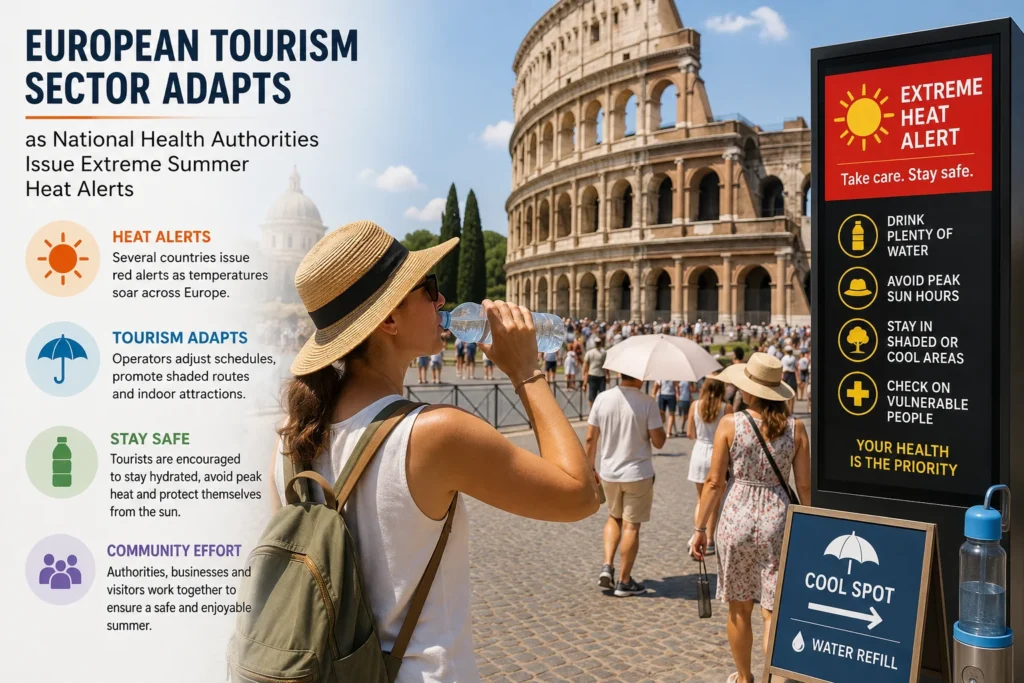
In Italy, the Ministry of Health escalated the heatwave alert status to red across 15 major urban centers, including Rome and Milan. The ministry’s official directives advise individuals to avoid outdoor exertion during peak solar radiation hours, maintain high fluid intake, and consume light meals. Tourism boards operating in these historic cultural hubs have increased the presence of mobile health units near prominent monuments to assist visitors navigating the extreme urban humidity.
Civil Protection Agencies Address Heightened Water Safety Risks
A primary concern voiced by European interior ministries involves the surge in water-related accidents as individuals seek relief from the stifling conditions. The French government convened an emergency crisis meeting following reports from public safety sectors that 40 individuals had drowned within a five-day window. Similar safety challenges were reported by law enforcement authorities in Germany, where multiple fatal swimming incidents occurred over a single weekend.
Civil protection frameworks emphasize that sudden immersion in open water bodies—such as rivers, lakes, and unpatrolled coastal areas—can trigger sudden physical shock, even during intense heat. Furthermore, local prosecutors in southern France reported tragic heat-related casualties involving young children left unattended in vehicles. Public safety campaigns have been urgently updated to remind families and group tours to never leave individuals inside parked vehicles under any circumstances, as cabin temperatures can reach lethal thresholds within minutes.
Practical Guidance from Tourism Boards for Navigating the Heat
National tourism boards are working closely with hoteliers, tour operators, and transport providers to minimize disruptions to the Europe summer travel experience while prioritizing visitor well-being. Travelers currently exploring or planning visits to Western European destinations are encouraged to incorporate verified safety habits into their daily schedules:
Optimize Daily Itineraries: Schedule walking tours, museum visits, and outdoor sightseeing during the cooler early morning or late evening hours. Limit exposure between midday and late afternoon when ground temperatures peak.
Monitor Official Meteorological Channels: Rely exclusively on updates from verified state agencies such as Meteo-France, Spain’s AEMET, the UK Met Office, and the Italian Ministry of Health for accurate, localized alert levels.
Utilize Regulated Swimming Zones: When visiting coastal areas or inland lakes, swim only in designated zones supervised by certified lifeguards. Avoid jumping into unauthorized natural water sources.
Prioritize Hydration and Acclimatization: Carry reusable water containers at all times and take frequent breaks inside air-conditioned spaces like galleries, shopping arcades, or certified cooling hubs provided by local municipalities.
As government ministries and municipal emergency teams deploy extra resources to manage the current weather system, travel consistency is expected to align gradually with shifting seasonal patterns. By maintaining situational awareness and adhering to official public safety declarations, international travelers can navigate the summer season effectively and safely.
For more travel news like this, keep reading Global Travel Wire