The landscape of global tourism is undergoing a massive transformation, driven by the rapid evolution of artificial intelligence. According to comprehensive data released in a major global consumer pulse study, a profound shift is occurring that extends far beyond standard AI-powered trip planning. Travelers worldwide are now exhibiting a remarkable willingness to allow travel AI agents to influence, negotiate, and execute booking decisions on their behalf. This emerging behavioral trend is fundamentally redefining the traditional concepts of brand loyalty, destination discovery, and consumer preference across the international hospitality and aviation sectors.
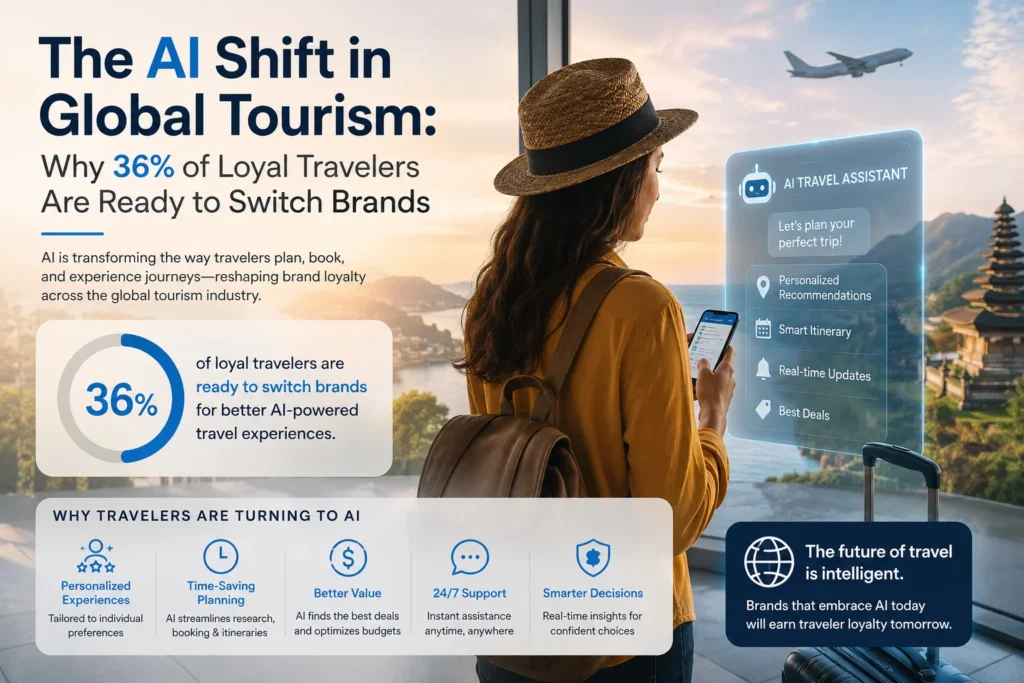
The data reveals that brand loyalty is facing an unprecedented test. For travel companies, the risk of losing long-term brand affinity is high if they fail to engage consumers at the exact moment of intent. Among loyal travelers—defined as those who consistently choose from one to three preferred brands within a specific hotel or airline category—a striking 36% stated they would allow a personal AI agent to switch them away from their favorite brands if a better fit or option was identified. Furthermore, 71% of surveyed travelers project that at least half of their total expenditure on hotels or airlines will be directly influenced by AI technologies over the next 12 months.
Consumer Trust and the Rise of Autonomous Travel Booking
The depth of trust that modern consumers are placing in automated systems marks a significant departure from traditional booking habits. The official research highlights that nearly three in four consumers, or 74%, would trust a personal AI agent more than their best friend to execute a purchase on their behalf. The distinction here is critical: consumers are not merely referring to basic informational chatbots or standard search engines, but rather to sophisticated, scalable agents designed to act, decide, and purchase based on specific user instructions.
Collaboration with these advanced tools is rapidly becoming the norm, with 87% of travelers expressing openness to working alongside an AI-powered travel agent to source the absolute best travel options. While fully autonomous purchasing is still in its early stages, the data underscores a notable momentum. Approximately 29% of travelers are prepared to let an AI agent make the final booking decision within predefined boundaries, such as strict price limits and personal preferences, prior to the consumer making the final payment. A pioneering 7% of travelers are already willing to completely empower an agent to shop autonomously, allowing it to independently make booking decisions and complete transactions.
Hospitality Industry Adapts to Agent-Ready Infrastructure
As consumer behavior pivots toward automated decision-making, forward-thinking hospitality operators are already restructuring their digital frameworks. Industry leaders, such as the Singapore-based global lodging operator Ascott, are actively updating their online systems and distribution channels. The goal is to ensure their properties and services remain highly visible in the specific digital environments where travel AI agents evaluate options.
By constructing specialized, agent-ready infrastructure, hospitality providers are directly linking their room inventory, personalization metrics, and booking mechanisms to major AI platforms. This ensures that when an AI assistant searches on behalf of a traveler, the brand’s offerings can be seamlessly discovered, analyzed, and booked. Consequently, corporate AI concierges are progressing from simple conversational chat tools into fully capable systems that handle end-to-end itinerary planning and booking execution.
The Changing Metrics of Hospitality and Airline Loyalty
The transition from using artificial intelligence for initial inspiration to empowering it to take direct action marks a definitive turning point for tourism marketing. Travelers are setting clear boundaries and parameters, then stepping back to let automated systems compare complex variables, filter optimal choices, and handle the administrative burden of booking.
This behavioral shift directly alters how global travelers select travel brands. Loyalty can no longer be viewed as an entitlement or a static metric. Instead, hospitality brands and airlines are being evaluated dynamically in real-time, based strictly on immediate price competitiveness, situational relevance, and how precisely the offering satisfies the specific criteria established by the user’s AI assistant.
However, human connection remains a powerful anchor within the tourism industry. The data indicates that 44% of travelers still demand to stay actively involved in at least one phase of their travel booking journey. This desire stems from a genuine enjoyment of the browsing experience and a deep emotional connection to specific travel brands. Therefore, the strategic mandate for global tourism entities is twofold: companies must establish a strong digital presence where automated agents make choices, while continuing to invest heavily in the elevated, real-world human experiences that foster genuine emotional trust.
About the Global Tourism Data
The insights are derived from a comprehensive global survey conducted between January 7 and January 22, 2026. The research captured a representative sample of 2,999 consumers across 16 countries, including Australia, Brazil, Canada, Chile, France, Germany, Greater China, Italy, India, Japan, Mexico, Spain, Sweden, the UAE, the UK, and the USA. The methodology integrated traditional online surveying with advanced synthetic panel testing and AI-moderated interviews conducted between April 20 and May 7, 2026, ensuring strict validation against rigorous responsible research standards.
For more travel news like this, keep reading Global Travel Wire