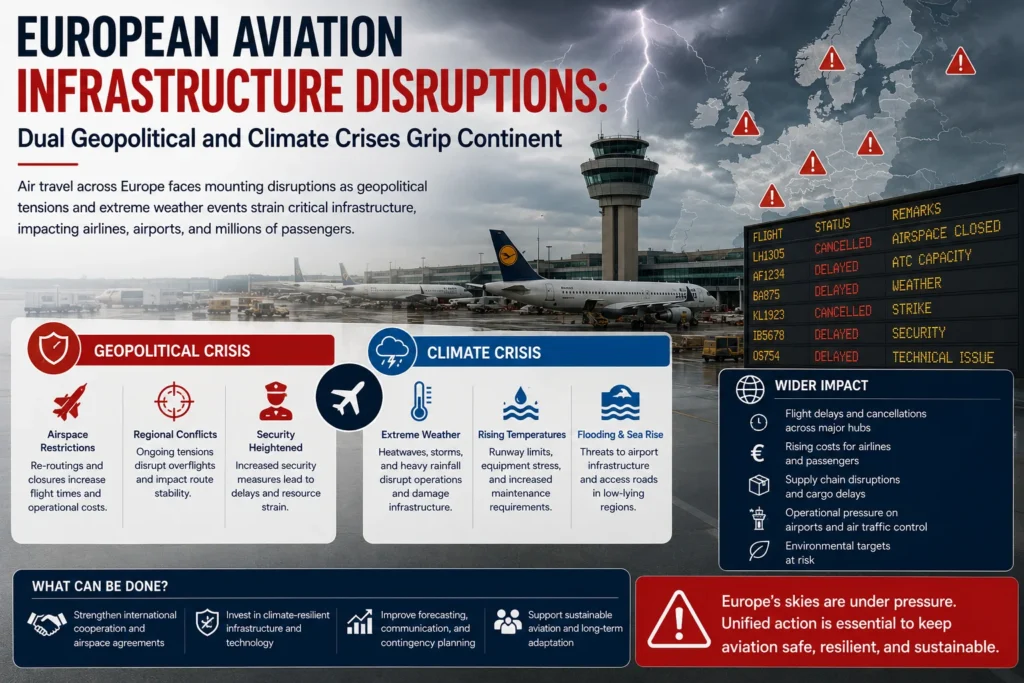
The European transport and aviation sector is facing a severe, multi-front operational challenge as simultaneous geopolitical escalations and extreme climate anomalies compromise regional infrastructure. Official security intelligence and transit data indicate that targeted military drone strikes on critical energy facilities in the Black Sea region have triggered severe electricity collapses across major urban centers. Concurrently, an intense early-summer heatwave is straining power grids across Western Europe, forcing unexpected utility failures and restricting operations at prominent cultural monuments.
The overlapping nature of these conflict-driven and climate-induced disruptions is forcing international airlines, airport regulators, and safety boards to completely recalibrate their risk assessments. With passenger volumes reaching their seasonal peak, the strain on transport networks underscores the extreme vulnerability of interconnected utility grids. Ground transit networks, flight routing pathways, and terminal passenger processing systems across multiple countries are all encountering unprecedented bottleneck conditions.
Sevastopol Grid Failure and Public Fuel Suspensions Restrict Black Sea Transit
In the Black Sea corridor, direct drone strikes conducted by Ukrainian forces overnight have severely compromised the structural integrity of the energy matrix. Official military statements and regional administration updates confirm that the attack successfully targeted several high-voltage electrical facilities, including the pivotal 330 kV Sevastopol substation and the matching Simferopolska hub. The resulting damage triggered immediate, widespread blackouts across Sevastopol—the largest urban municipality on the peninsula—knocking out municipal power grids, disabling tracking networks, and forcing vital public utilities to rely exclusively on back-up generators.
To conserve dwindling energy resources and maintain core emergency responses, regional authorities implemented a mandatory suspension of public fuel sales to civilian motorists. Municipal transport networks have drastically restricted the operating hours of local trolleybuses, regional trains, and retail centers. The Crimean Railway network confirmed a sharp reduction in interstate rail operations, scaling down active services from 18 down to just seven daily routes. For international travelers navigating transit hubs near the Black Sea zone, these infrastructural failures have introduced severe uncertainty, with ground transfers and regional connecting flights subject to indefinite delays due to the fuel distribution freeze.
Severe Heatwave Triggers Widespread Power Outages Across Northern France
As the Black Sea region manages conflict-related infrastructure failures, Western Europe is battling an equally disruptive climate crisis. Official announcements from French prefecture offices confirm that Europe’s record-breaking summer heatwave has initiated major power outages across northwestern France. A massive high-voltage grid transformer failure in the commune of Ergué-Gabéric, located near Quimper in Brittany, left more than 68,000 households and commercial transport entities completely without electricity. National grid operators RTE and Enedis reported that extreme ambient temperatures caused severe thermal overloads, with total grid clients experiencing disruptions peaking above 106,000 users.
The environmental stress has forced the French national energy provider, EDF, to aggressively curtail its domestic energy production to adhere to environmental safety regulations. Rising water temperatures along the Garonne river reached the legal limit of 28 degrees Celsius, forcing the complete shutdown of reactor number two at the Golfech nuclear plant. Output was similarly slashed at the Nogent-sur-Seine and Bugey nuclear facilities, removing roughly 4.6 percent of France’s total installed nuclear capacity from the active grid. These energy shortages occur at a time when airports, air traffic control towers, and high-speed rail systems require maximum electrical throughput to sustain intense summer passenger processing.
Tourism Landmark Modifications and Critical Travel Safety Guidelines
The combination of electrical grid failures and staggering ambient temperatures—which peaked at a historic 44.3 degrees Celsius in southwestern France—has directly impacted global tourism operations. In Paris, the management of both the Eiffel Tower and the Louvre Museum implemented emergency adjustments, closing facilities early or restricting hourly visitor access to prevent thermal exhaustion among crowds. Public safety ministries have escalated regional alerts, with 58 separate French departments placed under a maximum red alert for extreme heat.
Government authorities have issued strict public safety directives for any travelers currently transiting the continent. The UK Health Security Agency and French health ministries are urging individuals to avoid outdoor exposure during peak thermal hours, maintain constant hydration, and utilize public cooling centers. Simultaneously, maritime safety boards and regional coastguards have issued an explicit warning regarding cold water shock. Vacationers seeking immediate relief from the heat are cautioned against jumping abruptly into open seas or rivers, as the immense variance between air and water temperatures can cause immediate loss of muscular control and severe respiratory distress.
Structural Flight Routing Risks and Pre-Departure Recommendations
Aviation risk analysts note that the dual crises of summer represent a fundamental shift in European transit reliability. The escalation of energy infrastructure conflicts near the Black Sea forces commercial carriers to expand no-fly buffer zones, resulting in prolonged flight rerouting and increased fuel consumption across Eastern European airspace. Simultaneously, the climate-driven utility strain across Western European aviation corridors increases the likelihood of localized air traffic control delays and baggage processing backlogs due to equipment overheating.
With both environmental and geopolitical pressures projected to persist, international ministries are advising travelers to abandon passive scheduling assumptions. Prior to commencing any European transit, passengers must perform thorough pre-departure research, continuously reviewing active government foreign policy travel alerts and real-time airline operational bulletins. Maintaining flexible itineraries, securing comprehensive transit insurance, and confirming backup ground transportation are now mandatory protocols for navigating the complex realities of the current travel landscape.
For more travel news like this, keep reading Global Travel Wire