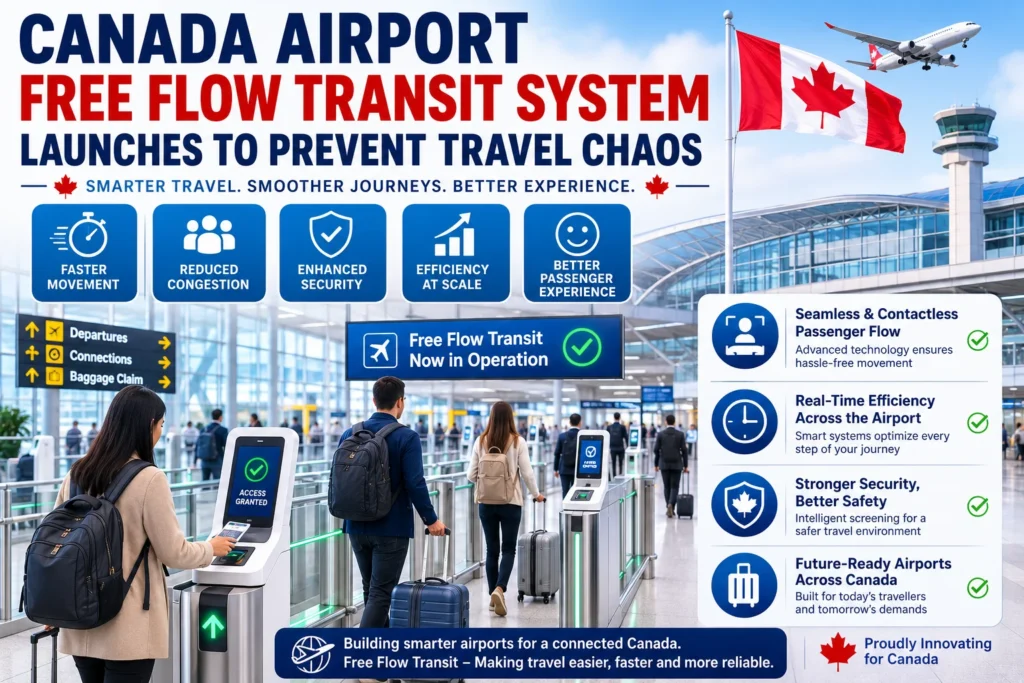
The Canada Border Services Agency (CBSA) has enacted a major structural modernization of its international aviation border network. To safeguard global passengers from travel chaos and the cascading airport disruptions that frequently impact traditional international connection points, federal authorities have officially initiated the Free Flow International-to-International Transit system. This sweeping initiative effectively eliminates traditional physical customs bottlenecks for eligible transiting passengers. Instead of routing through physical queues for face-to-face border interviews or kiosk-based passport verification, passengers connecting through participating Canadian airports to a third country can now transition directly from their arrival gate to their onward departure gate. By implementing an automated, digital-first border management architecture, Canada is reducing international connection times and setting a new efficiency benchmark for North American transit corridors.
Eradicating Physical Checkpoints for Seamless Tourism
Under conventional aviation border models, high passenger volumes entering a central customs hall routinely caused terminal gridlock, frequently resulting in delayed departures and missed flight connections. The architecture of the Canada airport free flow transit system resolves these physical choke points within designated terminal transit zones. While comprehensive international security screening remains fully active behind the scenes, the removal of the manual verification step allows premier Canadian gateways to process increased passenger volumes during peak holiday travel seasons without requiring extensive, multi-billion-dollar physical expansions to terminal infrastructure.
This structural upgrade specifically targets international leisure and business travelers seeking optimized transit corridors between Europe, Asia, and the Americas. By establishing a predictable, rapid transit environment, the new infrastructure aims to elevate the global reputation of Canadian hubs, drawing increased long-haul passenger traffic and fostering stronger partnerships with international commercial airlines.
Core Deployment Gateways: Vancouver, Toronto, and Montréal
To maintain maximum network stability, the CBSA has deployed the Free Flow transit framework across the three highest-volume international gateways in the country:
Vancouver International Airport (YVR): Serving as Canada’s premier transpacific gateway, the airport now utilizes the digital system to smoothly transition passengers arriving from Asian markets directly onto connecting flights heading to the Americas.
Toronto Pearson International Airport (YYZ): As Canada’s largest aviation hub, Toronto Pearson has integrated the platform to manage dense transatlantic and domestic connecting schedules, significantly reducing seasonal baggage and terminal crowding.
Montréal–Trudeau International Airport (YUL): The system is fully operational within Terminal 1 infrastructure, facilitating rapid connections for travelers routing between Europe, North Africa, and various destinations across the Americas.
Initial operational telemetry from these primary deployment hubs demonstrates a major reduction in terminal transfer times. Upon arrival, international travelers simply remain within secure airport transit zones, bypassing customs queues entirely. This operational shift instantly diminishes crowding in main arrival halls, optimizes gate efficiency, and accelerates aircraft turnaround times for international carriers.
The Digital Data Pipeline and Security Protocols
The operational engine driving this transit modernization is an integrated digital data exchange pipeline operating between commercial airlines and Canadian border authorities. Under the updated regulatory framework, air carriers transmit essential passenger manifest data—including onward ticket confirmations, final destinations, and scheduled departure times—securely into CBSA systems before the aircraft ever touches down on Canadian soil.
This real-time data transmission allows border authorities to conduct automated risk assessments while travelers are still in flight. Because passengers are fully accounted for within a monitored digital framework pre-arrival, compliant individuals are authorized to transit immediately upon disembarkation.
CBSA Free Flow Transit System Matrix
| Operational Metric | Program Data & Compliance Requirements |
| System Name | Free Flow International-to-International Transit |
| Managing Authority | Canada Border Services Agency (CBSA) |
| Initial Deployment Hubs | Vancouver, Toronto Pearson, Montréal (Terminal 1) |
| Primary Process Change | Elimination of physical border/kiosk checks for transit |
| Data Integration | Automated pre-arrival airline passenger data transmission |
| Transit Time Limit | Must depart within 24 hours of arrival |
| Required Documentation | Valid onward ticket, Passport, Destination Visa |
| Canada Entry Requirements | TRV or eTA (where legally applicable) |
Strict Compliance and International Travel Requirements
While the necessity for physical border interaction has been removed, the CBSA enforces strict regulatory control to ensure international security. Transiting travelers are legally required to hold valid travel documents for their final destination country, including passports and necessary entry visas. Passengers must possess absolute proof of onward travel scheduled within a strict 24-hour window from their initial arrival in Canada.
Furthermore, travelers must hold a valid Electronic Travel Authorization (eTA) or a Temporary Resident Visa (TRV) depending on their nationality and existing federal immigration guidelines. Because compliance is validated digitally prior to departure, travelers are insulated from the uncertainty of lengthy customs queues while their connecting flights are boarding. If an international traveler fails to meet these digital pre-clearance criteria, boarding is managed at the point of origin, preventing terminal stranding within Canadian hubs.
Competing with Global Mega-Hubs
Aviation infrastructure experts note that the implementation of the Canada airport free flow transit system positions the country to compete directly with hyper-efficient transit hubs operating across Europe and the Middle East. By reducing transit friction and minimizing connection anxiety, Canadian airports become significantly more attractive options for global airlines looking to optimize profitable long-haul routings.
Shorter, reliable layover windows provide airlines with enhanced scheduling flexibility, allowing for tighter connection structures and increased aircraft utilization rates. As international tourism volumes continue to rise, Canada’s transition toward automated, data-driven travel corridors demonstrates a commitment to technological modernization as a means to maintain strong logistics and passenger satisfaction in global aviation.
For more travel news like this, keep reading Global Travel Wire