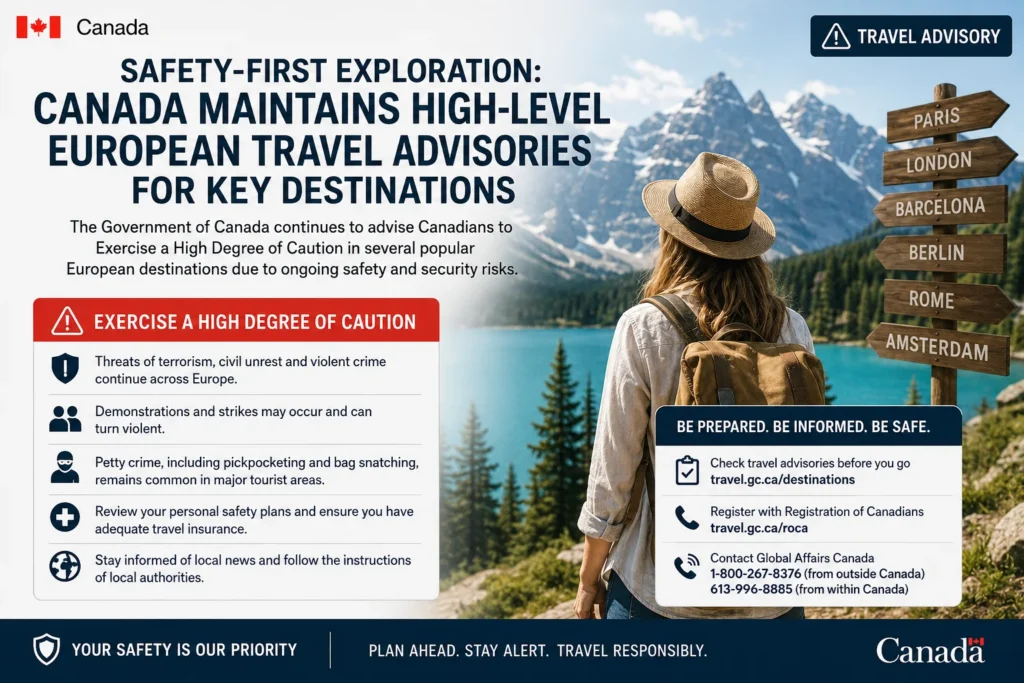
The Government of Canada has updated its international travel guidance, reinforcing Level 2 safety warnings for seven prominent European nations. Canadian citizens finalizing their summer and winter itineraries are being urged to carefully review the country-specific advisories for Denmark, France, Italy, Spain, Germany, Belgium, and the United Kingdom. Driven by an ongoing evaluation of global security dynamics and terrorism threat perceptions, these cautionary notices emphasize the need for heightened situational awareness when visiting some of the world’s most heavily frequented tourist hubs.
While transatlantic flights, leisure tours, and business travel remain fully functional across these regions, federal officials have opted for a proactive approach to public safety. The primary objective is to equip international travelers with the necessary information to safely navigate high-density public areas, including major metropolitan transportation terminals, heavily congested public squares, and world-renowned cultural monuments.
Deciphering the Canadian Travel Risk Assessment Matrix
To maximize personal safety abroad, it is essential for citizens to understand the standardized four-tiered warning framework utilized by Global Affairs Canada. This system allows prospective holidaymakers to accurately evaluate the geopolitical stability and safety metrics of a specific country prior to purchasing tickets or booking accommodations.
A Level 1 designation signifies that travelers only need to implement normal security precautions, indicating a baseline of stability equivalent to domestic conditions. A Level 2 notice—which currently governs the aforementioned European destinations—advises that visitors should exercise a high degree of caution. This classification is typically implemented when local conditions exhibit elevated crime rates, structural civil unrest, or a recognizable threat of targeted violence.
The most severe tiers consist of Level 3, which formally advises against all non-essential travel, and Level 4, an explicit recommendation to avoid all travel whatsoever. Industry analysts point out that while a Level 2 advisory does not restrict or discourage travel, it serves as an official reminder to practice active vigilance when moving through major urban spaces.
Security Postures and Petty Crime in France and Italy
France remains a central focus of these updated advisories due to its massive volume of annual international arrivals. Federal security assessments maintain the Level 2 status due to a generalized risk of terrorism, which has prompted local authorities to noticeably increase the presence of armed security personnel across Paris and other metropolitan centers.
These visible patrols are heavily concentrated around prominent religious structures, upscale shopping precincts, and major rail networks. Beyond structural threats, official statements highlight the persistent prevalence of opportunistic petty crime, such as organized pickpocketing and purse-snatching, particularly in high-density tourist zones during the peak holiday seasons.
Similarly, Italy’s travel notice emphasizes caution regarding large crowds and historic monuments. Cities experiencing massive seasonal tourism influxes—including Rome, Venice, Milan, and Florence—are designated as zones where travelers should remain particularly attentive. Local Italian law enforcement has deployed robust security details around ancient ruins, historic squares, and central transit hubs to successfully deter localized security incidents.
Monitoring Public Spaces in Belgium and the United Kingdom
Despite its compact geographic size, Belgium is subject to the same high degree of caution. National security operations remain active to closely monitor public gatherings, with an emphasis on protecting city centers and public transit systems. Official data suggests that massive outdoor music festivals, seasonal conventions, and large civic gatherings represent higher-density environments where international visitors should maintain elevated personal vigilance.
The United Kingdom’s Level 2 status reflects the broader regional security posture. Law enforcement agencies in major cultural hubs like London, Edinburgh, and Manchester have implemented highly visible policing strategies across government complexes and entertainment districts. Because the UK serves as a primary international aviation and maritime transit hub, major transportation networks and high-profile sporting venues are highlighted as sensitive zones subject to sudden security scale-ups.
Safety Profiles for Germany, Denmark, and Spain
Germany’s current travel classification is intrinsically tied to the overall security climate of Western Europe. Specialized security forces maintain an active, reassuring presence in primary destination cities like Berlin, Munich, and Frankfurt. Federal data indicates that large-scale seasonal public gatherings, such as traditional winter markets and outdoor beer festivals, draw immense crowds that require heightened awareness and proactive municipal policing to guarantee public welfare.
Denmark has also drawn specific mention in this latest wave of safety updates. Although the country consistently secures high placement on global indexes for quality of life and public safety, official Canadian metrics indicate that localized security risks cannot be entirely discounted. Travelers are encouraged to remain alert in Copenhagen’s central shopping corridors and on municipal train lines.
Spain mirrors these environmental realities. The Level 2 alert acknowledges the active monitoring systems utilized by Spanish authorities to protect historic quarters and nightlife districts in Madrid and Barcelona. Because high-density holiday environments inherently attract opportunistic property crime, travelers are reminded to safeguard their personal belongings and secure travel documents while enjoying the country’s diverse cultural offerings.
For more travel news like this, keep reading Global Travel Wire