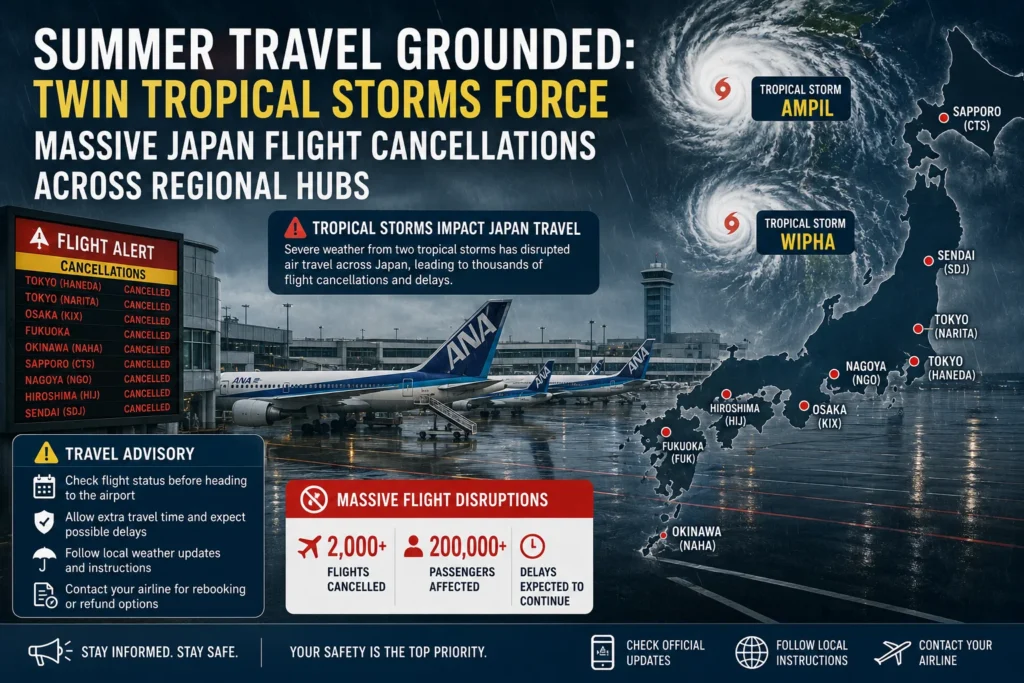
Japan’s aviation network has been pushed into widespread scheduling gridlock as a pair of powerful tropical weather systems barrels toward the archipelago. The multi-storm threat has forced major domestic carriers to implement immediate safety protocols, resulting in more than 100 preemptive flight suspensions. The simultaneous approach of Severe Tropical Storm Mekkhala and Tropical Storm Higos has produced severe conditions across the southern and western reaches of the country, directly impacting key transport gateways in Okinawa and Kyushu while sending secondary scheduling tremors into the nation’s premier mainland airport hubs.
With torrential downpours and violent wind gusts already lashing outer island territories, the convergence of these two distinct low-pressure systems represents a rare meteorological challenge. For international vacationers and domestic holidaymakers navigating Japan’s peak summer travel window, the active weather front has dramatically disrupted vacation itineraries, complicated transport linkages, and underscored the vulnerabilities of coastal transit infrastructure during the Pacific typhoon season.
The Atmospheric Dynamic Behind the Grounded Fleets
Official tracking briefs from the Japan Meteorological Agency (JMA) confirm that the country is grappling with an complex atmospheric interaction as both storms move closer together over coastal waters. Severe Tropical Storm Mekkhala, which was recently downgraded from a full typhoon but still packs destructive gusts of up to 144 kilometers per hour, is currently tracking past the southern Nansei Islands and is projected to skirt the coastlines of Kyushu and Shikoku.
Compounding the hazard, Tropical Storm Higos is migrating rapidly from the deeper Pacific Ocean. Forecasters warn that the proximity of these two distinct vortexes could generate the Fujiwhara effect—a complex atmospheric phenomenon where two nearby tropical systems begin to rotate around a common center or merge entirely. This interaction significantly complicates trajectory modeling, prompting transportation departments to lean heavily toward safety-first operational strategies.
Beyond the localized winds of the storm cores, a stalled seasonal rain front is interacting with the tropical moisture, dumping record-shattering precipitation across mainland prefectures. The city of Aso in Kumamoto Prefecture recorded 167.5 millimeters of rain over a mere 12-hour window, while Maibara in Shiga Prefecture logged an unprecedented 144 millimeters, establishing an all-time historical rainfall record for the municipality in the month of June.
Terminal Delays and Flight Suspensions in the Southern Corridors
The primary brunt of the operational fallout is concentrated across the southern air routes. Japan’s two principal carriers, Japan Airlines and All Nippon Airways, confirmed a combined cancellation of at least 120 flights scheduled to connect through Okinawa and Kagoshima. Airfields such as Naha Airport, a vital tourist artery for the tropical Ryukyu Islands, have experienced rolling operational pauses as cloud ceilings dropped and heavy squalls compromised runway visibility.
Conditions across the Kyushu region are equally severe. Tarmac and ground handling operations—including baggage loading, catering transfers, and aircraft refueling—stalled repeatedly as localized wind components exceeded safe legal working thresholds for airport personnel. To prevent an operational scenario where commercial aircraft become stranded at vulnerable regional outstations, network managers chose to proactively cancel return flights originating from Tokyo Haneda and Osaka Kansai before the airframes ever left the gates.
The disruption has quickly jumped from air corridors to the ground transit networks that international tourists rely on for regional exploration. Central Japan Railway issued warnings indicating that the vital Tokaido Shinkansen bullet train line faces imminent delays or suspensions, while East Japan Railway advised commuters of severe delays across regular urban and regional commuter tracks on the mainland.
Comprehensive Emergency Response and Public Safety Mandates
In a formal address to reporters, top government spokesman Minoru Kihara confirmed that the administration has enacted comprehensive disaster response measures in tight coordination with municipal authorities. While the priority remains centered on risk mitigation and managing localized infrastructure damage, the Fire and Disaster Management Agency took the substantial step of advising more than 1 million residents across high-risk zones to evacuate due to severe landslide and flash flooding alerts.
The JMA has maintained a Level 4 warning—the second-highest emergency tier—for potential debris flows and rising river levels in Yamaguchi, Fukuoka, and Oita prefectures. The sheer volume of rain has even impacted domestic manufacturing, forcing major automakers to temporarily shutter assembly lines at factories located within Fukuoka due to widespread regional road closures.
To support affected travelers during this transport crisis, major airlines have activated emergency consumer protocols. Passengers holding tickets for flights traversing the southern sectors are being offered flexible rebooking windows on subsequent flights free of charge, alongside full monetary refunds for completely aborted routes. Terminal operators are advising all incoming tourists to carefully monitor live flight status notifications via mobile applications and to secure confirmed reservations before making the journey to major airport departure halls.
For more travel news like this, keep reading Global Travel Wire