The Caribbean tourism and transit sector has been plunged into logistical gridlock following a catastrophic doublet earthquake sequence in northern Venezuela. According to official geological bulletins and civil defense ministries, two exceptionally powerful tremors struck back-to-back within a 39-second window. The dual-shock event has left extensive structural damage across major urban centers, prompted regional tsunami warnings across neighboring island destinations, and forced the total suspension of operations at Venezuela’s primary international aviation gateways.
Because the northern coast of South America serves as a vital bridge connecting regional Caribbean cruise networks, commercial flight paths, and tourism infrastructure, the seismic event has sent immediate scheduling shocks across the Americas. For international visitors, business travelers, and airlines operating within the Caribbean basin, the sudden closure of regional airspace has turned carefully planned itineraries into an ongoing emergency coordination effort.
The Destructive Science of the Doublet Fault Failure
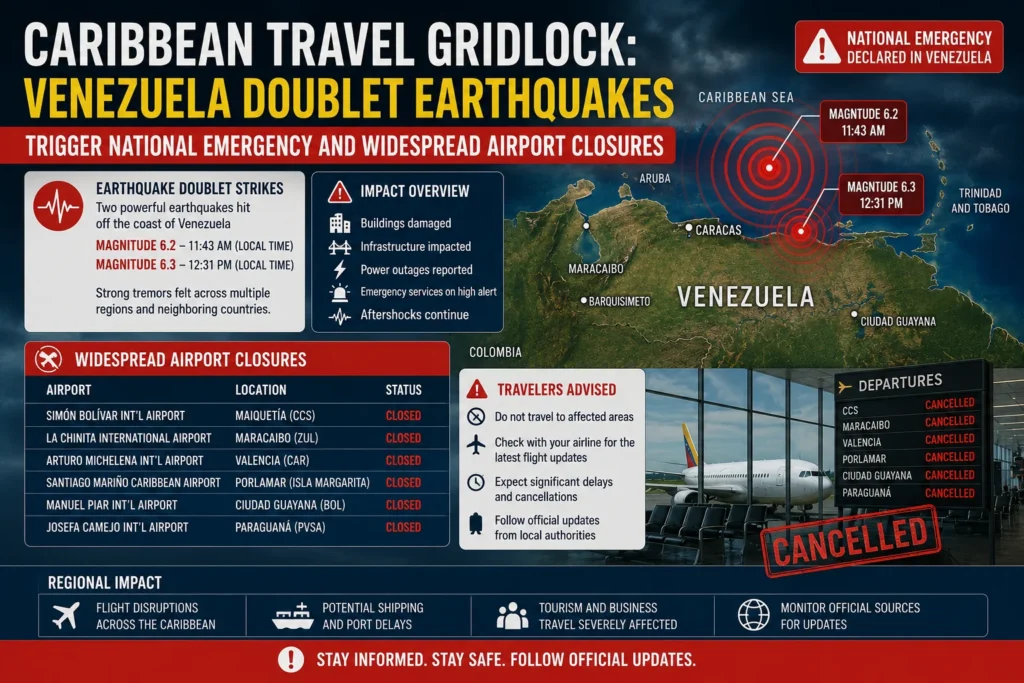
Official data verified by the United States Geological Survey (USGS) and regional seismological institutes highlights the unprecedented violence of the event. The disaster unfolded on June 24, 2026, when a magnitude 7.2 foreshock ruptured near the complex plate boundary where the Caribbean and South American tectonic plates meet horizontally along the San Sebastián and Boconó fault systems.
Before communities could process the initial shock, a secondary, even more massive magnitude 7.5 mainshock erupted just 39 seconds later near the Yumare-Morón corridor. This rare phenomenon—known as a doublet earthquake sequence—occurs when an initial fault rupture rapidly transfers static stress to an adjacent, locked segment of rock rather than fully releasing the energy.
Because both tremors were shallow crustal events, occurring at fragile depths between 10 and 22 kilometers, the seismic energy hit urban foundations with maximum force. The immediate results were a progressive structural failure cascade, entirely shattering the baseline for typical emergency response plans.
Devastation Spreads Across Key Tourism and Economic Zones
The geographical scope of the crisis spans the entire north-central corridor of the country. In the capital district of Caracas, severe ground acceleration resulted in the structural failure of numerous high-rise commercial buildings and apartments, completely paralyzing the municipal metro system and rendering local utility grids highly unstable.
The worst of the structural impact, however, is heavily concentrated along the coastal perimeter of La Guaira, a critical gateway for maritime tourism and cruise ship arrivals. In La Guaira, soft sedimentary soils exacerbated the ground movement through coastal amplification, triggering large-scale landslides and causing the complete collapse of more than 250 residential and commercial structures.
The industrial zones of Carabobo, Aragua, and Miranda have faced identical strain, logging widespread residential structural failures, fractured transport overpasses, and localized emergency evacuations. Official reports from the World Health Organization and the Pan American Health Organization (PAHO) confirm that emergency hospitals across the central states are operating under intense pressure, prompting the immediate activation of international medical surge teams to assist with mass casualty management.
Total Shutdown of Simón Bolívar International Airport
The seismic wave created an immediate operational emergency for Caribbean aviation infrastructure. In the immediate aftermath of the magnitude 7.5 mainshock, transport ministries ordered the complete closure of Simón Bolívar International Airport in Caracas—the nation’s largest aviation hub—to perform mandatory structural integrity assessments on its runways and terminal buildings.
With the airport disabled, regional control towers were forced to immediately implement large-scale flight diversions and preemptive route cancellations. The grounding of aircraft has stranded thousands of passengers inside transit zones and triggered a massive bottleneck across popular South American and Caribbean flight corridors, specifically severing the high-frequency air routes linking Caracas with Panama City and Bogotá.
Aviation officials are warning that the baseline for regional air travel will remain heavily modified for the foreseeable future. International airlines have rewritten their daily routing maps, using alternative flight paths to bypass northern Venezuelan airspace entirely, an operational adjustment that is increasing flight times and putting additional fuel burdens on commercial carriers across the region.
National State of Emergency and Recinded Tsunami Alerts
In response to the escalating crisis, the Venezuelan government officially declared a nationwide state of emergency, deploying civil protection units and military search-and-rescue teams to locate missing persons within the rubble. Public infrastructure, including sports complexes and educational centers, has been rapidly transformed into makeshift shelters for thousands of displaced residents.
The massive energy release along the coastal plate boundary initially triggered widespread panic across the broader Caribbean Sea. The Pacific Tsunami Warning Center swiftly issued a comprehensive tsunami alert for coastal communities throughout the basin. The urgent warnings targeted the ABC islands of Aruba, Bonaire, and Curaçao, alongside the US territories of Puerto Rico and the Virgin Islands.
Fortunately, subsequent real-time data from oceanographic monitoring buoys confirmed that the strike-slip nature of the fault movement did not result in the massive vertical displacement of the ocean floor required to generate a destructive maritime wave. All regional tsunami warnings were officially rescinded within hours, providing immense relief to coastal resort communities. As technical engineering teams begin the monumental task of inspecting damaged airport runways and maritime ports, international consulate offices are advising all foreign nationals to maintain close contact with their respective embassies and secure verified travel notifications before attempting to navigate the region.
For more travel news like this, keep reading Global Travel Wire