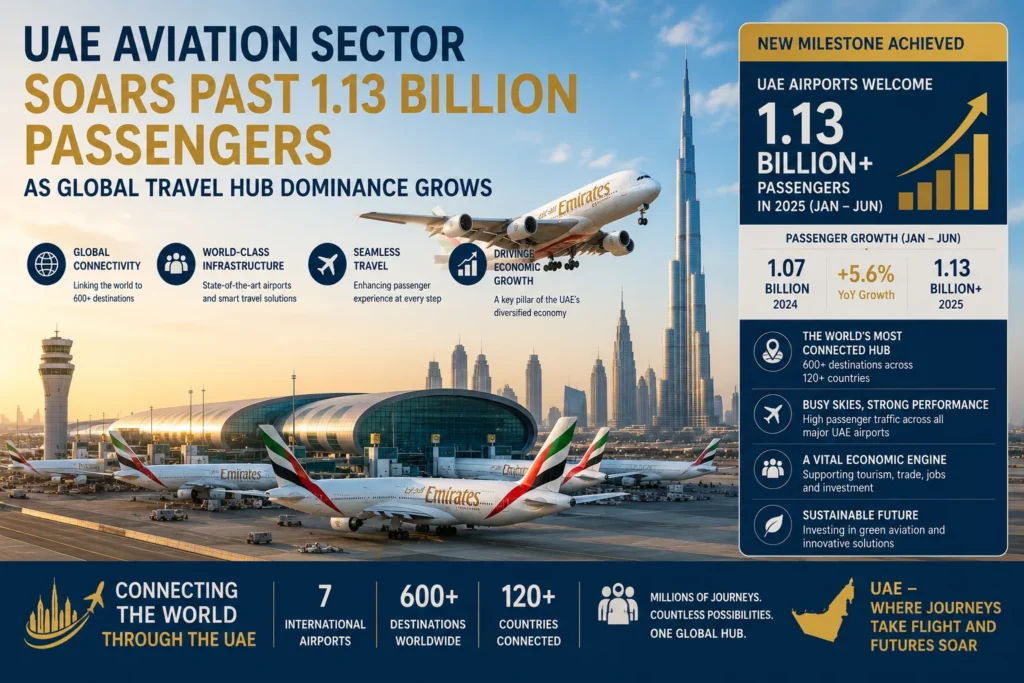
Official statistical reports released by the Federal Competitiveness and Statistics Centre demonstrate a decade of transformative growth across the United Arab Emirates’ civil aviation ecosystem. Between 2016 and 2025, airports across the nation collectively handled over 1.13 billion passengers and recorded more than 6.16 million aircraft movements. These figures underscore the country’s position as a central international crossroads for leisure travel, commercial transit, and global trade.
The long-term data highlights the success of national economic diversification strategies, sustained investments in airport infrastructure, and the continuous expansion of home-carrier flight networks. With international visitor arrivals and transit passenger volumes reaching record levels, the aviation sector remains a primary engine driving national economic competitiveness.
A Decade of Expansion in Passenger Volumes and Flight Operations
Annual airport performance metrics indicate a strong upward trajectory in both air traffic density and passenger throughput. By 2025, annual passenger traffic across all UAE airports surged to 156.87 million travelers, representing a 26.1 percent increase compared to the beginning of the ten-year period. Over the same timeframe, annual aircraft movements grew by 21 percent to reach 828,570 take-offs and landings.
Year-on-year comparisons reveal steady post-pandemic acceleration. In 2025 alone, passenger numbers expanded by 6.1 percent over 2024 levels, adding approximately nine million travelers to the national network in a single year. Flight operations similarly grew by 7.4 percent, representing an additional 56,772 flight movements.
When measured against 2019 pre-pandemic benchmarks, the sector’s structural expansion becomes even more evident. Annual passenger traffic in 2025 surpassed 2019 levels by 22.6 percent, reflecting nearly 29 million additional travelers, while annual flight movements increased by 34.2 percent, adding more than 211,000 flights to the national airspace system.
Dubai Leads National Aviation Operations with Dominant Market Share
Dubai’s aviation gateways maintained their position as the primary volume driver for national passenger traffic and flight operations throughout the ten-year review period. Between 2016 and 2025, Dubai airports processed 804.6 million passengers, accounting for 71.2 percent of the national total.
In terms of flight activity, Dubai led the nation with approximately four million aircraft movements, representing 64.9 percent of all take-offs and landings recorded across the country. The continuous modernization of passenger terminal facilities, the expansion of high-capacity long-haul routes, and the strategic positioning of home carriers have allowed Dubai to retain its status as the world’s premier international passenger hub.
Regional Aviation Hubs Drive Multi-Airport Growth Across the Emirates
While Dubai represents the largest single traffic share, regional airports across the other emirates contributed significantly to national connectivity and capacity expansion over the decade.
Abu Dhabi ranked as the second-largest aviation market in the country, processing 210.8 million passengers between 2016 and 2025, representing an 18.7 percent share of national traffic. Flight operations in the UAE capital reached 1.28 million movements during the same period, supported by the opening of state-of-the-art terminal facilities and expanding long-haul flight connections to key commercial markets across Asia, Europe, and North America.
Sharjah established itself as a critical regional nexus for low-cost passenger traffic and air freight operations. Between 2016 and 2025, Sharjah International Airport handled 110.1 million passengers (9.7 percent of national traffic) and managed 827,170 aircraft movements.
Emerging gateways in the northern emirates, including Ras Al Khaimah International Airport and Fujairah International Airport, also recorded accelerated growth rates. These regional airports have played an increasingly important role in diversifying tourist arrivals, serving specialized charter operations, and supporting regional economic development outside the primary metropolitan centers.
Strategic Infrastructure and Economic Vision 2031
The official statistics published by the Federal Competitiveness and Statistics Centre reflect broader national initiatives aimed at elevating the country’s global logistics and tourism profile. Statements from the Ministry of Economy and Tourism and the General Civil Aviation Authority emphasize that sustained capital investment in air traffic management systems, airport expansions, and guest experience technologies are central to fulfilling the objectives of the “We the UAE 2031” economic vision.
According to international competitiveness evaluations, the UAE consistently ranks at the top of global indices for air transport quality, airport infrastructure efficiency, and overall aviation system connectivity. The integration of international transit passengers with expanding domestic tourism offerings ensures that the civil aviation framework continues to serve as a cornerstone of sustainable national growth for decades to come.
For more travel news like this, keep reading Global Travel Wire