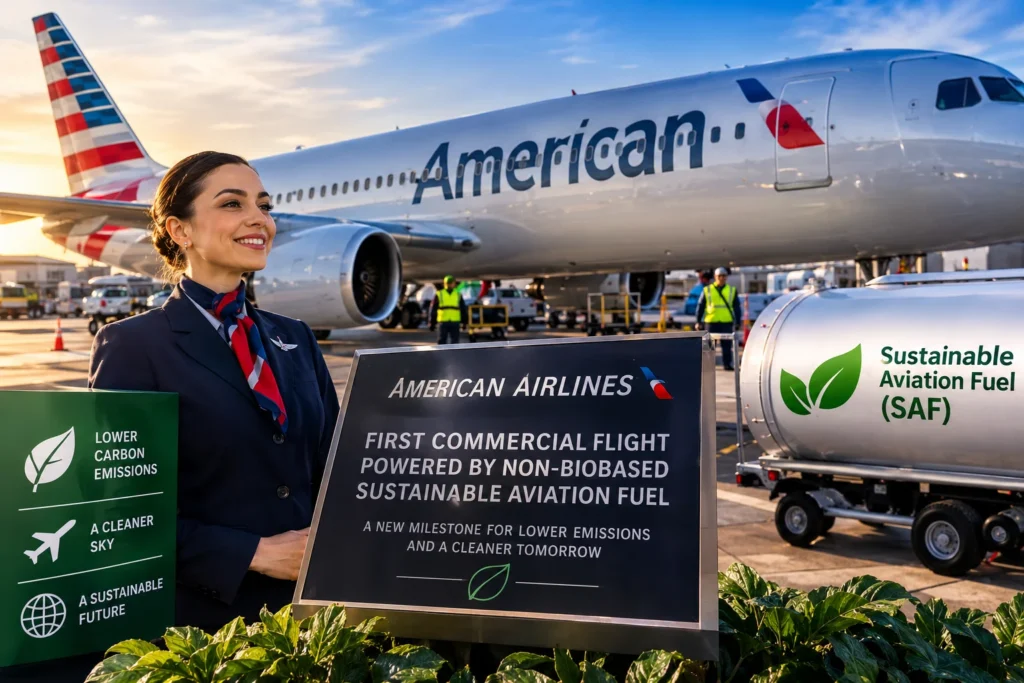
Commercial aviation reached a pivotal sustainability milestone as American Airlines completed the first passenger flight in the United States powered by non-biobased sustainable aviation fuel. Operating between Corpus Christi International Airport (CRP) and Dallas Fort Worth International Airport (DFW) in Texas, the historic flight demonstrated the real-world viability of synthetic electro-sustainable aviation fuel, commonly known as eSAF.
Unlike traditional sustainable aviation fuels that rely on biological feedstocks such as agricultural crops, animal fats, or used cooking oils, the eSAF utilized for this commercial service was manufactured using captured waste carbon dioxide and renewable electricity. The achievement proves that ultra-low-carbon fuel technologies can seamlessly integrate into existing airport refueling systems and commercial aircraft operations without requiring mechanical modifications or specialized handling.
Electro-Sustainable Aviation Fuel (eSAF) Production Cycle
├── Capture: Industrial Waste Carbon Dioxide (CO2)
├── Power: 100% Renewable Electricity & Water Electrolysis
├── Synthesis: Power-to-Liquids Catalytic Transformation
└── Delivery: Drop-In ASTM Jet-A Blended Fuel Infrastructure
Power-to-Liquids Technology Transforms Carbon Capture into Jet Fuel
The synthetic jet fuel powering the flight was engineered and produced by clean technology firm Infinium at its Pathfinder facility in Corpus Christi. As the world’s first commercial-scale power-to-liquids production site, the Pathfinder plant utilizes proprietary catalytic processes to convert waste carbon emissions and hydrogen derived from renewable power into drop-in synthetic hydrocarbons.
Power-to-liquids technology represents a technological leap forward for the global aviation sector. While biobased aviation fuels offer significant emissions reductions over conventional petroleum, their long-term scalability is often constrained by feedstock availability, land-use competition, and supply chain logistics. By decoupling fuel production from agricultural supply chains, non-biobased eSAF provides a virtually limitless production pathways where renewable power and industrial carbon capture intersect.
Comprehensive lifecycle analysis indicates that eSAF can reduce lifecycle greenhouse gas emissions by more than 90 percent compared to conventional petroleum-based jet fuel. Furthermore, the synthetic fuel burns cleaner than traditional jet fuel, producing negligible sulfur oxides and significantly lower particulate matter, which helps mitigate non-carbon aviation impacts such as contrail formation.
Seamless Airport Integration Validates Drop-In Infrastructure Compatibility
A critical objective of the commercial demonstration was verifying that synthetic eSAF functions seamlessly within standard airport supply chains. Prior to fueling the aircraft, Infinium blended the eSAF batch with conventional Jet-A fuel to ensure strict compliance with ASTM International performance specifications.
The certified fuel blend was delivered directly into the shared fuel hydrant infrastructure at Corpus Christi International Airport. From the common fuel storage tanks, the fuel was allocated into the operating aircraft without requiring segregated piping, dedicated trucks, or specialized ground support equipment.
Demonstrating drop-in compatibility removes one of the largest operational barriers to sustainable fuel adoption. Airlines and airport operators can utilize existing multi-billion-dollar refueling networks, allowing commercial flights to incorporate synthetic fuels immediately as production volumes become available worldwide.
Industry Leadership Drives Transition to Low-Carbon Commercial Aviation
Executive leaders from both American Airlines and Infinium emphasized that moving next-generation fuel technologies from laboratory development into active passenger operations is vital for meeting global net-zero aviation targets.
American Airlines Chief Executive Officer Robert Isom stated that the flight represents a landmark moment for commercial aviation, demonstrating how early investments in advanced fuel technologies can transition into practical, real-world application. Isom noted that scaling sustainable fuel production at competitive price points is essential to lowering airline emissions, maintaining long-term commercial competitiveness, and preserving global air connectivity.
Infinium Chief Executive Officer Robert Schuetzle highlighted that adding certified eSAF to the company’s production capabilities proves that scalable, low-carbon fuels made from waste carbon and green energy can reliably power commercial passenger transport.
Scaling Synthetic Fuel Production for Global Tourism and Corporate Travel
While the milestone flight represents an operational breakthrough, expanding eSAF availability to meet global commercial demand requires significant industrial scaling. To secure future supply, American Airlines has established a commercial off-take agreement to purchase substantial volumes of eSAF from Infinium’s planned Project Roadrunner facility in West Texas.
Currently under construction with support from international financial partners, Project Roadrunner is scheduled to begin commercial deliveries. Upon reaching full operational capacity, the facility is projected to produce more than five million gallons of eSAF annually. Additionally, strategic corporate travel partnerships, including corporate emissions reduction agreements, are helping aggregate demand to accelerate project financing and facility deployment.
As global travelers and enterprise travel buyers increasingly prioritize environmental sustainability, the successful deployment of non-biobased sustainable aviation fuel establishes a blueprint for decarbonizing long-haul air travel, protecting global tourism ecosystems, and building a cleaner future for international aviation.
For more travel news like this, keep reading Global Travel Wire