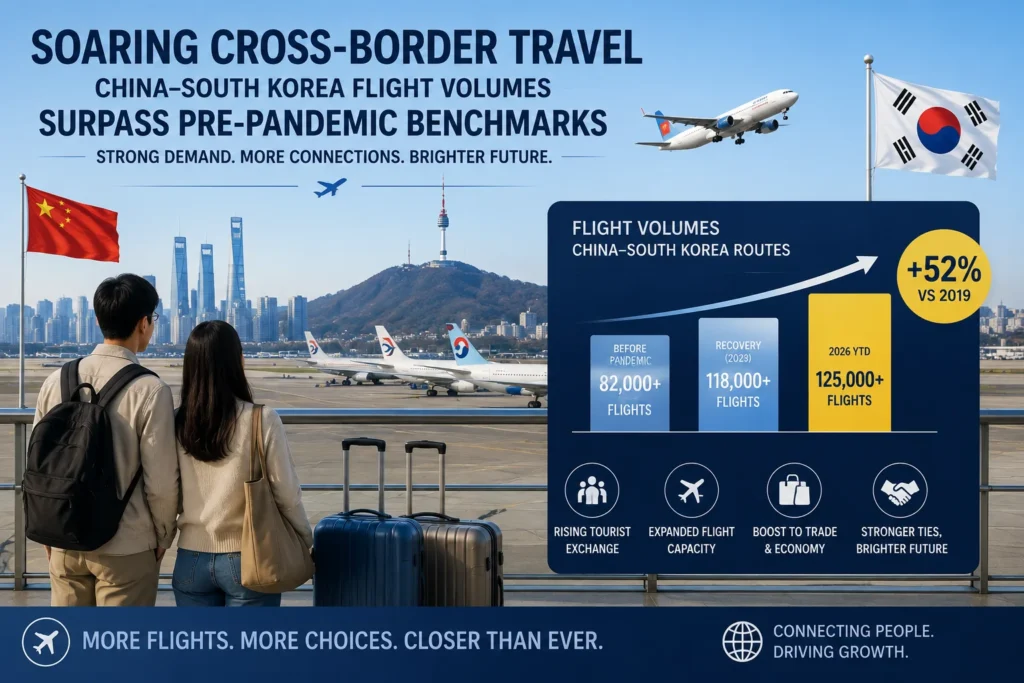
Cross-border aviation between China and South Korea is maintaining exceptionally strong momentum, driven by expanded airline networks, visa facilitation measures, and robust consumer demand for regional travel. Official civil aviation operational figures reveal that passenger flight schedules between the two East Asian nations have stabilized at near-peak capacity, significantly exceeding pre-pandemic operational levels and establishing new milestones for regional tourism recovery.
Aviation and transportation data indicates that over 5,140 commercial passenger flights operated along China-South Korea air corridors during the fortnight spanning late July and early August. This flight volume represents a 10.7% expansion compared to the same period in the previous year and a 12% surge over equivalent pre-pandemic baselines. The sustained frequency demonstrates that passenger demand across business, leisure, and cultural travel sectors has fully transitioned from initial recovery into structural expansion.
Visa Facilitation and Travel Policy Incentives Drive Inbound Growth
The primary catalyst behind this sustained surge in air traffic is the implementation of favorable immigration policies and reciprocal travel facilitation frameworks. Unilateral visa-free entry arrangements for South Korean passport holders visiting China, combined with the extension of group visa fee waivers by justice and tourism authorities through the end of the year, have substantially lowered entry barriers for international travelers.
Official immigration statistics confirm that approximately 1.7 million South Korean nationals visited China during the first six months of the year, marking a 16% year-on-year increase. South Korea has solidified its position as the leading inbound source market for Chinese tourism destinations. In response to simplified entry procedures, short-term weekend getaways have gained significant popularity. Flight departure schedules reveal a pronounced concentration of leisure travelers departing on Friday afternoons and returning on Sunday evenings, with key commercial hubs such as Shanghai recording high passenger occupancy rates among foreign visitors during weekend travel windows.
Similarly, group travel programs backed by regional government initiatives have successfully energized local tourism economies. By waiving administrative visa processing fees for foreign tour groups, both nations have incentivized travel agencies to develop diverse itinerary packages, ranging from urban shopping tours in Seoul and Busan to cultural exploration trips across eastern and southwestern China.
Airline Fleet Capacity Expansion and Increased Route Frequencies
To accommodate the growing volume of international passengers, major flag carriers and low-cost airlines have expanded flight frequencies and introduced new point-to-point connections. Fleet deployment metrics show significant growth across key performance indicators, including available seat capacity, total passenger volume, and passenger load factors.
Across major regional carriers, seat capacity on routes connecting South Korea and China expanded by more than 26% year-on-year during the first seven months of the year. Actual passenger volume outpaced capacity growth, surging by over 37% during the same timeframe, while average passenger load factors climbed past 86%. This strong demand profile reflects high passenger utilization rates across both primary international hubs and regional secondary airports.
Increased route density is particularly evident across coastal aviation gateways. In eastern China, daily passenger flights connecting Qingdao with Seoul reached an average of 18 departures per day, providing business travelers and tourists with flexible, high-frequency flight schedules.
Regional airport hubs across Northeast China are also playing a central role in facilitating cross-border mobility. Yanji Chaoyangchuan International Airport broadened its direct South Korean route network to encompass six major destinations, including Busan, Cheongju, and Daegu. Operating hundreds of monthly flights and recording daily peaks of up to 26 departures, the airport has emerged as a crucial aviation gateway for passenger traffic between Northeast China and South Korea.
Economic Synergy and the Future Outlook for Northeast Asian Tourism
The sustained growth in air connectivity reflects a broader deepening of economic, commercial, and cultural ties across Northeast Asia. Government tourism boards and industry analysts emphasize that international travel acts as a vital bridge for trade, foreign direct investment, and bilateral exchanges.
As municipal tourism departments and airport authorities continue upgrading passenger services, the outlook for East Asian regional travel remains highly positive. The combination of expanded flight availability, streamlined border controls, and targeted promotional campaigns positions China and South Korea to sustain elevated tourist arrivals through upcoming autumn and winter travel seasons. Destinations that prioritize seamless aviation connectivity and accessible visa procedures are well-positioned to capture a growing share of global tourism demand.
For more travel news like this, keep reading Global Travel Wire