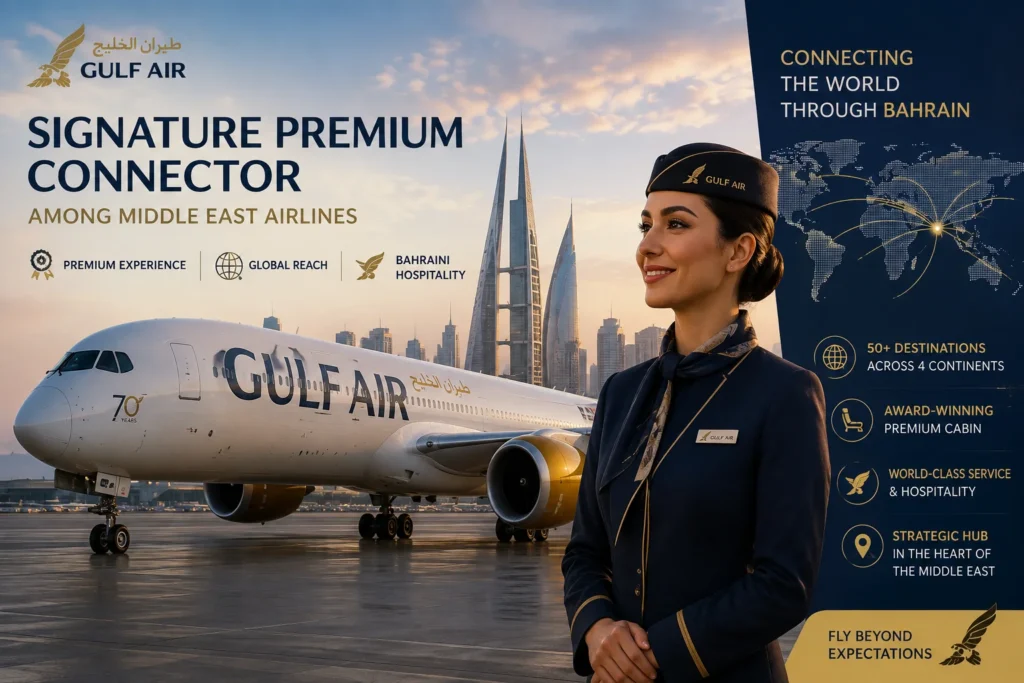
In an increasingly crowded regional aviation market, Gulf Air—the national carrier of the Kingdom of Bahrain—is defining its commercial positioning to differentiate itself from major neighboring airlines. Operating out of Bahrain International Airport, the country’s sole commercial gateway, the flag carrier is leveraging its 76-year operational legacy to serve international travelers through a distinct identity: a signature premium connector.
Rather than attempting to match the massive fleet scale or transfer hubs of neighboring carriers across the Arabian Gulf, Gulf Air leadership is establishing an operational framework centered on premium service quality, efficient transit times, and streamlined passenger processing.
Streamlined Airport Transfers and Rapid Transit Operations
A cornerstone of Gulf Air’s market strategy is the structural layout and proximity of its hub at Bahrain International Airport. Situated in Muharraq, adjacent to the capital city of Manama, the airport offers unmatched geographic accessibility compared to sprawling multi-terminal facilities in larger aviation hubs.
This compact footprint enables unique operational efficiencies that larger regional hub airports cannot easily match. Official performance metrics and carrier operations highlight key transit advantages:
Fast Airport Navigation: Premium and standard passengers benefit from streamlined security check-ins and short walking distances, allowing movement from landside drop-off to the departure gate in as little as 10 minutes.
40-Minute Minimum Connection Time: The centralized terminal infrastructure supports a minimum connecting time (MCT) of just 40 minutes, significantly reducing layover durations for long-haul international transfers.
Regional Accessibility: The airport’s location provides rapid access for passengers arriving via causeway links from neighboring Saudi Arabia, effectively expanding the carrier’s primary home catchment area.
By emphasizing speed and ease of transfer, the carrier appeals to corporate travelers and long-haul passengers seeking to avoid the congestion associated with mega-hub terminals.
Fleet Development and Long-Haul Connectivity Growth
To support its global reach as a signature premium connector, Gulf Air is continuously modernizing its mainline fleet. The carrier’s long-haul network relies heavily on its fleet of Boeing 787-9 Dreamliners, which serve long-distance routes linking Asia, Europe, and North America.
The long-haul cabin architecture emphasizes high-end passenger comfort. Fitted with Falcon Gold business class suites, the Boeing 787-9 layout provides flatbed seats, dedicated dining programs featuring local and international culinary offerings, and expanded space ratios. Complementing its long-haul operations, the carrier utilizes a fleet of Airbus A320neo and A321neo narrowbody aircraft to handle high-frequency regional routes across the Middle East and South Asia.
In addition to physical seating enhancements, the airline is upgrading its digital in-flight experience across both long-haul and regional fleets. The fleet-wide rollout of high-speed Starlink satellite Wi-Fi provides passengers with high-speed connectivity throughout their journey, aligning with modern corporate travel standards.
Connecting Key International Markets and Regional Routes
Gulf Air maintains a strategic global network designed to connect major commercial centers with the Middle East while securing essential airlift for the Kingdom of Bahrain.
| Network Segment | Key International Destinations Served | Primary Aircraft Operated |
| North America & East Asia | New York (JFK), Shanghai, Guangzhou, Manila, Singapore, Bangkok | Boeing 787-9 Dreamliner |
| Europe & UK | London Heathrow, London Gatwick, Manchester, Frankfurt, Paris, Milan, Madrid | Boeing 787-9 / Airbus A321neo |
| South Asia | New Delhi, Mumbai, Karachi, Lahore, Islamabad, Dhaka, Colombo | Airbus A320neo / A321neo family |
| Regional Middle East | High-frequency corridors including Dubai, Riyadh, Kuwait, and Muscat | Airbus A320 family |
The network balances long-haul intercontinental connections—such as linking North America and East Asia through Bahrain—with point-to-point traffic, ensuring strong commercial ties for regional trade and tourism.
Long-Term Outlook for Aviation Growth in Bahrain
The airline’s strategic refinement aligns directly with the Kingdom of Bahrain’s long-term economic diversification goals under Vision 2030. By positioning its national airline as a high-quality connector rather than a high-volume transit carrier, the kingdom aims to strengthen its status as a specialized hub for business travel, tourism, and logistics.
Through continuous fleet investments, enhanced digital services, and a focused commercial strategy, Gulf Air remains committed to delivering a distinctive hospitality experience while providing efficient global connectivity for international travelers.
For more travel news like this, keep reading Global Travel Wire