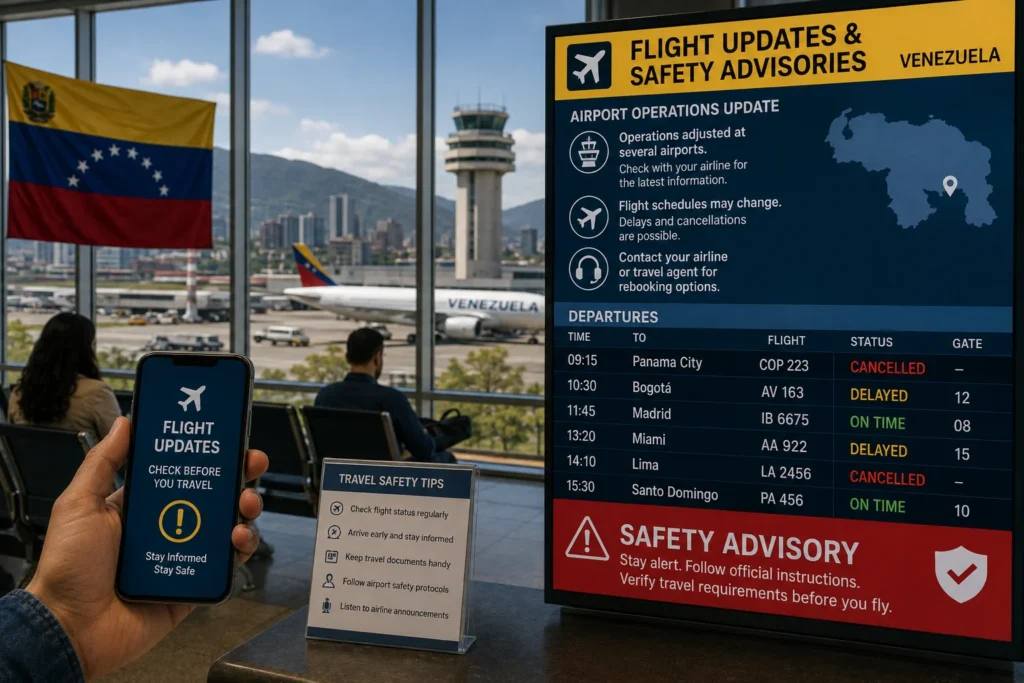
Official government guidance updates have introduced strict safety warnings and travel adjustments across Venezuela following significant seismic events and ongoing security challenges. The United Kingdom Foreign, Commonwealth & Development Office (FCDO) has revised its official travel advisory, advising against all travel to high-risk regional zones and warning against non-essential travel across the remainder of the country.
The advisory updates follow two major earthquakes registering magnitudes 7.2 and 7.5 that struck northern coastal areas west of Caracas. The seismic activity triggered landslides and physical infrastructure damage across La Guaira and parts of the capital district, directly impacting primary transportation networks.
Infrastructure Impact and the Shift to Regional Airport Hubs
The primary commercial air gateway serving the capital, Maiquetía Simón Bolívar International Airport (CCS), has suspended commercial passenger flights due to necessary infrastructure evaluations and repairs. To maintain international air transit links, commercial operations have been rerouted through four designated regional air gateways.
Aviation authorities and government transport departments recommend that travelers holding reservations confirm their flight status directly with operating airlines. International connections are currently being maintained through the following active airports:
Arturo Michelena International Airport (VLN – Valencia): Serving as a primary alternative entry point for passengers traveling toward central regions.
Jacinto Lara International Airport (BRM – Barquisimeto): Operational for international commercial connections with onward transport verifications advised.
General José Antonio Anzoátegui International Airport (BLA – Barcelona): Handling rerouted commercial passenger traffic along the eastern coastal corridor.
La Chinita International Airport (MAR – Maracaibo): Active for international arrival and departure flights in western territories.
The temporary commercial closure of the capital’s main airport emphasizes the sensitivity of regional transit networks during natural disaster responses. While alternative regional hubs prevent a total air transit suspension, ground travel between regional airports and central urban areas presents logistical challenges that require advance planning.
Government Safety Warning Tiers and Regional Hazard Profiles
Official foreign ministry guidelines categorize Venezuela’s territories into distinct risk tiers based on geological hazards, localized disaster declarations, and security conditions.
| Regional Zone / State | Official Travel Advisory Level | Primary Hazard & Risk Profile |
| Border Regions (Colombia & Brazil) | Advise Against All Travel | High risk within 80 km of Colombian and 40 km of Brazilian borders. |
| Zulia State | Advise Against All Travel | Heightened security risks and regional operational constraints. |
| Bolívar State (Orinoco Mining Arc) | Advise Against All Travel | Restricted security zones south of the Orinoco River. |
| La Guaira (Coastal Zone) | Emergency Management Zone | Severe structural damage from recent seismic activity; active military control. |
| Remaining National Territories | Advise Against All But Essential Travel | Infrastructure disruptions, periodic utility cuts, and limited emergency services. |
Government advisories emphasize that standard travel insurance policies are frequently invalidated when traveling into regions designated under “all travel” or “all but essential travel” warnings. Travelers are urged to verify policy terms directly with insurance underwriters prior to undertaking transit.
Official Entry Requirements and Passenger Compliance Directives
Travelers entering Venezuela under permitted circumstances must adhere to strict immigration and border protocols established by national civil authorities and SAIME (Servicio Autónomo de Registros y Notarías).
Passport Validity and Visa Regulations
All foreign passports must maintain a minimum validity period of six months beyond the intended date of departure. Tourists arriving by commercial air routes may receive a tourist card upon arrival valid for up to 90 days, provided they present proof of an onward or return ticket and confirmed accommodation details. Travelers entering via land or sea routes, as well as those traveling for non-tourism purposes (including journalism, voluntary work, or business), are required to secure an appropriate visa in advance through a Venezuelan diplomatic mission.
Border Controls and Dual Nationality Laws
Land border crossings with neighboring countries remain strictly controlled or closed. Official travel advisories explicitly caution against attempting overland border transit. Under national law, dual Venezuelan citizens are legally required to enter and exit the country using valid Venezuelan identity documents and passports.
Geological Safety and Landslide Precautions
The United States Geological Survey (USGS) and local emergency management agencies warn that seismic aftershocks combined with seasonal rainfall increase the risk of secondary landslides, particularly along mountainous roadways between coastal ports and interior valleys. Travelers driving through affected mountainous regions are advised to monitor official weather bulletins and watch for physical hazards such as ground displacement, rockfalls, or unstable slope conditions.
Long-Term Recovery and Transit Preparedness
National emergency response agencies continue conducting structural integrity reviews on public transit systems, bridges, and aviation infrastructure. Government civil defense updates advise all residents and visiting foreign nationals to remain outside damaged structures, maintain personal emergency action plans, and keep continuous contact with airline representatives regarding operational flight schedules.
As aviation authorities work to restore standard commercial operations at Maiquetía Simón Bolívar International Airport, international travel planning to the region requires strict adherence to official government notices and active verification of entry documentation.
For more travel news like this, keep reading Global Travel Wire