The Australian Department of Foreign Affairs and Trade (DFAT) has issued an updated security and transit alert for multiple destinations across the Middle East. Circulated via the government’s official Smartraveller platform, the revised guidance details a volatile regional security environment that presents ongoing challenges for international civil aviation, consumer holiday planning, and commercial transit corridors. Federal authorities are urging citizens to evaluate their itineraries carefully, warning that localized tensions can cause immediate flight cancellations, sudden airspace restrictions, and unexpected border closures.
While diplomatic breakthroughs, such as the mid-June 2026 de-escalation agreement between the United States and Iran, have prompted recent safety updates, government strategists emphasize that long-term stability remains unpredictable. For international tourists and business travelers utilizing Gulf mega-hubs as stepping stones between Europe, Asia, and Oceania, the fluid security environment requires continuous vigilance and proactive itinerary management.
Dynamic Risk Tiering and Major Transit Hub Classifications
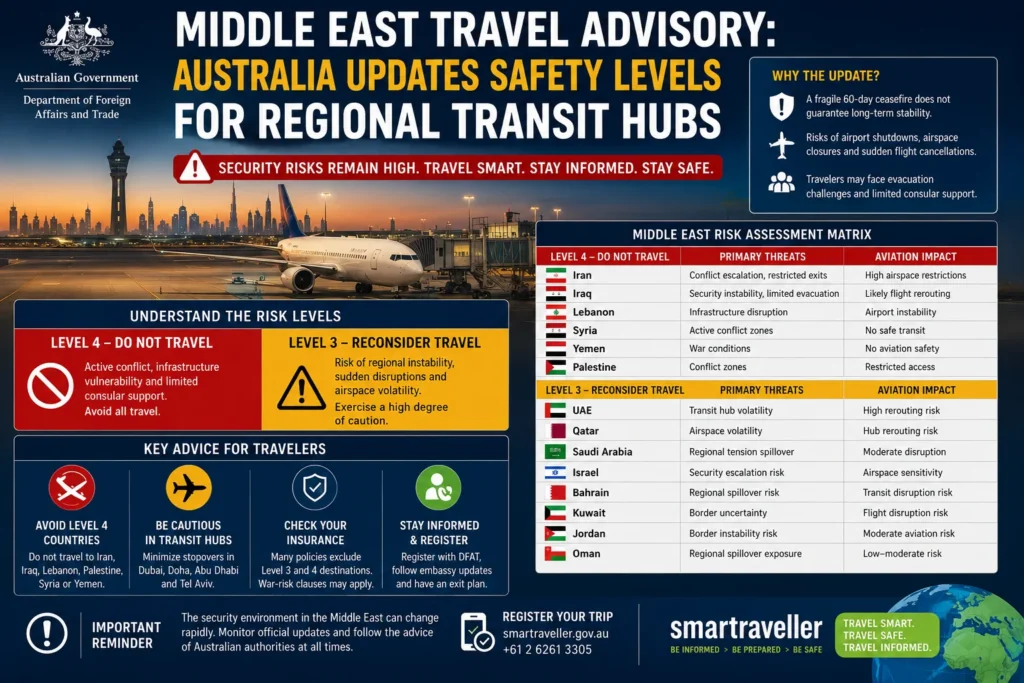
The Australian government structures its official safety notices using a four-tier risk classification matrix. In the latest ministerial update, several high-traffic destinations and transit zones have been adjusted to reflect changing field conditions, splitting the region into distinct operational tiers.
Under the updated directives, a collection of prominent commercial and tourism destinations have been moved to Level 3, which advises citizens to “Reconsider Your Need to Travel.” This specific category currently applies to Bahrain, Israel, Kuwait, Qatar, and the United Arab Emirates (UAE), alongside preexisting Level 3 advisories for Jordan, Oman, and Saudi Arabia.
While primary international aviation nodes—including Dubai International Airport, Hamad International Airport in Doha, and Zayed International Airport in Abu Dhabi—remain fully operational, they are flagged as high-alert environments. Federal officials point out that even when a destination is categorized under Level 3, airspace management authorities may implement sudden, short-notice corridor closures to safeguard commercial jetliners from regional cross-border activity.
Simultaneously, the strict Level 4 “Do Not Travel” designation remains firmly in place for high-conflict territories and highly vulnerable infrastructure zones. This extreme risk classification continues to cover Iran, Iraq, Lebanon, the Palestinian Territories, Syria, and Yemen. For these nations, the Australian government explicitly notes that active security risks are severe, commercial transit alternatives are highly constrained, and the capacity for embassies to provide direct consular or evacuation assistance is severely limited.
Middle East Regional Security and Aviation Risk Matrix
The operational parameters established by federal transport ministries outline the official safety rankings and corresponding transit warnings for major regional destinations.
| Destination Country | Official Advice Level | Primary Transit Risk Factors | Expected Civil Aviation Impact |
| Iran | Level 4: Do Not Travel | Infrastructure vulnerability, rapid escalation | Severe airspace closures, limited exits |
| Iraq | Level 4: Do Not Travel | Active security threats, limited safety assets | Routine flight rerouting enforced |
| Lebanon | Level 4: Do Not Travel | Severe regional instability, civil volatility | High risk of sudden terminal shutdowns |
| Palestinian Territories | Level 4: Do Not Travel | Active conflict zones, high-risk security | Restricted land and air movement |
| Syria | Level 4: Do Not Travel | Ongoing military conflict, high danger | Commercial aviation completely suspended |
| Yemen | Level 4: Do Not Travel | Widespread war conditions, high instability | Comprehensive lack of airspace safety |
| United Arab Emirates | Level 3: Reconsider Travel | Strategic transit hub proximity, escalation risk | Short-notice rerouting, schedule volatility |
| Qatar | Level 3: Reconsider Travel | High-density hub vulnerability, regional tension | Potential flight path adjustments |
| Israel | Level 3: Reconsider Travel | Regional escalation risk, localized flashpoints | High airspace sensitivity, snap cancellations |
| Kuwait | Level 3: Reconsider Travel | Border infrastructure sensitivity, security shifts | Possible gateway delays, route adjustments |
| Saudi Arabia | Level 3: Reconsider Travel | Regional tension spillover, safety variances | Moderate route deviations expected |
| Jordan | Level 3: Reconsider Travel | Border proximity risks, regional civil unrest | Minor to moderate transport shifts |
| Bahrain | Level 3: Reconsider Travel | Regional security exposure, transit caution | Low to moderate operational changes |
| Oman | Level 3: Reconsider Travel | General regional spillover considerations | Low overall aviation disruption baseline |
Insurance Deficits and Financial Travel Vulnerabilities
A critical section of the federal advisory focuses on the sudden financial exposures facing international holidaymakers during periods of geopolitical volatility. DFAT strongly encourages all outbound passengers to audit their comprehensive travel insurance policies before booking flights or confirming cruise departures.
Standard consumer travel protection packages routinely carry general exclusions regarding war, acts of war, or military actions. If a traveler voluntarily chooses to enter or transit a zone designated as Level 3 or Level 4, their policy provider may legally reject claims relating to itinerary disruptions, emergency medical transfers, or forced accommodation extensions.
Furthermore, because these security parameters are now publicly documented, subsequent flight cancellations or border closures are legally viewed as “known circumstances.” Consequently, claims filed for sudden travel changes under these conditions may be disqualified from financial reimbursement, leaving self-funded tourists responsible for emergency rebooking fees and alternative transit costs.
Precautionary Guidelines for Active Travelers
For global tourists currently situated within the region or managing essential transit paths through major Gulf terminals, emergency response agencies recommend a systematic safety approach:
Minimize Stopover Duration: Keep airport transit windows as brief as possible when routing through Level 3 destinations, avoiding non-essential overnight stays outside airport secure zones.
Maintain Digital Registry Profiles: Australian nationals should log their active itineraries and contact data directly with the DFAT Crisis Registration Portal to receive timely emergency updates.
Coordinate Carrier Communication: Establish direct notification links with operating airlines to receive instant tracking alerts regarding gate alterations, flight diversions, or schedule changes.
Secure Document Redundancy: Keep physical and digital duplicates of valid passports, transit visas, and onward booking confirmations safely secured within carry-on baggage.
National aviation ministries continue to monitor the intersection of diplomatic negotiations and civil aviation safety across the region. As international travel demand remains high, adhering to verified government advisories and maintaining robust situational awareness is the most effective approach to navigating complex international transit lanes safely.
For more travel news like this, keep reading Global Travel Wire