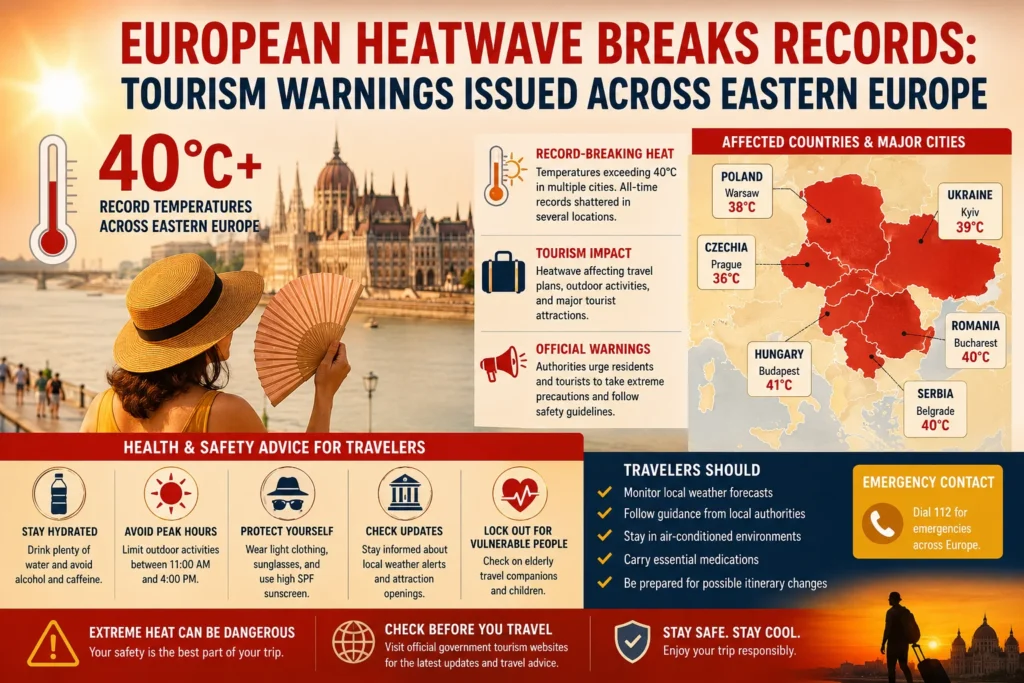
A historic meteorological event is altering the peak summer travel season across the continent. National meteorological agencies and federal ministries have issued widespread public safety declarations as a prolonged period of extreme temperatures in Europe moves steadily eastward. Official forecast models from state weather services confirm that tens of millions of international tourists and residents are facing an unprecedented weekend of intense heat. Regional governments are actively modifying public infrastructure, adjusting transit schedules, and issuing strict health advisories to manage the operational strain.
Statistical compilations from state environmental departments show that over 193 million people across the European continent experienced ambient temperatures exceeding 35 degrees Celsius on Saturday, June 27, 2026. This extensive thermal anomaly has already shattered all-time maximum temperature records in several primary Western European tourism destinations, including the United Kingdom, France, and Switzerland. The intense weather pattern shows no immediate signs of dissipating as it shifts toward central and eastern destination corridors.
Massive Regional Disruptions and Event Cancellations
The exceptional nature of this atmospheric event has forced municipal authorities and national tourism boards to cancel or severely curtail major seasonal outdoor gatherings to protect public health.
France: In Paris, municipal health administrators enacted emergency protocols as local hospital networks reported an 80 percent surge in emergency assistance calls compared to the same operational week last year. To mitigate heat exhaustion risks among dense crowds, the city’s annual Pride March and the Solidays charity music festival were officially called off by regional administrators.
Germany and the Netherlands: Municipal councils across major metropolitan areas systematically withdrew permits for scheduled weekend street parties, open-air concerts, and community food festivals.
Hungary: Despite maximum-tier warnings issued by the national weather authority, the scheduled Budapest Pride march proceeded through the capital, with civil organizers distributing emergency water supplies and sun umbrellas to participants navigating the extreme urban heat island effect.
Nationwide High Alerts and Meteorological Milestones
State weather services across Central and Eastern Europe have escalated their emergency monitoring frameworks to the absolute highest levels.
The German Weather Service (DWD) declared a comprehensive red alert covering the vast majority of the federal territory. On Saturday afternoon, state meteorologists officially verified the highest temperature ever recorded in German history, with the mercury reaching 41.5 degrees Celsius in the eastern region. DWD forecasters indicated that as the atmospheric pressure intensifies, localized peaks approaching 42 degrees Celsius remain highly probable over the next 24 hours.
Simultaneously, Denmark’s national meteorological institute documented an unprecedented climate milestone. Early afternoon readings revealed a historic national record, which was subsequently broken just one hour later when official sensors logged 37 degrees Celsius just north of Aarhus.
In the Czech Republic, hydrometeorological stations logged an all-time record high of 40.6 degrees Celsius at a monitoring station situated just north of Prague. Further east, Slovakia’s hydrometeorological institute confirmed that the country had endured its warmest night on record, with minimum overnight baseline temperatures failing to drop below 26.3 degrees Celsius.
Transnational Emergency Weather Classifications
The structural shift of the heat mass has prompted a wave of maximum-tier administrative declarations across eastern travel corridors.
| Country | Official Warning Status | Documented / Forecast Peak | Primary Operational Impact |
| Germany | National Red Alert | 41.5°C (All-time record) | Public event cancellations, infrastructure strain |
| Czech Republic | Maximum Tier Alert | 40.6°C (All-time record) | Urban transit speed restrictions implemented |
| Denmark | Severe Weather Warning | 37.0°C (All-time record) | Coastal tourism crowding, rail monitoring |
| Slovakia | Extreme High Alert | 26.3°C (Record nightly low) | Increased power grid load from cooling units |
| Romania | National Red Alert | 38.0°C – 41.0°C Forecast | Extended restrictions from Monday to Wednesday |
Romania’s Ministry of Environment became the latest national authority to declare a comprehensive red alert, warning international travelers that nearly the entire country will face hazardous thermal conditions from Monday through Wednesday. Identical maximum-tier alerts remain active across Hungary, Moldova, and the broader Balkan peninsula as regional energy grids and emergency services adjust to prolonged peak demand.
Critical Infrastructure and Energy Adjustments
The extreme ambient temperatures have had direct consequences for national energy grids and industrial cooling infrastructure. In both Switzerland and France, federal energy regulators ordered the temporary shutdown or output reduction of specific nuclear power reactors. This operational intervention was deemed necessary because the river water utilized to cool the energy generation plants was in danger of overheating, which poses severe ecological risks to native aquatic ecosystems.
State transport ministries have also issued specific speed restrictions for national rail networks. High steel rail temperatures can cause track buckling, requiring proactive safety delays for long-distance holiday passenger trains.
Safety Strategy for International Summer Tourists
For global travelers currently navigating Europe during this extreme weather event, national health ministries and tourism offices emphasize adherence to verified safety protocols:
Hydration Management: Consume large volumes of water continuously, avoiding beverages that accelerate dehydration, regardless of active physical exertion levels.
Peak Heat Avoidance: Restrict direct outdoor sightseeing, urban walking tours, and strenuous physical activity between the peak hours of 11:00 AM and 4:00 PM.
Utilization of Managed Cooling: Identify public cooling centers, air-conditioned museums, and shaded botanical zones when exploring metropolitan centers.
Water Safety Vigilance: Exercise extreme caution when utilizing lakes, rivers, or coastal areas to cool off; adhere strictly to local lifeguard flags to prevent accidental drowning incidents.
Government agencies continue to monitor the progression of the trapped air mass originating from North Africa. As international summer tourism continues at a high volume, staying informed through official state weather alerts and prioritizing physical well-being is essential for all travelers currently in the region.
For more travel news like this, keep reading Global Travel Wire