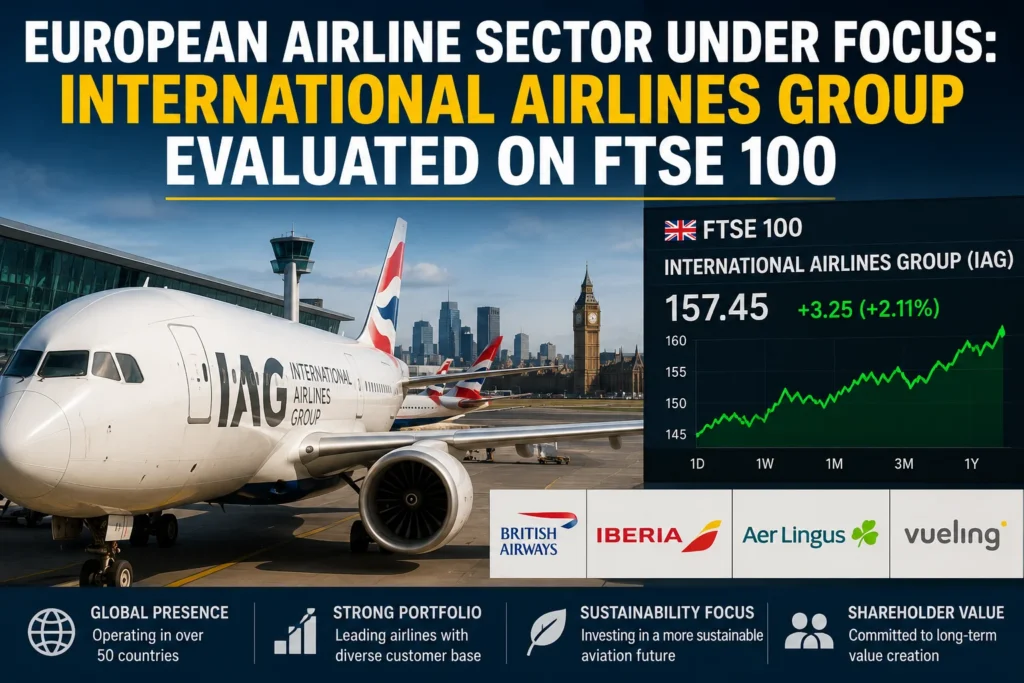
The European airline sector is entering a pivotal week as global travel demand faces evolving economic conditions and localized operational challenges. Investors and tourism analysts are closely tracking corporate health, profitability trends, and shifting capacity schedules across major carriers. At the center of this financial and operational scrutiny is the International Airlines Group, which remains a benchmark constituent in the London Stock Exchange’s FTSE 100 airline comparison.
As the peak summer tourism season accelerates, network operations and capacity management are dominating industry boardrooms. According to recent public disclosures and aviation group telemetry, European carriers have been carefully managing schedule integrity and adjusting routes in response to ongoing airspace restrictions in parts of the Middle East. While some international flights are gradually resuming, network complexity persists, forcing multinational airline groups to constantly balance route availability with regional yield profitability.
Multi-Brand Network Structures in European Tourism
International Airlines Group operates a diverse, multi-brand platform that heavily influences both transatlantic and intra-European tourism corridors. The group’s primary commercial power relies on its core network and low-cost brands, which explicitly include British Airways, Iberia, Vueling, and Aer Lingus. Through these distinct brands, the conglomerate directly commands a substantial market share of key holiday routes connecting the United Kingdom, continental Europe, Latin America, and major North American gateways.
Official statistics from international aviation boards highlight that global airline passenger revenues are highly sensitive to fluctuating jet fuel costs, which have recently experienced upward pressure. For corporate entities and transport investors, assessing ticket yields, load factors, and fuel-hedging strategies is critical to determining corporate resilience ahead of peak seasonal tourism traffic.
Investor Sentiment and Earnings Dynamics
Recent operational reports from the group indicate a mixed but resilient financial posture. The airline group’s full-year corporate data revealed that realized past profitability came in slightly above initial market expectations, bolstered by strong premium leisure travel and robust transatlantic holiday bookings.
However, forward-looking updates published in June 2026 reflect a more cautious near-term outlook, with full-year earnings per share expectations seeing minor downward adjustments. This variance underscores how sensitive the modern travel market remains to external cost shocks and operational overheads.
On the London Stock Exchange, the group’s shares continue to trade actively. Based on mid-year market documentation, the airline group commands a market capitalization in the low twenty billion pound range, featuring a price-earnings ratio in the single digits. This valuation framework positions the multinational company directly alongside other large-cap transport and infrastructure stocks listed on the London market, giving analytical researchers a clear baseline to compare efficiency metrics across the broader aviation industry.
Capacity Management and Strategic Regional Adaptations
The operational decisions implemented by major airline platforms have direct consequences for consumer travel options, tour operators, and regional tourism boards. By optimizing aircraft utilization and seat configurations, carriers try to maximize the revenue generated per available seat kilometer.
The group earns its primary revenue through multi-tiered passenger ticketing, specialized cargo transport, extensive loyalty program partnerships, and ancillary travel services, such as baggage upgrades and seat selections.
As institutional investors conduct a comprehensive FTSE 100 airline comparison, the financial performance of network legacy carriers is routinely weighed against low-cost point-to-point competitors. Adjusting long-haul vs short-haul flight capacity remains the primary mechanism for mitigating fuel inflation. Market data shows that carriers with robust corporate liquidity and active hedging structures are better positioned to insulate consumers from sudden fare hikes, thereby stabilizing regional holiday arrival numbers.
Long-Term Outlook for Sustainable Aviation Growth
The long-term trajectory of the European aviation ecosystem is increasingly tied to fleet modernization and sustainable network expansion. According to official transport ministry statements and international civil aviation updates, major groups are actively investing in next-generation, fuel-efficient aircraft to permanently lower baseline operating costs and comply with tightening environmental standards.
Despite persistent headwinds stemming from geopolitical airspace constraints and global macroeconomic volatility, consumer intent for international vacation travel remains structurally resilient. For leading multi-brand networks, navigating these cyclical pressures requires strict capital discipline, agile scheduling software, and an unwavering focus on safeguarding the passenger experience across all operational subsidiaries. As the current trading week unfolds, the aviation sector’s ability to maintain high load factors while managing capacity adjustments will ultimately dictate corporate profitability and shape broader regional tourism patterns throughout the remainder of the fiscal year.
For more travel news like this, keep reading Global Travel Wire