The global travel and tourism sector is facing fresh regulatory updates as international travel advisories undergo a series of critical revisions. Government agencies worldwide are actively reassessing their security guidelines for Venezuela following powerful seismic activity that has impacted infrastructure across several regions. This sudden spike in natural disaster risk introduces an unexpected layer of physical danger to a country already categorized under complex safety warnings due to ongoing localized instability, crime rates, and poor healthcare infrastructure.
According to verified seismic data from the United States Geological Survey, multiple significant tremors and an intense earthquake sequence recently struck the country, with heavy impacts extending through coastal zones and densely populated urban sectors like the state of Yaracuy. Government agencies note that when a destination navigating deep economic or institutional strain experiences a major natural disaster, the localized capacity for emergency services, medical responses, and communication recovery is severely diminished, significantly heightening risks for foreign nationals.
Complicated Realities and Consular Limitations in the Ground Zone
The physical damage left behind by the recent tremors has established major barriers for inbound tourism and domestic mobility. Official notifications from foreign ministries highlight structural failures affecting critical transport networks, including regional bridge systems and primary multi-city highways. For international visitors, these compromised conditions result in restricted inter-city movement and elevate the possibility of becoming isolated in remote regions where medical response teams are pushed to their absolute limits.
Furthermore, these environmental developments complicate the execution of emergency services provided by foreign diplomatic delegations. Official circulars from the U.S. Embassy in Caracas confirm that the local consular section has transitioned into an emergency-only stance for its citizens, with extremely limited capacity to project assistance outside the immediate capital municipality. Major global travel departments continue to warn that because formal tourism infrastructure is minimal outside of major metropolitan areas, visitors who choose to enter high-risk territories do so at their own risk, face severe medical evacuation challenges, and encounter a lack of running water or electricity in remote public medical facilities.
Aviation Responses and Strict Security Protocols
The international aviation sector is maintaining a watchful stance as carriers look to groups like the International Civil Aviation Organization to guide structural safety assessments for commercial airstrips. Air transit into the country was already subject to stringent security routing, and the recent earthquakes have added operational questions regarding terminal integrity and runway maintenance. Flight operations at Caracas International Airport have encountered notable scheduling adjustments, causing major carriers to review route frequencies, coordinate delay parameters, and prioritize relief or logistical flights.
Simultaneously, the global travel insurance sector has moved to adjust coverage terms. Financial regulators point out that the manifestation of an extreme natural disaster inside an area already flagged for systemic risk often triggers specific policy exclusions, leading to premium adjustments and narrowed windows for emergency extraction coverage.
Beyond the immediate environmental fallout, official safety frameworks emphasize that historical security concerns remain active. State Department alerts continue to emphasize risks involving organized crime, kidnapping threats along airport transport corridors, and restricted movement near specific border zones such as the Venezuela-Colombia border region. Travelers are explicitly warned against utilizing unregulated public or taxi transportation when departing the main international terminal serving Caracas due to verified security concerns near airport banking facilities.
Dynamic Risk Management Strategies for Essential Travel
For individuals who cannot postpone their transit, government safety offices have broadcasted strict compliance procedures to minimize exposure. The paramount directive from international regulators is the complete avoidance of non-essential civilian trips into the region until a comprehensive assessment confirms long-term stabilization.
For authorized or essential travelers, international departments mandate enrollment in formal embassy registration platforms, such as the Smart Traveler Enrollment Program, which broadcasts direct real-time alerts. Travelers are instructed to avoid damaged public landmarks, steer completely clear of internal political demonstrations or protests, secure localized private security logistics when conducting business, and maintain independent short-term supplies of essential items including clean water, food, and necessary prescription medications.
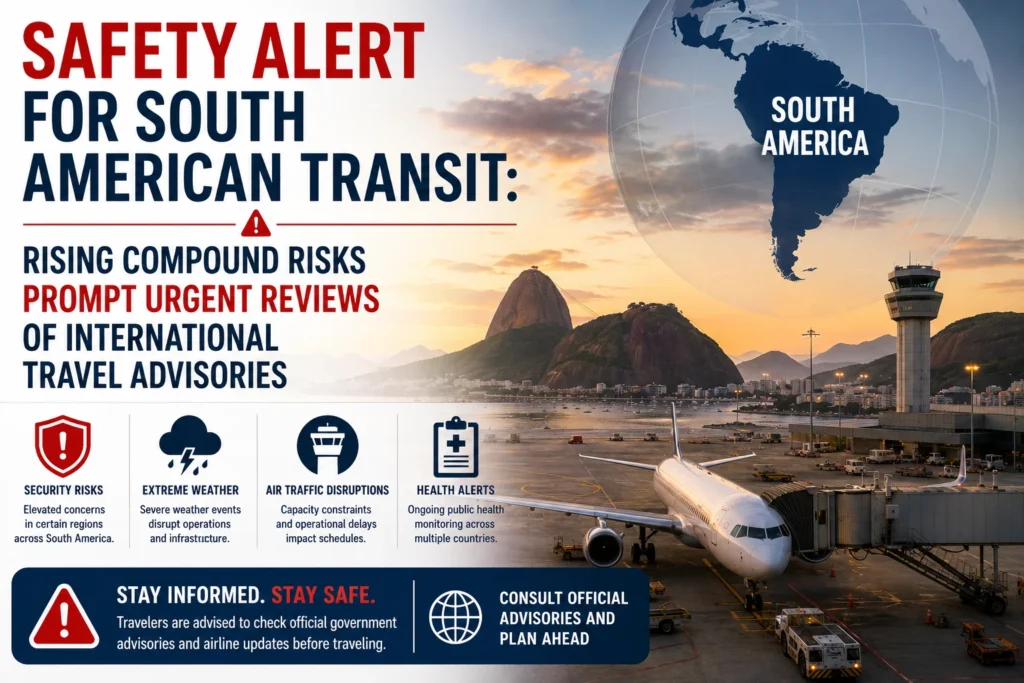
The rapid overlap of major seismic events with structural vulnerabilities illustrates a growing trend in global destination risk analysis known as “compound risk.” For the broader tourism and international transit industries, these evolving dynamics prove that overall destination safety is no longer judged solely by the absence of civil conflict, but by the physical resilience of a nation’s transportation networks and emergency response frameworks against sudden natural shocks.
For more travel news like this, keep reading Global Travel Wire