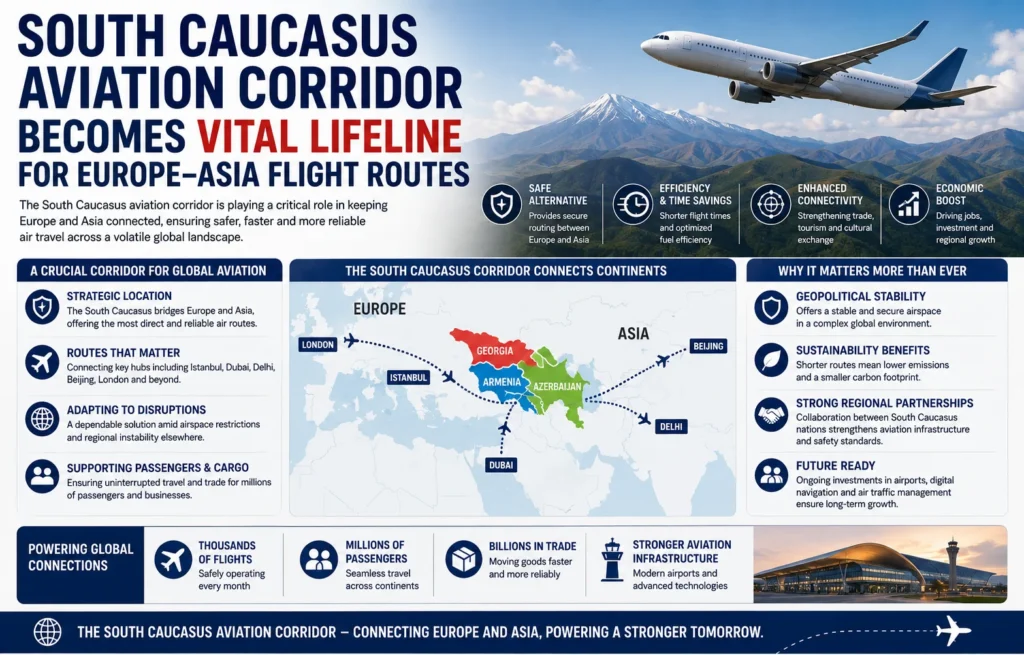
The geographic framework of international civil aviation is undergoing a structural transformation as global air travel adapts to shifting airspace constraints across Eurasia. Long-haul flight paths linking major European gateways with Asia-Pacific destinations are increasingly relying on a strategic aerial transit route through the South Caucasus. Comprising the airspace of Georgia and Azerbaijan, this narrow geographical pass—often described in international transport logistics as part of the Trans-Caspian Middle Corridor—has emerged as an essential passage for maintaining uninterrupted passenger traffic between continents.
As global passenger volumes continue their long-term expansion toward projected historic highs over the next two decades, the operational coordination among civil aviation authorities across the South Caucasus is proving pivotal for international tourism networks, air connectivity, and airline schedule predictability.
Shifting Airspace Dynamics Redefine Eurasia Flight Corridors
For decades, commercial air carriers operating transcontinental services between Western Europe and East Asia utilized a variety of flight paths across northern and central Eurasia. However, recent restrictions across northern airspace, combined with temporary closures and operational advisories across several Middle Eastern flight corridors, have substantially reduced the available airspace options for non-stop commercial flights.
To maintain flight safety and operational continuity, international air carriers have redirected a significant volume of daily transcontinental services through the aerial transit zone situated between the Black Sea and the Caspian Sea. According to official air traffic management reports published by regional civil air navigation service providers, transit traffic passing through Azerbaijani and Georgian airspace has experienced dramatic growth, with overflight counts increasing by more than 100 percent compared to historical baseline averages.
Civil aviation navigation bodies, working in close alignment with the European Organisation for the Safety of Air Navigation and international transport agencies, have expanded surveillance systems, introduced performance-based navigation protocols, and modernized air traffic control infrastructure to safely accommodate this unprecedented concentration of high-altitude transit traffic.
Essential Role in Supporting International Tourism and Air Connectivity
The strategic importance of the South Caucasus airspace extends directly into the global tourism economy. Long-haul international flights are the primary delivery mechanism for high-value leisure and business tourism between Europe and major Asian destinations, including Japan, South Korea, China, and Southeast Asian hubs.
When flight paths are forced into lengthy detours around closed airspace, flight durations increase significantly. Extended flight times require additional jet fuel consumption, elevate airline operating overheads, and necessitate complex crew scheduling adjustments—factors that ultimately push passenger ticket prices higher and strain carrier capacity.
By providing a direct, reliable overflight corridor, the South Caucasus airspace enables commercial airlines to minimize flight times, contain fuel burn, and maintain predictable flight schedules. This operational stability is vital for international tour operators, hospitality providers, and regional tourism boards that rely on steady intercontinental air connectivity to drive inbound visitor spending.
Furthermore, the surge in transit traffic has heightened the global profile of regional aviation hubs. Facilities such as Heydar Aliyev International Airport in Baku and Tbilisi International Airport in Georgia have reported increased passenger transit volumes and enhanced regional connectivity as carriers optimize their operational footprints across the region.
Public Sector Modernization and Air Navigation Infrastructure
Recognizing their critical role in global civil aviation, national civil aviation authorities across the South Caucasus have implemented comprehensive airspace modernization strategies. Public sector investments have focused on enhancing radar coverage, deploying satellite-based automatic dependent surveillance systems, and upgrading air traffic management software to maintain rigorous safety standards.
Official statements from regional civil air navigation authorities emphasize that maintaining high-capacity, safe, and predictable airspace is a national priority. Through structured coordination with neighboring air navigation service providers and international civil aviation organizations, regional authorities ensure that civil aircraft can navigate the corridor with minimal air traffic delay, even during periods of peak traffic volume.
These infrastructure enhancements have also improved local airport operations, enabling regional flag carriers to expand their own international route networks. By serving as an operational bridge between continents, the region is positioning itself not only as an essential transit route, but also as an increasingly accessible destination for international business and leisure travel.
Long-Term Outlook for Global Travel Infrastructure
The rising reliance on the South Caucasus highlights the interconnected nature of modern commercial aviation and international tourism. As global air traffic demand continues to expand, maintaining resilient, safe, and open flight corridors remains essential for the economic health of the travel industry.
The quiet operational success of air traffic controllers and civil aviation authorities in the South Caucasus ensures that millions of passengers continue to reach their Asian and European destinations safely and efficiently each day. Moving forward, continued public investment in air navigation technology, sustainable transport infrastructure, and international regulatory cooperation will remain essential to preserving this critical aerial bridge, ensuring the ongoing resilience of global air travel and international tourism ecosystems.
For more travel news like this, keep reading Global Travel Wire