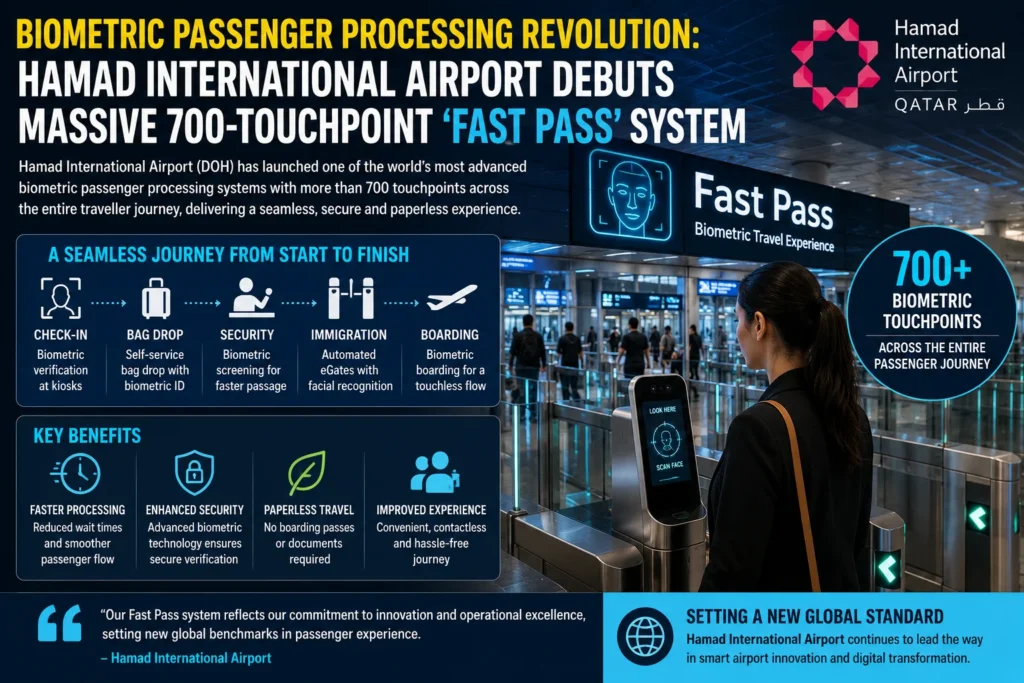
The future of global aviation infrastructure has taken a monumental step forward in Doha. Hamad International Airport (HIA) has officially initiated one of the largest and most comprehensive deployments of paperless identification technology in existence. Developed through a close-knit operational alliance with national carrier Qatar Airways and multinational aviation technology specialist SITA, the newly inaugurated “Fast Pass” service shifts the entire departure experience away from traditional documentation checks, utilizing high-speed facial recognition to manage travelers from the terminal entrance directly to their aircraft cabin.
This multi-million-dollar technology framework has integrated facial validation hardware across more than 700 distinct security and commercial touchpoints inside the terminal. The comprehensive scope of this rollout makes it a benchmark for international hub operations, positioning the Gulf gateway at the forefront of digital terminal management. By connecting disparate stages of airport processing into a single automated pipeline, the airport is establishing a highly reliable blueprint for managing ever-increasing global tourism volumes without sacrificing operational security or expanding physical queuing zones.
The Mechanics of a Completely Paperless Transit Journey
The newly introduced biometric passenger processing framework is engineered to eliminate the friction points traditionally associated with long-haul international travel. Instead of a multi-stage process requiring travelers to repeatedly produce printed boarding vouchers and passports, the active setup transforms an individual’s facial features into their universal, secure token of identity.
The initial enrollment procedure has been designed for maximum convenience, taking only a few seconds to complete. Travelers can choose to establish their permanent digital profile via two primary administrative pathways:
Mobile Integration: Passengers can securely capture their physical biometrics at home or on the move through the official Qatar Airways smartphone check-in application before arriving at the airfield.
On-Site Terminals: Alternatively, travelers can complete their data enrollment upon entering the main terminal using the self-service registration kiosks positioned throughout the departures hall.
Once the initial authentication loop links the physical traveler to their verified passport, the traveler can move through the terminal at a continuous pace. Dedicated self-service baggage drop units utilize integrated optical sensors to confirm the traveler’s identity, automatically generating the correct luggage tracking labels.
The identical facial scanning mechanics govern automated security access lanes and individual boarding gates. Rather than fumbling through personal items for physical papers, a brief glance at an eye-level camera module verifies the passenger and unlocks the gate in a single motion.
Data Protection and Freedom of Choice Preserved
In an era where digital identity management is subject to strict global privacy standards, the aviation authorities responsible for the Fast Pass architecture have emphasized that data protection and individual user control remain core to the system’s design. The underlying backend network runs on an infrastructure built to respect strict international privacy laws. This ensures that sensitive facial data is encrypted, cross-referenced securely against civil aviation databases, and never compromised or shared with unauthorized entities.
Furthermore, airport administrators explicitly clarified that participating in the Fast Pass program is entirely a matter of personal choice. Recognizing that certain international tourists and corporate flyers prefer standard validation methodologies, the traditional manual processing desks remain active. Fully staffed immigration counters and conventional boarding lines will operate side-by-side with the automated lanes, with specialized terminal ambassadors stationed on the floor to guide passengers toward their preferred processing method.
Aligning Airport Infrastructure with Global Travel Trends
The introduction of this massive automated ecosystem comes at a time when international air transport hubs are facing unprecedented capacity pressures. Analytical research published by the International Air Transport Association (IATA) confirms a profound paradigm shift in consumer behavior, indicating that a substantial majority of modern airline passengers actively favor biometric identity verification over standard paper or mobile barcode mechanisms. As airports everywhere adapt to handle record volumes of global flyers, relying exclusively on manual document verification creates unsustainable logjams at primary border checkpoints.
By verifying an individual’s data once at the start of the journey and recognizing that secure profile at every subsequent step, the airfield can significantly boost its hourly passenger throughput. The automated system shortens processing times to a matter of seconds per traveler, allowing terminal operators to seamlessly handle peak wave schedules without requiring costly physical expansions of terminal buildings.
Looking forward, the innovation roadmap for Hamad International Airport involves extending the availability of Fast Pass to additional operational segments. In the coming phases, the platform is scheduled to support international transfer and connecting passengers moving between long-haul flights. Additionally, the infrastructure will soon be extended to accommodate other global airlines operating out of Doha, paving the way for a universally touchless journey across the entire aviation sector.
For more travel news like this, keep reading Global Travel Wire