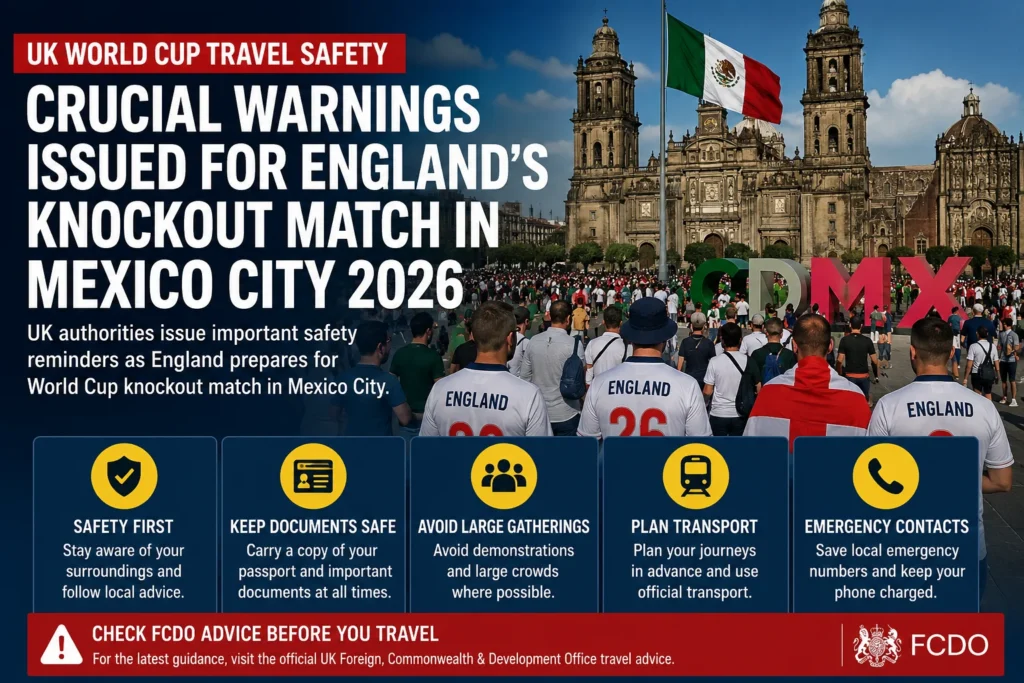
British law enforcement and national transport officials have issued an urgent public safety advisory across the United Kingdom to prevent severe road disruption surrounding England’s upcoming World Cup knockout fixture. The strategic warning centers on the exceptionally high risk of impaired driving and extreme driver fatigue caused by the late-night broadcasting schedule of the match hosted in Mexico City.
The high-stakes Round of 16 encounter is scheduled for a 01:00 BST kick-off, which translates to an 18:00 local evening start time in Mexico. Because the live broadcast occurs during the early morning hours for UK residents, government transport bodies anticipate that hundreds of thousands of football supporters will remain awake throughout the night, subsequently attempting to commute to work or travel shortly after the final whistle blows.
Alcohol Impairment Risks During Late-Night Match Screenings
National law enforcement agencies have reiterated that consuming alcohol while watching the high-profile fixture creates a highly dangerous environment for anyone who intends to get behind the wheel later that morning. According to official government road safety frameworks, alcohol significantly degrades a driver’s reaction speed, narrows visual processing fields, and severely lowers overall concentration levels.
Official road safety reports clarify a common and dangerous misconception among sports fans: the belief that heavy caffeine intake, eating a large meal, or resting for just a few hours can somehow “neutralize” alcohol in the bloodstream. Government transport data emphasizes that alcohol is only removed from the human body through natural metabolic processes over time.
Furthermore, medical and transport authorities stress that there is absolutely no universal “safe” amount of alcohol for driving, as metabolic rates vary drastically by individual physiology, weight, and age. Supporters gathering at commercial pubs, licensed bars, or private residences are being strongly urged by the government to arrange alternative transport—such as pre-booked taxis or dedicated sober drivers—to completely avoid potentially lethal traffic collisions.
Severe Fatigue and Cognitive Decline Following Overnight Wakefulness
Beyond the immediate dangers of chemical intoxication, transport safety bodies are sounding the alarm regarding severe driver fatigue. The 01:00 BST start time means the football match concludes during a timeframe where human alertness naturally plummets, directly coinciding with the body’s natural circadian low point.
Official highway guidance identifies prolonged sleep deprivation as a primary catalyst for major road traffic accidents, particularly during early morning journeys when the sun is rising. Fatigue often manifests subtly as reduced situational awareness, delayed braking responses, and poor lane discipline. In the most severe instances, sleep-deprived drivers may experience “microsleeps”—brief, involuntary lapses into unconsciousness lasting from a fraction of a second to several seconds, which frequently lead to catastrophic highway crashes.
To combat these profound cognitive risks, official safety guidelines recommend the following preventative measures for all football fans:
Prioritizing deep, restorative rest both immediately before and after the late-night match window.
Scheduling mandatory Rest Service pauses during any necessary long-distance travel.
Implementing shared driving responsibilities among passengers to ensure no single person is overburdened by exhaustion.
Postponing all non-essential road travel until a full, natural sleep cycle has been completed.
Coordinated Public Policing Response Across the United Kingdom
A comprehensive, multi-agency security and traffic operation is currently being deployed across multiple UK regions to manage the public safety fallout of this high-stakes knockout game. This coordinated strategy involves close collaboration between regional police forces, highway patrols, and owners of licensed premises to actively prevent public disorder and dangerous road behaviors.
Official police statements suggest that authorities expect a massive surge in pedestrian and vehicle activity around public screening venues, fan zones, and city centers. The potent combination of acute sleep deprivation, high alcohol consumption, and the intense emotional volatility associated with World Cup knockout football is viewed by law enforcement as a high-risk trigger for both public disturbances and reckless driving.
The national policing strategy includes a significantly increased presence of mobile patrols around major entertainment districts, as well as proactive monitoring of licensed venues to ensure capacity and safety regulations are strictly followed. The primary goal of the deployment is to facilitate the peaceful and safe dispersal of large crowds once the match concludes in the early morning hours.
Strategic Travel Planning for Post-Match Commutes
National transport authorities are urging the public to engage in proactive, advanced travel planning to completely avoid the localized gridlock predicted for the morning commute following the game. This includes the advance booking of ride-share services and the clear identification of safe pedestrian routes to avoid urban congestion near major screening hubs.
Safety bodies have also noted that early morning travel often involves reduced visibility, morning fog, and accumulated fatigue from the night before, which exponentially compounds the danger of severe road accidents. The use of trains, buses, and coaches is being heavily promoted by the government as the safest overall alternative to private vehicle use. Officials stress that drivers must be brutally honest about their own levels of tiredness before picking up their keys.
Analyzing the Logistics of Non-European Time Zone Sporting Events
This urgent advisory is part of a much broader national strategy designed to manage the unique infrastructure pressures created by international sports tournaments held outside of European time zones. When major global events occur in the Americas or Asia, they force a sudden shift in domestic public behavior that heavily stresses the UK’s emergency services, highways, and transport infrastructure.
The intersection of major sleep disruption and alcohol consumption creates a highly predictable pattern of public risk that authorities attempt to mitigate through preemptive communication. The upcoming Mexico City fixture serves as a prime example of how global sporting schedules can directly impact domestic road safety and public health. By issuing these clear warnings, transport officials aim to shift the cultural narrative from “staying up for the game” to “managing recovery for public safety.”
For more travel news like this, keep reading Global Travel Wire