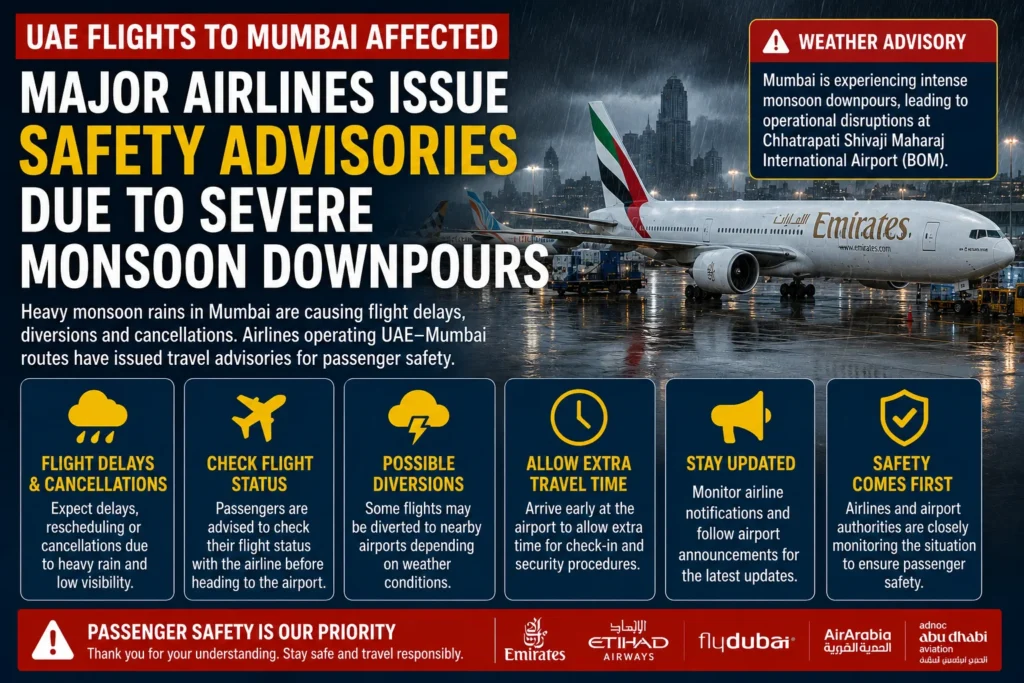
The arrival of the annual monsoon season across Maharashtra has triggered major operational challenges at Chhatrapati Shivaji Maharaj International Airport (CSMIA). Continuous, torrential rainfall over consecutive days has significantly impacted air travel infrastructure in Mumbai, prompting a cascade of delays and cancellations. Due to these adverse atmospheric conditions, commercial flight routes between the United Arab Emirates (UAE) and the financial capital of India stand affected, leading major regional and international carriers to issue immediate travel advisories for passengers.
Official meteorological summaries indicate that the current downpour has severely limited runway visibility and compromised standard landing conditions. The intense rainfall has not only disrupted scheduled airport arrivals and departures but has also caused severe localized waterlogging across major transportation corridors linking the airport to the wider metropolitan region. Consequently, aviation authorities and operating airlines are urging travelers to verify their exact flight operational status prior to making their way to departure terminals.
Significant Delays Recorded Across UAE and Dubai Departure Stations
The severe weather system has had a noticeable impact on scheduled operations out of major UAE aviation hubs. Multiple international flights routing from Dubai International Airport (DXB) toward Mumbai experienced extended scheduling shifts. Live flight tracking information published by international airport operators confirmed that evening departures on Monday were broadly adjusted to accommodate weather windows in India.
Specific schedule updates illustrate the extent of the transit variations. An IndiGo flight, scheduled for an early evening departure from Dubai, experienced a one-hour delay to its standard timetable before receiving clearance to proceed. Similarly, a SpiceJet service faced a more extended adjustment, with its late-night departure delayed by approximately three hours as operations teams waited for stabilization in the Mumbai airspace.
While certain international wide-body services managed to depart their origin stations on schedule, reverse operations were equally impacted. Inbound arrivals into the UAE from Mumbai recorded a sequence of rolling delays, with flight timetables on the shared route experiencing average extensions of one to three hours.
Extensive Cancellations and Flight Diversions at Mumbai Airport
The intensity of the rainfall led to a high-volume restructuring of the daily aviation timetable at CSMIA. Official airport data indicated that numerous scheduled operations were cancelled entirely due to the persistent downpours and high-velocity wind conditions. To manage the safety of airborne passengers, air traffic controllers were required to redirect several incoming flights to alternate domestic landing fields.
According to official aviation tracking logs, multiple aircraft unable to execute a safe approach in Mumbai were successfully diverted to secondary airports across the region. Flights routing from various international and domestic origins were redirected to alternative facilities, including airfields in Ahmedabad, Hyderabad, Bengaluru, and Vadodara. These safety maneuvers led to a dense accumulation of aircraft at regional stations and necessitated a coordinated effort by ground handling teams to manage passenger transfers once conditions stabilized.
Official Civil Alerts and Government Safety Directives
The severity of the weather system prompted the India Meteorological Department (IMD) to issue an advanced orange alert for Mumbai, predicting heavy to very heavy rainfall accompanied by gusty winds. Local civic authorities took immediate precautionary measures, directing the temporary closure of regional schools, colleges, and educational institutions to reduce public exposure to waterlogged roads and potential infrastructure hazards.
The impact of the deluge also extended to major regional road networks. Portions of a prominent inter-city expressway were temporarily shut down following localized landslides and severe water accumulation, restricting land-based connectivity between major urban centers.
The escalating transit crisis led international government bodies to issue targeted advisories for foreign nationals currently residing in or traveling to the region. The Ministry of Foreign Affairs of Oman formally requested its citizens located within the affected Indian city to exercise extreme caution. The ministry advised travelers to avoid any non-essential local transit, stay indoors during peak downpours, and strictly monitor the weather updates and safety directives published by local municipal authorities.
Strategic Travel Recommendations for International Commuters
With the monsoon season traditionally active from June through September, transport agencies emphasize the importance of strategic planning for any international journeys booked during these months. The current operational environment at Chhatrapati Shivaji Maharaj International Airport highlights the necessity of real-time schedule monitoring, as weather patterns can alter gate availability and runway acceptance rates with minimal advance notice.
Airlines have reiterated that their passenger advisories remain dynamic. Travelers holding valid tickets for flights between the UAE and Mumbai are advised to rely primarily on direct digital communication from their respective carriers, including mobile application notifications and official email alerts. Furthermore, passengers are encouraged to account for significant transit delays on city roads leading to the airport terminals, given that slow-moving surface traffic due to waterlogging can severely extend standard commuting times.
For more travel news like this, keep reading Global Travel Wire