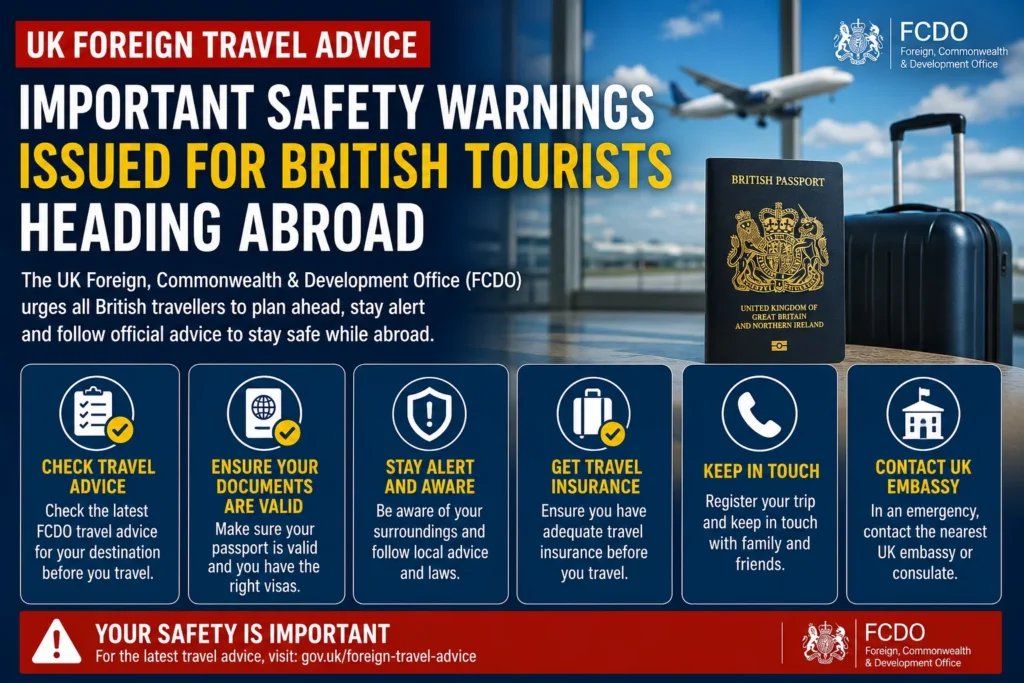
The UK government’s foreign travel advice framework has undergone significant updates, introducing heightened safety parameters for multiple international destinations. Official documentation from the Foreign, Commonwealth and Development Office (FCDO) indicates a broader range of overseas regions are now flagged under stricter safety classifications. British nationals planning summer departures are being strongly encouraged to review the updated public guidance, which details specific zones where the government now advises against all or all but essential travel due to shifting security conditions, natural hazards, or localized civil unrest.
The revised operational guidance covers distinct regions across sections of the Middle East, Eastern Europe, Africa, Asia, and South America. Government travel boards emphasize that these advisories are frequently region-specific rather than country-wide. For example, specific border zones, coastal provinces, or major metropolitan areas may carry high-risk designations while surrounding regions remain stable. Because local security and environmental conditions can fluctuate rapidly, travelers are urged to verify the precise wording on official government portals prior to departure.
Critical Insurance Implications of Government Safety Advisories
National travel industry bodies and consumer safety organizations have highlighted that disregarding official FCDO guidance carries severe consequences that extend far beyond immediate personal safety. The vast majority of standard UK travel insurance policies are directly linked to the government’s foreign travel advice matrix. Under standard industry frameworks, any voluntary transit into a territory where the government explicitly advises against all or all but essential travel will automatically invalidate standard medical and repatriation coverage.
Failing to secure specialized high-risk insurance coverage can leave families fully liable for extensive emergency medical bills, evacuation costs, or legal fees should an incident occur. Given these financial and logistical risks, transport authorities recommend a three-stage verification process for holidaymakers: check the official country-specific page during the booking phase, re-verify the status immediately prior to departure, and register for automated digital notification updates while remaining abroad.
Record European Heatwaves Trigger Severe Environmental Health Warnings
In tandem with geopolitical adjustments, climate-related alerts have taken a central role in this season’s international safety updates. The Met Office, working alongside the UK Health Security Agency (UKHSA), previously initiated rare top-tier red heat-health alerts within England as domestic temperatures reached the mid-to-high 30s Celsius. This represented an unprecedented sequence of consecutive high-temperature warnings, underscoring the intensity of the regional weather systems passing through Western Europe.
Across mainland Europe, national meteorological ministries and international climate monitoring networks report that ambient temperatures are consistently exceeding 40 degrees Celsius in highly frequented Mediterranean coastal resorts and historic city centers. Local public health authorities across Spain, Italy, and Greece have activated emergency heat management protocols. These public safety initiatives include the establishment of air-conditioned municipal cooling centers, strict daytime bans on heavy outdoor labor, and official guidance advising tourists to suspend strenuous outdoor excursions during peak afternoon hours.
Public health agencies emphasize that prolonged exposure to extreme thermal environments presents significant physiological strain, particularly for young children, elderly travelers, and individuals with pre-existing cardiovascular or respiratory conditions. Official medical guidance recommends drinking water consistently to prevent acute dehydration, utilizing high-factor broad-spectrum sun protection, and modifying traditional sightseeing itineraries to focus activities during cooler early morning or late evening windows.
Heightened Focus on Balcony Safety, Alcohol Consumption, and Local Regulations
The mid-season safety updates also place renewed scrutiny on behavioral risks in popular tourist corridors. Consular statistics highlight a persistent concern regarding severe injuries and fatalities resulting from hotel balcony falls, particularly involving younger demographics visiting prominent Mediterranean beach destinations.
In response, British consular services, in direct coordination with regional authorities in Spain’s Balearic Islands, have re-launched targeted public safety campaigns in major resort hubs like Mallorca. These joint initiatives emphasize the life-altering physical consequences of reckless behavior, specifically addressing the dangers of misjudging heights or attempting physical stunts while under the influence of alcohol.
Furthermore, official travel briefings clarify that insurance underwriters routinely deny claims for accidents occurring while the policyholder is legally intoxicated or engaged in actions classified as voluntary endangerment. Additionally, municipal laws have tightened around public consumption of alcohol and anti-social behavior in designated resort zones, with local police forces authorized to issue substantial financial penalties for non-compliance.
Essential Financial Protection, Passport Validity, and Fraud Prevention
The final pillar of the current government advisory focuses on administrative readiness and financial safeguards. The UK Civil Aviation Authority (CAA) has issued fresh warnings regarding sophisticated holiday-related financial fraud, including fraudulent booking platforms, non-existent villa rentals, and unauthorized social media travel offers. To prevent significant financial losses, regulators state that flight-inclusive package vacations should be strictly verified under recognized financial protection schemes like ATOL (Air Travel Organisers’ Licensing).
Furthermore, entry regulations regarding the European Schengen Area require strict compliance following the UK’s transition out of the European Union. Standard border control protocols dictate that a British passport must be issued less than 10 years before the date of entry into the country and must possess at least three months of validity remaining beyond the intended date of departure. Because printed expiry dates can occasionally misrepresent these rolling window calculations, travelers are advised to verify their exact issue dates well in advance of arriving at international departure terminals.
For more travel news like this, keep reading Global Travel Wire